
24 Best Procrastination Books
The best procrastination books, ranked by how many expert sources recommend each one, with notes on practical tools, habits, and who each guide suits.
Our take
Procrastination books approach delay from different angles. Some examine the discomfort, fear, or self-defeating expectations attached to a task. Others make it easier to choose a next step, reduce distractions, or repeat a useful habit. A reader who avoids one difficult project may need something different from someone managing too many commitments or struggling to protect uninterrupted time.
Solving the Procrastination Puzzle offers a short, focused starting point. The Now Habit gives pressure and guilt more attention, while The Procrastination Equation develops a broader explanation of motivation. For practical organization, Getting Things Done provides a system; Atomic Habits concentrates on repeatable behavior. Four Thousand Weeks asks whether the expectation of doing everything is part of the problem. These books vary in how much they explain and how much they prescribe. Start with the one that most closely describes what happens when you delay, then try a small part of its approach before collecting more methods.
24 books · 10 sources · Last updated
As an Amazon Associate, we earn from qualifying purchases (at no extra cost to you).
How to choose from this list
Skip to the full rankingIf you want a concise starting point: Solving the Procrastination Puzzle
If pressure and perfectionism make starting hard: The Now Habit → Procrastination
If you want to understand motivation: The Procrastination Equation
If your commitments feel disorganized: Getting Things Done
If you want repeatable small actions: Atomic Habits
If you’re overwhelmed by doing everything: Four Thousand Weeks
The 24 books, ranked
Ranked by how many expert sources name each book. Ties go to the book more people recommend.

For readers who want a brief, focused introduction to why intentions fail. The concise research-based explanations make it easier to start than a large productivity manual, though the tools need repetition beyond a quick first reading.
What it's about
Timothy Pychyl examines how habits and self-defeating ideas interfere with good intentions. Drawing on psychological research, this concise guide combines explanations, practical tips, and humor to help readers recognize procrastination and begin changing their responses to tasks.

The Now Habit
A Strategic Program for Overcoming Procrastination and Enjoying Guilt-Free Play
For readers whose delay is tangled with pressure, perfectionism, or guilt about rest. The emphasis on making room for play differs from harder-discipline approaches, though the full program requires more adjustment than a few isolated tips.
What it's about
Neil Fiore presents a program for understanding and addressing procrastination without sacrificing leisure. Psychological exercises and practical strategies target the pressures that make starting difficult, helping readers approach tasks with less stress and create room for guilt-free play.

The Procrastination Equation
How to Stop Putting Things Off and Start Getting Stuff Done
For readers who want an explanatory model of motivation and delay. The attention to different influences makes it more analytical than a motivational checklist, though the framework can feel more elaborate than necessary for one stalled task.
What it's about
Piers Steel investigates why people delay tasks despite expecting harmful consequences. Drawing on psychological, biological, and cultural explanations, he examines motivation and distraction, then presents practical approaches to understanding and changing procrastination in everyday life.

For readers overwhelmed by untracked commitments and unclear next steps. The capture-and-review system offers more organizational structure than a mindset book, though maintaining the system takes effort and will not resolve every emotional reason for avoidance.
What it's about
David Allen presents a system for managing personal and professional commitments without relying on memory alone. He explains how capturing tasks, clarifying next actions, organizing information, and reviewing commitments can help people approach their work with greater focus.
Also recommended by
6 people Ev Williams recommended this book
Ev Williams
"Still the best advice on getting your life in order and freeing up your brain to be creative." - Ev Williams
Ev Williams's recommendation of this book  Dustin Moskovitz recommended this book
Dustin Moskovitz
"Put first things first." - Dustin Moskovitz
Dustin Moskovitz's recommendation of this book  Tony Hsieh recommended this book
Tony Hsieh
One of 4 books Tony Hsieh recommended in Inc.com
Tony Hsieh's recommendation of this book  Michael McCullough recommended this book
Michael McCullough
"Helps you actually to action." - Michael McCullough
Michael McCullough's recommendation of this book  Howard Stern recommended this book
Howard Stern
"A game changer. I’ve read it maybe 20 times." - Howard Stern
Howard Stern's recommendation of this book  Michael Hyatt recommended this book
Michael Hyatt
Michael Hyatt recommended this book on his website.
Michael Hyatt's recommendation of this book

Eat That Frog!
21 Great Ways to Stop Procrastinating and Get More Done in Less Time
For readers who want a short set of rules for prioritizing important work. The central image makes the advice easy to remember, though starting with the hardest task does not explain every form of persistent avoidance.
What it's about
Brian Tracy uses eating a frog as a metaphor for tackling the most important and demanding task first. His guide offers twenty-one approaches to prioritization, preparation, concentration, and overcoming procrastination, helping readers direct effort toward work that matters.
Also recommended by
1 person Blake Randall recommended this book
Blake Randall
"" - Blake Randall
Blake Randall's recommendation of this book

The Willpower Instinct
How Self-Control Works, Why It Matters, and What You Can Do to Get More of It
For readers who want to understand self-control before choosing tactics. The mix of explanations and exercises is broader than a task-management system, though its wide focus means procrastination shares attention with other forms of temptation.
What it's about
Kelly McGonigal examines self-control through psychology, neuroscience and the material from her Stanford course. She explains how temptation, stress and competing goals affect decisions, then offers exercises involving attention, habits and awareness of one's own responses.
Also recommended by
1 person Jane McGonigal recommended this book
Jane McGonigal
"The better book on will power."- Jane McGonigal
Jane McGonigal's recommendation of this book

For readers who want to make small actions easier to repeat. The emphasis on cues and environment offers more practical habit design than motivational exhortation, though it addresses behavior generally rather than the specific emotions behind a stalled task.
What it's about
James Clear examines how small, repeated changes can reshape behavior over time. Drawing on research in psychology, biology, and neuroscience, he presents practical approaches to building useful habits, breaking unwanted routines, and creating systems that support improvement.

For readers whose delay begins with too many competing priorities. The repeated focus on one consequential action makes choosing simpler than a large task system, though competing responsibilities rarely disappear as neatly as the central idea suggests.
What it's about
Gary Keller and Jay Papasan argue that concentrating on the most important priority can improve results. They examine habits and distractions that consume time and explain how a clearer focus can guide everyday choices.
Also recommended by
4 people Charles Poliquin recommended this book
Charles Poliquin
Charles Poliquin recommended this book in the "Tools of Titans" book.
Charles Poliquin's recommendation of this book  Maria Sharapova recommended this book
Maria Sharapova
"It kind of hit home for me [...] that when you wake up in the morning, you put your focus on this one thing of what you want to accomplish during the day, which seems like a no-brainer." - Maria Sharapova
Maria Sharapova's recommendation of this book  Alexis Ohanian recommended this book
Alexis Ohanian
"Makes a strong case for tossing out my daily Todo list in favor of focusing just One Thing every day." - Alexis Ohanian
Alexis Ohanian's recommendation of this book  Kat Cole recommended this book
Kat Cole
"Big fan of this book." - Kat Cole
Kat Cole's recommendation of this book

For readers who start tasks but repeatedly lose concentration. The emphasis on protected attention is more specific than general motivation advice, though long uninterrupted sessions are harder to arrange in reactive jobs or caregiving routines.
What it's about
Newport makes the case that focused, distraction-free work is a rare and valuable skill. He explains why shallow busyness takes over and offers rules for building routines that protect serious thinking.
Also recommended by
1 person Tai Lopez recommended this book
Tai Lopez
"Great book on how to focus the mind. Read this if you need to be more productive." - Tai Lopez
Tai Lopez's recommendation of this book

For readers who want to explore fears and conflicts behind repeated delay. The counseling perspective gives personal patterns more space than quick-action guides, though the reflective exercises and broad coverage require time and honest self-examination.
What it's about
Jane Burka and Lenora Yuen examine procrastination through their counseling and workshop experience. They explore fears of failure, success, and control, then offer strategies for setting goals, managing time, and living or working with people who delay tasks.

Stop Procrastinating
A Simple Guide to Hacking Laziness, Building Self Discipline, and Overcoming Procrastination
For readers who want accessible tactics for acting despite reluctance. The attention to guilt and self-criticism makes the advice gentler than the title suggests, though its broad collection of techniques needs selecting rather than applying all at once.
What it's about
Nils Salzgeber offers practical strategies for acting despite reluctance and reducing the guilt surrounding procrastination. The guide discusses willpower, distractions, habits, and self-criticism, with techniques intended to make starting and completing tasks easier.

For writers and artists who want a forceful prompt to show up for their work. The short reflections name creative avoidance memorably, though the combative and sometimes spiritual framing offers less explanation than a research-led guide.
What it's about
Pressfield names the inner enemy of creative work, Resistance, then breaks down how fear, procrastination, and self-sabotage keep people from doing what matters. It is short, blunt, and aimed at writers, artists, entrepreneurs, and anyone stuck at the starting line.
Also recommended by
16 people Joe Rogan recommended this book
Joe Rogan
"A great book about harnessing creativity." - Joe Rogan
Joe Rogan's recommendation of this book  Lex Fridman recommended this book
Lex Fridman
"Beautiful book." - Lex Fridman
Lex Fridman's recommendation of this book  Aubrey Marcus recommended this book
Aubrey Marcus
"One of the most influential books in my life." - Aubrey Marcus
Aubrey Marcus's recommendation of this book  Ryan Holiday recommended this book
Ryan Holiday
One of Ryan Holiday's 2 answers to "what book are you most likely to give out as a gift?"
Ryan Holiday's recommendation of this book  Seth Godin recommended this book
Seth Godin
Seth Godin mentioned this book on "The Tim Ferriss Show" podcast.
Seth Godin's recommendation of this book  Brian Koppelman recommended this book
Brian Koppelman
"Talks about resistance." - Brian Koppelman
Brian Koppelman's recommendation of this book +10
More recommendations
- Marie Forleo
"The essential no-bullshit guide for anyone who battles self-doubt or struggles to bring any important project to life." - Marie Forleo
- Daniel Pink
"I have [a little sign] on my desk here that says, 'Beat the resistance.' So, I’ve given [this book] out a lot too." - Daniel Pink
- Derek Sivers
"Are you a writer who doesn’t write, a painter who doesn’t paint, an entrepreneur who never starts a venture? Then you know what “Resistance” is. This book is about that. Read it." - Derek Sivers
- Soman Chainani
"Half drill sergeant, half Zen voodoo master, [the author] shot me out of my stupor and taught me the meaning of creative discipline." - Soman Chainani
- Russell Moore
"About showing up and not waiting for inspiration to hit." - Russell Moore
- Jen Sincero
"Read this thing if you want to blast past your fears and insecurities and resistance to being your biggest, badassiest self." - Jen Sincero
- Jodie Cook
"This book is a sharp reality check for every artist. It will help you become unblocked, right now and possibly forever." - Jodie Cook
- Danny Miranda
"Odds of re-reading: close to 100%." - Danny Miranda
- James Clear
"[One of] the 10 best nonfiction books of all-time." - James Clear
- Michael Hyatt
Michael Hyatt recommended this book on his website.
- Marie Forleo

For readers whose delay is tangled with impossible expectations about getting everything done. The acceptance of limits offers a different starting point from efficiency manuals, though the reflective argument supplies fewer step-by-step task techniques.
What it's about
Oliver Burkeman explores how to live meaningfully within a finite lifespan. Drawing on philosophy and psychology, he questions the drive to accomplish everything and offers ways to accept limits, choose commitments, and relate differently to time.
Also recommended by
1 person Tim Ferriss recommended this book
Tim Ferriss
"Quite unlike anything I’ve ever read." - Tim Ferriss
Tim Ferriss's recommendation of this book

For readers whose self-criticism makes setbacks harder to face. The exercises address the emotional response to difficulty more directly than scheduling systems, though it is a broader book about self-treatment rather than a guide to managing tasks.
What it's about
Kristin Neff explores treating yourself with kindness during failure, insecurity, and difficulty. Drawing on research and personal experience, she introduces exercises involving mindfulness and shared human vulnerability, offering an alternative to judging worth through constant comparison and achievement.
Also recommended by
1 person Brené Brown recommended this book
Brené Brown
"[The author]'s powerful research and her ability to explain how self-compassion affects our everyday lives makes this book a transformative read." - Brené Brown
Brené Brown's recommendation of this book

How to Stop Procrastinating
A Simple Guide to Mastering Difficult Tasks and Breaking the Procrastination Habit
For readers who prefer a practical sequence of actions to a long theoretical discussion. The systematic habit focus gives everyday tasks a clear frame, though familiar productivity techniques receive more attention than the deeper causes of delay.
What it's about
S.J. Scott presents a systematic framework for developing the habit of taking action on difficult tasks. The guide focuses on breaking patterns of procrastination and applying a more deliberate approach to getting things done across everyday life.

For readers overwhelmed by work that may not deserve immediate action. The focus on elimination, delegation, and deliberate delay challenges automatic busyness, though some options depend on workplace authority or resources the reader may lack.
What it's about
Rory Vaden proposes a system for deciding how to handle competing tasks. His approach uses elimination, automation, delegation, consolidation, and deliberate delay to help readers assess their work, address stalled productivity, and make more purposeful use of time.

The Procrastination Cure
For readers who want several short tactics to try against everyday delay. The range makes it easy to target one obstacle, though the checklist format provides less explanation of underlying patterns than the more analytical books.
What it's about
Damon Zahariades presents tactics for addressing habitual delay and getting started on important tasks. He examines common reasons for procrastination and offers methods involving rewards, accountability, priorities, energy tracking, perfectionism, and breaking large projects into manageable periods.

The Productivity Project
Accomplishing More by Managing Your Time, Attention, and Energy
For readers who want to compare productivity experiments involving time, energy, and attention. The personal trials make the ideas approachable, though one person’s experience is a starting point for testing rather than proof of a universal method.
What it's about
Chris Bailey recounts a year of personal productivity experiments and interviews with experts. The resulting guide offers practices for managing time, attention, and energy, including setting priorities, limiting distractions, and working more deliberately.

For readers who like visual tools, worksheets, and an explicit sense of purpose. The structured exercises offer more concrete scaffolding than a purely motivational book, though the terminology and repeated tracking can feel overengineered.
What it's about
Petr Ludwig and Adela Schicker connect procrastination with motivation, self-discipline, and a sense of purpose. They translate research into practical tools, including daily worksheets and revised to-do lists, for changing how readers approach tasks and organize their time.

The Science of Overcoming Procrastination
How to Be Disciplined, Break Inertia, Manage Your Time, and Be Productive
For readers who want a compact introduction to momentum, motivation, and task structure. The broad mix of tactics makes sampling straightforward, though the research framing is less developed than in books by specialist procrastination researchers.
What it's about
Patrick King explores biological and psychological explanations for postponing work, then translates them into practical productivity tactics. Topics include building momentum, structuring schedules, strengthening motivation, recognizing unproductive patterns, and overcoming analysis paralysis.

For readers who want encouragement to repeat small actions consistently. The cumulative-results philosophy gives everyday habits a clear purpose, though the broad motivational treatment offers less help with a particular task’s emotional or practical obstacles.
What it's about
Jeff Olson argues that small choices and repeated daily habits accumulate into significant results over time. His self-help guide explains a philosophy of consistent action, applying simple disciplines to personal goals, happiness and the influence people have on others.
Also recommended by
1 person Ryan Flaherty recommended this book
Ryan Flaherty
"Talks about forming habits before they form you, and what types of habits you want to form." - Ryan Flaherty
Ryan Flaherty's recommendation of this book

For readers who make sincere plans but struggle to act on them. The emphasis on creating reasons to follow through addresses the intention-action gap directly, though the model requires designing and testing personal arrangements rather than copying a checklist.
What it's about
Steve Levinson and Pete Greider explore why good intentions often fail to produce action. They present a model for recognizing obstacles to follow-through and creating compelling reasons to act, applying it to projects, resolutions, and personal goals.

For creative readers whose delay comes from approval-seeking or uncertainty about originality. The brief principles and cartoons offer a different voice from productivity manuals, though the advice is deliberately opinionated rather than a comprehensive method.
What it's about
Cartoonist Hugh MacLeod offers forty principles for sustaining creative work, illustrated with his drawings. Drawing on advertising and artistic experience, he discusses originality, commitment, outside approval, and balancing the work that pays with the work that matters personally.
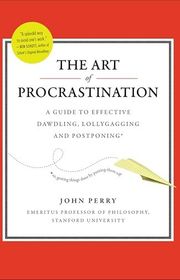
The Art of Procrastination
For readers who want a humorous, less punitive way to examine delay. Perry’s structured-procrastination idea makes productive avoidance visible, though its playful workarounds are not a complete system for urgent obligations or persistent impairment.
What it's about
Philosopher John Perry explores structured procrastination, the habit of completing useful tasks while avoiding something supposedly more important. Personal examples and comic reflections consider perfectionism, task lists, and ways procrastinators can work with their existing patterns.
Sources
- 1
Self-help books on procrastination, summarised honestly
howtostopprocrastinating.org
- 2
8 Must-Read Books on Procrastination
njlifehacks.com
- 3
12 Best Books on Stopping Procrastination
upjourney.com
- 4
Top 19 Best Procrastination Books For 2021
zerotoskill.com
- 5
25 Best Books About Overcoming Procrastination in 2024
developgoodhabits.com
- 6
Procrastination Books
goodreads.com
- 7
100 Best Procrastination Books of All Time (Updated for 2026)
shortform.com
- 8
Best sources to UNDERSTAND procrastination?
reddit.com
- 9
Special Column: Procrastination - 'Mind Your Library' Resilience Kit
researchguides.smu.edu.sg
- 10
Best books for a pro-procrastinator
reddit.com


Edited by
Software engineer whose passion for tracking book recommendations from podcasts inspired the creation of MRB.
Lead investor at 3one4 Capital whose startup expertise and love for books helped shape MRB and its growth.
Comments
Did we miss something? Have feedback?
Help us improve this page by sharing your thoughts