
7 Best Reinforcement Learning Books
The best reinforcement learning books, ranked by expert source recommendations, with notes to help you choose core theory, bandit analysis, and practical coding.
Our take
Reinforcement learning studies how an agent learns to make decisions through interaction and rewards. Understanding the subject involves probability, sequential decision models, algorithms, and the practical difficulty of evaluating learning systems. Books differ in whether they emphasize the central ideas, mathematical guarantees, links with control theory, or implementations that you can run and inspect.
Reinforcement Learning by Sutton and Barto provides a systematic conceptual foundation. Algorithms for Reinforcement Learning is more compact and mathematically concentrated, while Bandit Algorithms develops exploration and regret analysis in depth. Decision Making Under Uncertainty offers a broader planning framework, and Neuro-Dynamic Programming connects the subject with optimization and approximate control. For implementation, Foundations of Deep Reinforcement Learning combines explanations with SLM Lab, while Deep Reinforcement Learning Hands-On emphasizes extensive coding examples. Neither practical route removes the need for mathematical understanding. Start with Sutton and Barto, then add a coding companion or a theoretical specialization according to your background and purpose.
7 books · 9 sources · Last updated
As an Amazon Associate, we earn from qualifying purchases (at no extra cost to you).
How to choose from this list
Skip to the full rankingIf you want a systematic introduction: Reinforcement Learning
If you want theory connected with Python: Reinforcement Learning → Foundations of Deep Reinforcement Learning
If you prefer extensive implementation examples: Deep Reinforcement Learning Hands-On
If you want compact algorithmic theory: Algorithms for Reinforcement Learning
If you want exploration and regret analysis: Bandit Algorithms
If you come from planning or control: Decision Making Under Uncertainty → Neuro-Dynamic Programming
The 7 books, ranked
Ranked by how many expert sources name each book. Ties go to the book more people recommend.

For readers who want a systematic grounding in reinforcement learning before chasing particular implementations. The progression connects algorithms with their underlying ideas, though probability, mathematical notation, and sustained work on exercises are part of the commitment.
What it's about
This textbook introduces reinforcement learning through the problem of agents learning from rewards and interaction. It develops foundational methods including dynamic programming, Monte Carlo learning, and temporal difference learning, connecting algorithms with the ideas behind them.

Algorithms for Reinforcement Learning
For mathematically comfortable readers who want a compact survey of core algorithms and their analysis. The concise treatment helps organize the field, though its density makes it better after an introduction than as a first encounter.
What it's about
Csaba Szepesvári surveys reinforcement learning algorithms grounded in dynamic programming. The discussion connects methods for learning control policies with their theoretical foundations, explaining approaches to maximizing long-term performance and the computational challenges involved when agents learn through interaction.
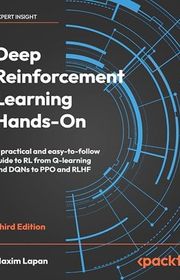
Deep Reinforcement Learning Hands-On
For programmers who learn best by implementing and experimenting with agents. The extensive examples provide a practical complement to the theoretical books, though Python, calculus, and machine-learning familiarity are assumed and dependencies require attention.
What it's about
Maxim Lapan develops reinforcement learning through practical implementations and progressively more advanced methods. Examples connect foundational algorithms with deep learning, using Python tools and PyTorch to explore how agents learn from interaction and how their performance can be evaluated.

Neuro-Dynamic Programming
For readers with optimization and control backgrounds who want the foundations of approximate dynamic programming. The theoretical development connects approximation with sequential decisions, though its demanding mathematics and historical terminology make it a specialist route.
What it's about
Dimitri Bertsekas and John Tsitsiklis develop approximation methods for dynamic programming and sequential decision problems. The book connects neural networks and reinforcement learning with planning and control, examining approaches that make complex optimization problems more practical to address.

Bandit Algorithms
For readers interested in rigorous exploration-exploitation theory and regret analysis. Its depth on bandit settings goes beyond the introductory treatments here, though substantial probability and mathematical maturity are prerequisites and full reinforcement learning is broader.
What it's about
Tor Lattimore and Csaba Szepesvári develop the theory and algorithms of sequential decision making in bandit problems. Mathematical analysis examines exploration, exploitation, and regret, moving through stochastic, adversarial, and contextual settings while connecting probability foundations with algorithm design.

For readers who want reinforcement learning placed within a wider framework of uncertain decisions and planning. The applications help connect formal models with problems, though reinforcement learning occupies only part of the book.
What it's about
Mykel Kochenderfer introduces computational decision making when observations are imperfect and outcomes uncertain. Probabilistic models, utility theory, planning, and reinforcement learning connect algorithms with applications such as speech recognition and aircraft collision avoidance, including problems involving multiple interacting agents.
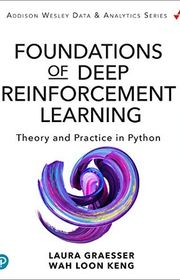
Foundations of Deep Reinforcement Learning
For Python programmers who want intuition, algorithm theory, and implementation discussed together. The companion SLM Lab makes experimentation concrete, though working knowledge of machine learning is assumed and the software environment may require adaptation.
What it's about
Laura Graesser and Wah Loon Keng introduce deep reinforcement learning by connecting intuitive explanations with algorithms and Python implementations. Using their companion SLM Lab, they examine methods, experimental practice, and the practical difficulties involved in getting agents to learn.
Sources
- 1
CS885 Winter 2022 - Textbook
cs.uwaterloo.ca
- 2
RL FAQ
spaces.facsci.ualberta.ca
- 3
Deep RL Resources
slm-lab.gitbook.io
- 4
Resources for Deep Reinforcement Learning
medium.com
- 5
The Best Books on Reinforcement Learning
datasciencetexts.com
- 6
28 Best Reinforcement Learning Books of All Time
shortform.com
- 7
Reinforcement Learning Books
goodreads.com
- 8
What would be a best book for reinforcement learning
reddit.com
- 9
Best books to learn Reinforcement learning?
reddit.com




Edited by
Software engineer whose passion for tracking book recommendations from podcasts inspired the creation of MRB.
Lead investor at 3one4 Capital whose startup expertise and love for books helped shape MRB and its growth.
Comments
Spotted a missing book, a wrong order or a mistake? Tell us and we'll fix this page.
We're a reading guide, not the author or publisher, so we can't send books or pass on messages.