
13 Best Numerical Analysis Books
The best numerical analysis books, ranked by how many expert sources recommend each one, with notes for beginners, students and scientific computing users.
Our take
Numerical analysis explains how to turn mathematical problems into calculations a computer can perform reliably. These books help students, scientists and engineers understand approximation, convergence and the errors that arise when exact answers are unavailable. Most expect calculus and some linear algebra, so an introductory title here is still a university-level text.
The main choice is between learning to use methods and learning to analyze them. Numerical Mathematics and Computing connects numerical ideas with practical computation. Süli and Mayers’ An Introduction to Numerical Analysis takes a more theoretical route. For a wider conceptual survey, Scientific Computing: An Introductory Survey emphasizes choosing methods and interpreting results. Numerical Linear Algebra concentrates on matrix algorithms, while Matrix Computations provides a larger reference and Accuracy and Stability of Numerical Algorithms examines whether computed answers deserve confidence.
Start with Numerical Mathematics and Computing for practice, or Süli and Mayers’ An Introduction to Numerical Analysis if proofs are your main goal.
13 books · 9 sources · Last updated
As an Amazon Associate, we earn from qualifying purchases (at no extra cost to you).
How to choose from this list
Skip to the full rankingIf you want practical computational foundations: Numerical Mathematics and Computing
If you want a broad conceptual overview: Scientific Computing
If you're ready for a rigorous reference: Analysis of Numerical Methods → Introduction to Numerical Analysis
If you want to study matrix algorithms: Numerical Linear Algebra → Matrix Computations
If you need to assess numerical reliability: Accuracy and Stability of Numerical Algorithms
If you want a scientist's perspective: Numerical Methods for Scientists and Engineers
The 13 books, ranked
Ranked by how many expert sources name each book. Ties go to the book more people recommend.
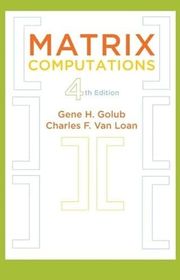
Matrix Computations
For researchers and developers who need a substantial reference for matrix algorithms. Its detailed treatment connects theory with practical computation, but its scope and challenging exercises make it less approachable than a shorter introductory textbook.
What it's about
Golub and Van Loan examine the mathematical foundations and implementation of numerical matrix methods. The book develops algorithms for linear systems, least squares and eigenvalue problems, with derivations and exercises that support scientific computing and numerical software development.

Introduction to Numerical Analysis
For advanced students who want a substantial mathematical reference across core numerical methods. Its breadth and error analysis support deeper study, though the density makes it a demanding choice for a first encounter with the subject.
What it's about
Josef Stoer and Roland Bulirsch develop numerical analysis through error estimates, interpolation, integration, linear systems and iterative methods. Their textbook examines eigenvalue problems and other computational techniques, connecting mathematical foundations with methods used in applied mathematics.

Numerical Analysis
For calculus students who want a broad first course with plenty of worked examples and exercises. Its accessible treatment makes standard methods easier to practice, though readers seeking deeper proofs may outgrow its level of analysis.
What it's about
Richard Burden and his coauthors introduce numerical approximation through its theory and practical applications. Examples and exercises explain how methods work, when they succeed and why they fail, connecting calculus-based techniques with problems across scientific disciplines.

Analysis of Numerical Methods
For readers who want a rigorous classical treatment that can fill gaps left by introductory courses. The analysis of methods rewards close study, but its older presentation offers less guidance on contemporary software and implementation.
What it's about
Eugene Isaacson and Herbert Keller analyze numerical techniques for solving mathematical problems. Linear systems, matrix factorization, nonlinear equations, eigenvalues and polynomial approximation provide a framework for understanding existing methods and developing new ones, with examples and exercises.
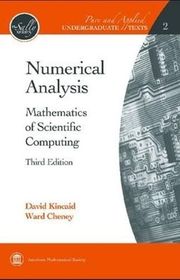
Numerical Analysis: Mathematics of Scientific Computing
For students who want careful proofs connected to algorithms they can implement. Its pseudocode bridges mathematical reasoning and programming without requiring one language, though the broad coverage calls for sustained study rather than quick practical lookup.
What it's about
David Kincaid and Ward Cheney introduce numerical analysis through mathematical reasoning, proofs and computational algorithms. Pseudocode connects the theory with implementation, while examples explain how methods for scientific computing emerge from mathematical questions and can be translated into programs.
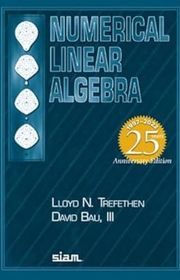
Numerical Linear Algebra
For students ready to study matrix algorithms through short, focused lectures. Its compact structure develops geometric understanding alongside computation, but it assumes linear algebra knowledge and does not replace a broad course in numerical analysis.
What it's about
Trefethen and Bau present numerical linear algebra in forty lecture-sized chapters. Topics connect matrix factorizations, least squares, eigenvalues and iterative methods, explaining how mathematical structure and finite-precision computation shape the algorithms used in scientific work.

Numerical Mathematics and Computing
For learners who want numerical ideas tied closely to programming and practical problem solving. Its attention to predicting and controlling computational error gives calculations context, but it offers less theoretical depth than the more proof-oriented references.
What it's about
Ward Cheney and David Kincaid introduce scientific computing through numerical methods and programming. Their textbook emphasizes solving practical problems while recognizing computational errors, developing techniques for detecting, predicting and controlling inaccuracies in numerical results.
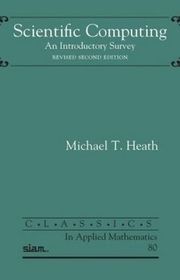
Scientific Computing: An Introductory Survey
For computationally oriented students who want the ideas behind a wide range of numerical methods. Its emphasis on problem formulation and algorithm choice gives a useful overview, but readers seeking formal proofs need a mathematical companion.
What it's about
Michael Heath surveys methods and software for solving mathematical problems in computational modeling and data analysis. The book emphasizes formulating problems, choosing algorithms and interpreting results, explaining numerical ideas without making detailed proofs the center of the presentation.
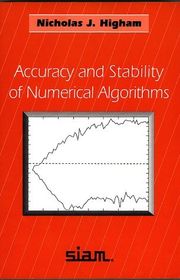
Accuracy and Stability of Numerical Algorithms
For readers who need to judge whether computed answers are trustworthy. Its concentrated treatment of rounding errors and stability goes beyond broad surveys, but it works best after you already know the numerical methods being analyzed.
What it's about
Nicholas Higham studies how finite-precision arithmetic affects numerical algorithms. Error analysis, conditioning and stability provide tools for understanding the reliability of computed results, particularly in matrix computations, and for recognizing when apparently reasonable calculations can mislead.

An Introduction to Numerical Analysis
For mathematically confident students who want to understand why algorithms work. Its attention to accuracy and stability builds a strong theoretical foundation, though readers seeking immediate programming practice will want more concrete computational examples alongside it.
What it's about
Endre Süli and David Mayers explain the mathematical foundations of numerical algorithms. The textbook studies approximation and computational solutions to equations, emphasizing stability, accuracy, reliability, and efficiency, with analysis of why methods succeed or fail.
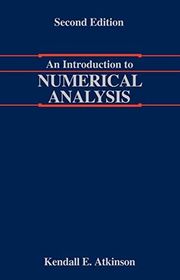
An Introduction to Numerical Analysis
For undergraduates who want a formal treatment of standard numerical topics with substantial problem sets. Atkinson develops the mathematical foundations carefully, but its level of formality makes it less gentle than an examples-first introduction.
What it's about
Kendall Atkinson develops numerical methods for equations, interpolation, integration, linear systems and differential equations. The text connects computational procedures with their mathematical analysis, providing problems that help students examine approximation, convergence and the behavior of numerical solutions.

Numerical Methods for Scientists and Engineers
For scientists and engineers who want insight into algorithm choice and numerical behavior. Its emphasis on understanding the problem behind a calculation remains valuable, though the older computational setting requires adaptation to modern tools and workflows.
What it's about
Richard Hamming examines numerical methods with an emphasis on gaining insight from computation. His systematic approach compares algorithms, connects answers to their underlying problems and addresses roundoff, truncation error and stability in scientific calculations.

Numerical Analysis
For students who learn by connecting mathematical ideas with working computational examples. Recurring themes such as conditioning and convergence provide structure across topics, but the MATLAB orientation may require translation if you use another programming language.
What it's about
Timothy Sauer introduces numerical algorithms for scientific and engineering problems, using MATLAB to illustrate their construction. Convergence, conditioning, complexity and orthogonality provide recurring themes as the textbook balances accuracy and efficiency in computational methods.
Sources
- 1
Numerical Analysis Reference List
sites.math.rutgers.edu
- 2
Reading List for Numerical Analysis Group D. Phil. Students
maths.ox.ac.uk
- 3
100 Best Numerical Analysis Books of All Time
shortform.com
- 4
Numerical Analysis Books
goodreads.com
- 5
Scientific Computing - Numerical Analysis PhD Qualifying Exam
siebelschool.illinois.edu
- 6
CSCC51S Numerical Approximation, Integration and Ordinary Differential Equations: textbooks
cs.toronto.edu
- 7
MA580: Numerical Analysis I
mtchu.math.ncsu.edu
- 8
Undergraduate Numerical Analysis/Methods Textbooks
webpages.sdsmt.edu
- 9
advice on picking a numerical analysis book?
reddit.com






Edited by
Software engineer whose passion for tracking book recommendations from podcasts inspired the creation of MRB.
Lead investor at 3one4 Capital whose startup expertise and love for books helped shape MRB and its growth.
Comments
Spotted a missing book, a wrong order or a mistake? Tell us and we'll fix this page.
We're a reading guide, not the author or publisher, so we can't send books or pass on messages.