
6 Best Functional Analysis Books
The best functional analysis books, ranked by how many expert sources recommend each one, with notes for first courses, graduate study, and applications.
Our take
Functional analysis extends ideas from linear algebra and calculus to spaces of functions and the operators acting on them. It supports the study of differential equations, quantum mechanics, and many other areas of analysis. These books suit readers who already know proofs, linear algebra, and undergraduate real analysis, but they differ considerably in how much topology, measure theory, and mathematical maturity they assume.
Introductory Functional Analysis with Applications develops the foundations gradually and is a useful starting point for readers with an applied background. Conway's A Course in Functional Analysis offers a graduate route with a strong operator-theory emphasis. Brezis's Functional Analysis, Sobolev Spaces and Partial Differential Equations connects the subject directly with PDEs. Rudin, Lax, and Yosida provide different advanced treatments, while Reed and Simon organize their account around the needs of mathematical physics.
Start with Kreyszig if this is your first encounter, then choose a graduate text that matches your intended applications.
6 books · 9 sources · Last updated
As an Amazon Associate, we earn from qualifying purchases (at no extra cost to you).
How to choose from this list
Skip to the full rankingIf this is your first course: Introductory Functional Analysis with Applications
If you're moving into graduate operator theory: Introductory Functional Analysis with Applications → A Course in Functional Analysis
If your goal is partial differential equations: Functional Analysis, Sobolev Spaces and Partial Differential Equations
If your goal is mathematical physics: Methods of Modern Mathematical Physics, Volume I
The 6 books, ranked
Ranked by how many expert sources name each book. Ties go to the book more people recommend.
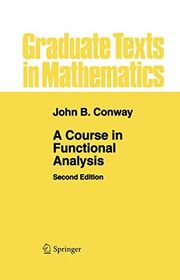
A Course in Functional Analysis
For graduate students who want a sustained route through Hilbert spaces, Banach spaces, and operators. Its operator-theoretic development offers a different emphasis from Brezis's PDE route, though the exercises and proofs still require considerable mathematical maturity.
What it's about
John Conway develops functional analysis from Hilbert and Banach spaces through bounded operators, duality, and spectral theory. The graduate-level text uses proofs, examples, and exercises to build foundations for more advanced work in analysis and operator theory.

Functional Analysis
For graduate readers comfortable with real analysis, complex analysis, and abstraction. Its treatment of topological vector spaces and distributions is broader than an elementary normed-space introduction, though the compact proofs make it demanding for first-time self-study.
What it's about
Walter Rudin develops functional analysis for graduate students through general theory, distributions, Fourier transforms, Banach algebras, and spectral theory. Proofs and exercises connect topological vector spaces, completeness, convexity, and linear operators with applications in mathematical analysis.

Introductory Functional Analysis with Applications
For readers coming from engineering or an undergraduate analysis course. Its gradual development and applications offer a gentler entry than Rudin, though it is less suitable as your only reference for modern graduate-level operator theory.
What it's about
Erwin Kreyszig develops functional analysis through metric, Banach and Hilbert spaces, before treating operators and spectral theory. Worked problems connect the mathematical foundations with applications in the natural sciences, including techniques used in quantum mechanics.
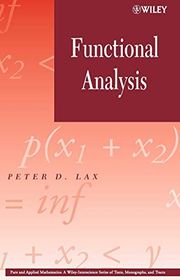
Functional Analysis
For readers with a solid analysis background who value connections to mathematical problems. Its short, lecture-like chapters offer a more expansive applied perspective than a terse theorem sequence, though the breadth makes prerequisites and pacing uneven.
What it's about
Peter Lax presents functional analysis through spaces, linear operators, and their connections with other areas of analysis. Topics include spectral theory, compact operators, semigroups, and operator indices, with examples and applications motivating the development of general results.

For readers who want functional analysis to lead into partial differential equations. Its Sobolev-space development and worked exercises make that connection more direct than the general references, though measure theory and confident proof-reading are important prerequisites.
What it's about
Haim Brezis connects foundational functional analysis with the theory of partial differential equations. Hilbert spaces, operators and Sobolev spaces lead into boundary-value and evolution problems, supported by exercises and solutions that develop the mathematical techniques.
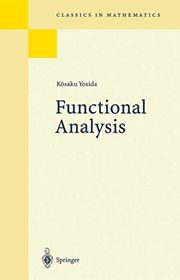
Functional Analysis
For advanced readers who need a substantial operator-theory reference. Its concentrated treatment is useful after a first course and extends beyond introductory applications, though the dense presentation makes cover-to-cover self-study difficult without supporting material.
What it's about
Kōsaku Yosida develops functional analysis with an emphasis on linear operators and applications to analysis. Banach and Hilbert spaces, spectral theory, distributions, and semigroups form part of a detailed treatment intended for advanced mathematical study.
Sources
- 1
A good book of functional analysis
mathoverflow.net
- 2
Good book for self study of functional analysis
math.stackexchange.com
- 3
Recommended books on functional analysis
reddit.com
- 4
Suggestion ls for functional analysis books
reddit.com
- 5
Functional Analysis Books
goodreads.com
- 6
Reading Course: Math 598, Introduction to Functional Analysis
math.purdue.edu
- 7
The 11 Best Functional Analysis Books: Basic to Advanced
celsiuselements.com
- 8
18.102: Introduction to Functional Analysis
math.mit.edu
- 9
Math 205B Homepage, Winter 2020-2021
math.stanford.edu









Edited by
Software engineer whose passion for tracking book recommendations from podcasts inspired the creation of MRB.
Lead investor at 3one4 Capital whose startup expertise and love for books helped shape MRB and its growth.
Comments
Spotted a missing book, a wrong order or a mistake? Tell us and we'll fix this page.
We're a reading guide, not the author or publisher, so we can't send books or pass on messages.