
4 Best Microservices Books
The best microservices books, ranked by how many expert sources recommend each one, with notes on who each suits, from architecture to migration and data.
Our take
Microservices books are most useful when they help you weigh the cost of distributing a system, not simply divide an application into smaller pieces. Service boundaries, data ownership, communication, testing, and operations all affect whether the approach fits a team. These books suit developers and architects who already understand how a backend application works and want to examine those decisions more carefully.
Sam Newman's Building Microservices offers a broad architecture introduction, though the entry here is the original edition. Microservices Patterns gives a more structured catalogue of design choices, illustrated in Java. Monolith to Microservices concentrates on changing an existing system rather than assuming a fresh start. Designing Data-Intensive Applications reaches beyond microservices, providing background for reasoning about storage and distributed data. Start with Newman's overview, then choose Richardson for implementation patterns, the migration book for an existing application, or Kleppmann for deeper data-system tradeoffs.
4 books · 8 sources · Last updated
As an Amazon Associate, we earn from qualifying purchases (at no extra cost to you).
How to choose from this list
Skip to the full rankingIf you want an architecture overview: Building Microservices
If you want implementation patterns: Microservices Patterns
If you're changing an existing application: Monolith to Microservices
If you want deeper data-system foundations: Designing Data-Intensive Applications
The 4 books, ranked
Ranked by how many expert sources name each book. Ties go to the book more people recommend.

For developers and architects who want reusable solutions to recurring design problems, Richardson connects patterns with worked Java examples. Its structured treatment is useful after an overview, though the examples require translation when your stack differs.
What it's about
Chris Richardson presents patterns for designing applications as cooperating services, with Java examples. He explores service decomposition, communication, distributed transactions, queries, testing and deployment, explaining how architectural choices address the complications of a microservices system.
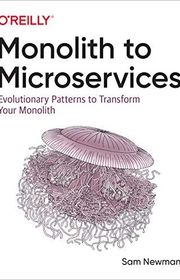
For teams working with an existing application, Newman focuses on incremental change and the difficulty of separating services and data. Its migration emphasis makes it more immediately relevant than a general overview, but assumes familiarity with the underlying architecture.
What it's about
Sam Newman explores ways to move parts of an existing monolithic application into separate services. He examines incremental extraction, decomposition, database boundaries, and organizational challenges, using patterns and examples to discuss the tradeoffs involved in changing a working system.

For developers who want a broad introduction before choosing specific patterns, Newman connects service design with testing, deployment, and organizational concerns. This original edition establishes the concepts, but predates the expanded second edition and later operational practice.
What it's about
Sam Newman introduces the design and operation of systems built from small, autonomous services. He examines microservices' benefits and drawbacks, covering modeling, integration, testing, deployment, and monitoring through practical examples and the experience of a fictional company.

Designing Data-Intensive Applications
The Big Ideas Behind Reliable, Scalable, and Maintainable Systems
For readers who want to understand data consistency, replication, and storage tradeoffs behind service boundaries, Kleppmann provides broader foundations. Its depth rewards experienced developers, but it is not a microservices implementation guide and this is the original edition.
What it's about
Martin Kleppmann examines the design choices behind systems that store and process large amounts of data. He compares databases, replication, partitioning, transactions, batch processing and streams, explaining tradeoffs involving reliability, consistency, scalability and maintainability.
Sources
- 1
Best Microservices Books
jobroadmaps.com
- 2
software-architecture-books
github.com
- 3
The Complete Collection of Microservices Books
blog.drinkbird.com
- 4
Microservices Books
goodreads.com
- 5
How to start learning microservices in a structured way?
reddit.com
- 6
Microservice Books
reddit.com
- 7
Books
samnewman.io
- 8
Microservices Resource Guide
martinfowler.com




Edited by
Software engineer whose passion for tracking book recommendations from podcasts inspired the creation of MRB.
Lead investor at 3one4 Capital whose startup expertise and love for books helped shape MRB and its growth.
Comments
Spotted a missing book, a wrong order or a mistake? Tell us and we'll fix this page.
We're a reading guide, not the author or publisher, so we can't send books or pass on messages.