
20 Best Growth Hacking Books
The best growth hacking books, ranked by how many expert sources recommend each one, with notes on experiments, acquisition, metrics and product-led growth.
Our take
Growth hacking books cover more than tactics for getting attention. The useful questions include who gets value from a product, how to reach those customers, why they return and which measurements show meaningful progress. Some books explain a repeatable experimentation process, while others focus on acquisition channels, product design, word of mouth or the organizational demands of expansion. A technique that worked for one company still needs testing against your customers, costs and constraints.
Hacking Growth provides a broad process for teams, and Traction helps narrow the search for acquisition channels. Lean Analytics connects measurement with business models and stages, while Interviewing Users adds depth that numbers alone can't provide. Obviously Awesome tackles positioning, and Product-Led Growth focuses on software that customers can try and adopt themselves. For B2B services, The Paper Plane Plan offers a more relevant setting than many startup examples. The Cold Start Problem is most useful when participation makes the product more valuable. Start with a broad process book, then choose the specialist title that matches the problem you can actually observe.
20 books · 10 sources · Last updated
As an Amazon Associate, we earn from qualifying purchases (at no extra cost to you).
How to choose from this list
Skip to the full rankingIf you're new to growth work: Growth Hacker Marketing → Hacking Growth
If you need acquisition channels: Traction → Lean Analytics
If you need better customer understanding: Interviewing Users → Obviously Awesome
If you're building self-service software: Product-Led Growth → Don't Make Me Think
If you sell B2B services: The Paper Plane Plan → Growing Happy Clients
If your product depends on a network: The Cold Start Problem → Viral Loop
The 20 books, ranked
Ranked by how many expert sources name each book. Ties go to the book more people recommend.

For founders who need a disciplined way to choose acquisition channels. The nineteen-channel survey and Bullseye framework make it useful before committing a budget, though the channel examples need adapting to today's platforms and your own customer behavior.
What it's about
Gabriel Weinberg and Justin Mares examine nineteen channels for acquiring customers. Drawing on founder interviews, they introduce the Bullseye framework for testing options, identifying promising channels, and building a repeatable approach to startup growth.
Also recommended by
3 people Alexis Ohanian recommended this book
Alexis Ohanian
"The question every founder asks after shipping is always: how do I get traction? This book actually answers it." - Alexis Ohanian
Alexis Ohanian's recommendation of this book  James Altucher recommended this book
James Altucher
"'How do I know if my business is getting traction, or how do I get traction for my business, or how do I get users?' [This book] answers all of these questions and more." - James Altucher
James Altucher's recommendation of this book  Seth Godin recommended this book
Seth Godin
"The latest, most specific tactics from the red-hot center of the internet marketing universe. From someone who has done it. Twice." - Seth Godin
Seth Godin's recommendation of this book

For teams that want to make experimentation a regular part of product and marketing work. Its coverage extends beyond acquisition to retention and monetization, though coordinating the process requires more organizational effort than trying isolated tactics.
What it's about
Sean Ellis and Morgan Brown explain growth hacking as a process of experimentation centered on customers. Their guide connects acquiring, retaining, engaging, and monetizing users with coordinated teamwork and repeated testing, showing how companies can investigate opportunities for growth.

For product teams examining why customers return and how repeated use develops. The four-stage model gives behavior design a concrete structure, though habit formation needs ethical judgment and does not by itself establish lasting customer value.
What it's about
Nir Eyal explains a four-stage model for designing products that encourage repeated use. Examples and practical guidance help founders, designers, marketers, and product managers examine how technology influences behavior and how customer habits develop.
Also recommended by
1 person Marc Goodman recommended this book
Marc Goodman
One of Marc Goodman's answers to "sources you've learned from in the last year?"
Marc Goodman's recommendation of this book

For beginners who want a short introduction before tackling a larger growth handbook. Holiday explains the shift toward product-centered experimentation through recognizable examples, though the primer offers less operational detail and its early startup stories need context.
What it's about
A primer on the new rules of marketing for startups and creators. It explains how companies like Dropbox and Airbnb built massive user bases not with traditional ads, but by building viral features directly into their products.

For readers who want a consulting-derived framework for organizing growth tactics. Its focus on a repeatable sales process connects marketing activities across the customer journey, though the authors' own model offers a narrower lens than a broad experimental handbook.
What it's about
Raymond Fong and Chad Riddersen explain growth hacking through a framework developed in their consulting work. Examples connect creative marketing approaches with business growth, offering a blueprint for selecting and applying scalable tactics across companies in different industries.

For teams collecting data without knowing which numbers should guide action. Its business-model and stage-based frameworks make measurement more purposeful, though readers still need to define and validate metrics for their own product rather than copy examples.
What it's about
Alistair Croll and Benjamin Yoskovitz explain how startups can choose useful metrics for their business model and stage of development. Case studies and frameworks cover validating assumptions, distinguishing actionable data from vanity measures, and focusing experiments around a central metric.

For software teams building trials, freemium offers or self-service adoption. Bush links product value with acquisition and conversion more closely than general marketing guides, though the approach fits less naturally when customers need extensive consultation before using the product.
What it's about
Wes Bush explains how software businesses can use the product itself to acquire, convert, and retain customers. Examples and practical guidance address free trials, freemium offers, pricing, and growth teams, connecting customer access to product value with a broader business strategy.

Viral Loop
From Facebook to Twitter, How Today's Smartest Businesses Grow Themselves
For readers who learn from company histories and want to understand self-reinforcing customer growth. The narratives make viral mechanisms easier to picture, though the older internet-business examples provide more inspiration than a detailed implementation manual.
What it's about
Adam Penenberg investigates businesses whose products spread as customers use them and invite others. Stories of internet entrepreneurs explain how these self-reinforcing networks develop, examining the design choices and customer behavior behind rapid online growth.
Also recommended by
3 people Keith Rabois recommended this book
Keith Rabois
Keith Rabois recommended this book on a Medium blog post.
Keith Rabois's recommendation of this book  Ryan Hoover recommended this book
Ryan Hoover
"Interesting stories about today's biggest viral web businesses but lacking insights, imho." - Ryan Hoover
Ryan Hoover's recommendation of this book  Tim Draper recommended this book
Tim Draper
"[One of the books] that are recommended or required at Draper University." - Tim Draper
Tim Draper's recommendation of this book

For marketers who want to understand why people share some ideas and ignore others. Berger's framework helps shape messages and products for word of mouth, though it cannot promise that any particular campaign will spread.
What it's about
Jonah Berger investigates why certain products, ideas, and stories spread through word of mouth. Research and examples explain how social motives, emotions, everyday reminders, and other factors influence what people share and what others choose to pass along.
Also recommended by
1 person Changpeng Zhao recommended this book
Changpeng Zhao
"A must-read for all product designers and marketers, and a lot of people in our team have taken the lessons in this book to heart." - Changpeng Zhao
Changpeng Zhao's recommendation of this book
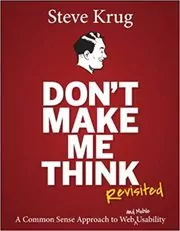
For teams whose visitors or users struggle to understand what to do next. Krug's emphasis on clarity and usability testing targets avoidable friction, though the scope is interface design rather than acquisition strategy or a complete growth process.
What it's about
Steve Krug explains how to design websites people can navigate and understand with little effort. Using practical examples, he examines information design, scanning, usability testing, and mobile experiences, emphasizing clarity in everyday interactions.
Also recommended by
5 people Ev Williams recommended this book
Ev Williams
On the "books read" section of Ev Williams' GoodReads profile.
Ev Williams's recommendation of this book  Brian Armstrong recommended this book
Brian Armstrong
"A framework to simulate how customers experience your product, especially the moments of confusion." - Brian Armstrong
Brian Armstrong's recommendation of this book  Jeff Atwood recommended this book
Jeff Atwood
"The single best book on usability I've ever read." - Jeff Atwood
Jeff Atwood's recommendation of this book  Nick Ganju recommended this book
Nick Ganju
"About usability and making software and user interfaces that are friendly to people." - Nick Ganju
Nick Ganju's recommendation of this book  Garry Tan recommended this book
Garry Tan
"The simplest book I recommend everyone to read when they want to do design." - Garry Tan
Garry Tan's recommendation of this book

Explosive Growth
A Few Things I Learned While Growing My Startup To 100 Million Users & Losing $78 Million
For founders who want a personal account of growth decisions and costly mistakes. Lerner connects tactics with the pressures of running a startup, though the memoir's exceptional outcomes should not be treated as a repeatable forecast for another business.
What it's about
Cliff Lerner recounts the growth of his startup and the costly lessons that accompanied it. Personal stories and case studies connect product decisions, experimentation, and marketing tactics with the experience of building apps and navigating a rapidly expanding business.

Growing Happy Clients
Our Processes & Experiences for Growing Fortune 500 Corporates & the Fastest Growing Scaleups
For consultants and growth practitioners managing clients as well as experiments. Its attention to stakeholders, meetings and difficult results fills a gap left by tactical guides, though it is less relevant to readers seeking their first acquisition ideas.
What it's about
Daphne Tideman and Ward van Gasteren examine the consulting skills involved in helping clients pursue growth. Their process runs from initial contact through project reflection, addressing stakeholders, goals, meetings, deliverables, and difficult results within complex organizations and client relationships.

For agencies and other B2B service companies that find software-startup examples hard to apply. Davies translates experimentation into a service-business setting, though the lessons draw heavily on one company's experience rather than a comprehensive cross-industry comparison.
What it's about
Ross Davies adapts growth hacking ideas for companies that sell services to other businesses. Drawing on experiments in his own company, he presents a step-by-step approach to testing growth tactics and applying an experimental mindset beyond software and technology startups.

For founders building marketplaces, communities or other products whose value depends on participation. Chen focuses on getting networks started and sustaining them, though this lens is less useful for a business that gains little value from connections between customers.
What it's about
Andrew Chen examines how products build network effects, gaining value as more people use them. Drawing on technology companies and startup experience, he offers frameworks for attracting an initial network, sustaining growth, and competing with established services.
Also recommended by
1 person Balaji Srinivasan recommended this book
Balaji Srinivasan
"Useful for anyone trying to bootstrap a new community or network, which is virtually every founder these days." - Balaji Srinivasan
Balaji Srinivasan's recommendation of this book

100 Days of Growth
For marketers who need a range of ideas to turn into experiments. The short, tactic-focused entries are easy to browse when planning work, though platform-dependent suggestions need checking and the collection offers less help with overall strategy.
What it's about
Sujan Patel and Rob Wormley collect one hundred business growth tactics with examples and implementation guidance. Short entries explore approaches such as guest posting, offers, and homepage testing, giving marketers a range of ideas to adapt and evaluate in their own businesses.

Interviewing Users
For teams that can see what customers do but struggle to understand why. Portigal gives interviewing its own practical method, though recruiting participants, listening carefully and interpreting the results require more time than checking an analytics dashboard.
What it's about
Steve Portigal explains how to plan, conduct and interpret user interviews. The updated edition covers questioning techniques, fieldwork, documentation, bias and remote research, helping teams turn conversations with users into findings that can inform business and product decisions.

Obviously Awesome
How to Nail Product Positioning so Customers Get It, Buy It, Love It
For teams whose prospects don't understand the product's value or how it differs from alternatives. Dunford offers a concrete positioning process, though clarifying the offer won't replace the acquisition tests and product improvements covered elsewhere here.
What it's about
April Dunford provides a process for positioning products so customers understand their distinctive value. She connects competitive alternatives, unique capabilities, customer needs, and market categories, showing how these choices support marketing and sales.

For beginners who want an explicit sequence from mindset through experiments to scaling. Its tools give early exploration some structure, though the broad framework needs translation into specific customer problems, meaningful measurements and tests for your business.
What it's about
Nader Sabry introduces growth hacking through a sequence of mindset, strategy, experimentation, and scaling. Tools and examples accompany practical guidance for identifying growth problems and testing opportunities, giving beginners a structured approach to developing and evaluating ideas for their organizations.
The Growth Handbook
For readers who want a compact collection of practitioner perspectives across the customer journey. The essay format offers several useful entry points, though differences in voice and emphasis make it less unified than a single-author program.
What it's about
This collection brings together essays and excerpts from business growth practitioners on acquisition, activation, retention, monetization, experimentation, and measurement. Contributors examine common challenges in connecting customers with product value, offering perspectives on building more sustainable paths to growth.

For founders facing the organizational demands of very rapid expansion. Its stage-based discussion connects growth with hiring, management and business models, though prioritizing speed over efficiency is a context-dependent strategy rather than a default for every company.
What it's about
Reid Hoffman and Chris Yeh examine how companies pursue rapid growth under uncertainty, sometimes prioritizing speed over efficiency. Case studies illustrate the changes in business models, hiring, management, and company culture required at successive stages of expansion.
Also recommended by
8 people Bill Gates recommended this book
Bill Gates
"The case studies you’re about to explore and the tools you’re about to gain have never been more relevant. This is an ideal moment to be reading this book." - Bill Gates
Bill Gates's recommendation of this book  Vinod Khosla recommended this book
Vinod Khosla
"An insightful book on how to scale at a very fast pace and more importantly WHEN." - Vinod Khosla
Vinod Khosla's recommendation of this book  Brian Chesky recommended this book
Brian Chesky
"Shares some of the key secrets for building mission-oriented, global businesses at speed." - Brian Chesky
Brian Chesky's recommendation of this book  Sam Altman recommended this book
Sam Altman
"Have been waiting for it to come out so that I can recommend it to everyone." - Sam Altman
Sam Altman's recommendation of this book  Eric Schmidt recommended this book
Eric Schmidt
"Paints the picture, with key case studies, of what it really takes to build a market-leading company." - Eric Schmidt
Eric Schmidt's recommendation of this book  Anthony Pompliano recommended this book
Anthony Pompliano
"No brainer pick up for every entrepreneur and investor." - Anthony Pompliano
Anthony Pompliano's recommendation of this book +2
More recommendations
- Changpeng Zhao
"Has been very helpful to Binance as we chart our growth as an organization." - Changpeng Zhao
- Sheryl Sandberg
"Shows how companies can build value for customers and shareholders in the digital age." - Sheryl Sandberg
- Changpeng Zhao
Sources
- 1
22 Best Growth Hacking Books recommended by Growth Hackers in 2019
growwithward.com
- 2
The 27 Best Growth Marketing Books in 2026 (and Our Top Pick)
growthmethod.com
- 3
Top 15 Growth Hacking Books to Read in 2025
growthrocks.com
- 4
Growth Hacking Books
goodreads.com
- 5
Growth Hacking Books: 12 books to start with
roypovarchik.com
- 6
Can anyone recommend some modern books?
reddit.com
- 7
What books/newsletters/blogs/podcasts about marketing you'd recommend?
reddit.com
- 8
Top 10 Books on Growth and Growth-Hacking
userguiding.com
- 9
25 Growth Hacking Books to Skyrocket Success
dashly.io
- 10
Best Growth Marketing Books: The Ones Actually Worth Reading
filipkonecny.com






Edited by
Software engineer whose passion for tracking book recommendations from podcasts inspired the creation of MRB.
Lead investor at 3one4 Capital whose startup expertise and love for books helped shape MRB and its growth.
Comments
Spotted a missing book, a wrong order or a mistake? Tell us and we'll fix this page.
We're a reading guide, not the author or publisher, so we can't send books or pass on messages.