
16 Best Startup Books
The best startup books, ranked by how many expert sources recommend each one, with notes for choosing customer research, growth, positioning, and leadership guides.
Our take
Startup books address different problems: discovering customers, choosing a market, building a product, finding a route to growth, and leading a team. A useful book for one stage can be frustrating at another. Broad frameworks help organize uncertainty, while narrower guides give more detail on conversations, positioning, hiring, or the responsibilities that come with a growing company.
The Lean Startup introduces experimentation, and The Mom Test focuses on learning from customer conversations. Obviously Awesome examines positioning, while Traction compares ways to reach customers. The Cold Start Problem is particularly relevant to products whose value depends on other users. Leadership questions receive more attention in The Hard Thing About Hard Things and Creativity, Inc. For a smaller independent business, The $100 Startup and The E-Myth Revisited offer different perspectives from the venture-backed technology stories. Start with The Mom Test if you are still exploring a problem, then choose the book that matches the decision you face next.
16 books · 9 sources · Last updated
As an Amazon Associate, we earn from qualifying purchases (at no extra cost to you).
How to choose from this list
Skip to the full rankingIf you're exploring a customer problem: The Mom Test → The Lean Startup
If you need a route to customers: Traction
If buyers don't understand your value: Obviously Awesome
If your product depends on a network: The Cold Start Problem
If you're leading a growing team: The Hard Thing About Hard Things → Creativity, Inc.
If you want a small independent business: The $100 Startup → The E-Myth Revisited
The 16 books, ranked
Ranked by how many expert sources name each book. Ties go to the book more people recommend.

For readers who want a provocative framework for thinking about differentiation and durable advantage. Thiel challenges imitation more sharply than a procedural startup manual, though the concentrated arguments and strong preferences leave less space for incremental or service-based businesses.
What it's about
Peter Thiel examines how startups can create something new rather than imitate existing businesses. Written with Blake Masters, the book explores independent thinking, technological progress, and the search for opportunities that produce distinctive value in any industry.
Also recommended by
22 people Andrew Ng recommended this book
Andrew Ng
"Gives an overview of entrepreneurship and innovation." - Andrew Ng
Andrew Ng's recommendation of this book  Ben Horowitz recommended this book
Ben Horowitz
"I learned a lot reading it." - Ben Horowitz
Ben Horowitz's recommendation of this book  Bryan Johnson recommended this book
Bryan Johnson
"A must read." - Bryan Johnson
Bryan Johnson's recommendation of this book  Chris Dixon recommended this book
Chris Dixon
Chris Dixon recommended this book on Twitter.
Chris Dixon's recommendation of this book  Dustin Moskovitz recommended this book
Dustin Moskovitz
Dustin Moskovitz recommended this book during a Stanford lecture in 2014.
Dustin Moskovitz's recommendation of this book  Elon Musk recommended this book
Elon Musk
"[This author] has built multiple breakthrough companies, and [this book] shows how." - Elon Musk
Elon Musk's recommendation of this book +16
More recommendations
- Eric Weinstein
"If you really understand something that the rest of the world is confused about, and it’s an important truth, [this book] says here are all the ways you might want to make that work." - Eric Weinstein
- Keith Rabois
Keith Rabois recommended this book on a Medium blog post.
- Kishore Biyani
"Captures some interesting perspectives and insights on the way the world and the business organisations are changing and challenging the status quo." - Kishore Biyani
- Lee Stranahan
"A great business book." - Lee Stranahan
- Luis von Ahn
"I love [this book]." - Luis von Ahn
- Marc Andreessen
"The first book any working or aspiring entrepreneur must read—period." - Marc Andreessen
- Mark Zuckerberg
"This book delivers completely new and refreshing ideas on how to create value in the world." - Mark Zuckerberg
- Matt Mullenweg
"[This book] was excellent." - Matt Mullenweg
- Max Levchin
One of Max Levchin's answers to "what's your favourite business book you'd advise to young entrepreneurs?"
- Nassim Taleb
"When a risk taker writes a book, read it. In the case of [this author], read it twice. Or, to be safe, three times. This is a classic." - Nassim Taleb
- Sam Altman
This book was on Sam Altman's bookshelf.
- Patrick O'Shaughnessy
"An obvious suggestion, because [this book] is the talk of the town and sits at the top of bestseller lists everywhere." - Patrick O'Shaughnessy
- Tom Bilyeu
Tom Bilyeu recommended this book on his website.
- Ryan Petersen
"[Part of] my biz book canon." - Ryan Petersen
- Brian Dean
"Business classic that lives up to the hype. Completely reframes what a startup should do with their product and positioning." - Brian Dean
- Rupert Murdoch
"Brilliant, often provocative." - Rupert Murdoch
- Eric Weinstein
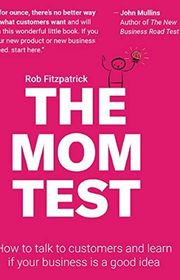
The Mom Test: How to Talk to Customers & Learn If Your Business Is a Good Idea When Everyone Is Lying to You
For founders who want better information from customer conversations. Fitzpatrick's compact examples make biased questions and vague compliments easier to recognize, though the conversation skills address one part of validation and do not establish a viable business by themselves.
What it's about
Rob Fitzpatrick explains how founders can learn from customer conversations without inviting reassurance or leading answers. The book focuses on discussing actual behavior, identifying meaningful problems, and recognizing when feedback offers evidence rather than polite encouragement.

The Lean Startup
How Today's Entrepreneurs Use Continuous Innovation to Create Radically Successful Businesses
For founders who want a framework for testing assumptions under uncertainty. Ries connects experiments with decisions about products and strategy, though the examples and terminology are easier to absorb than the organizational discipline needed to apply the ideas well.
What it's about
Eric Ries proposes developing businesses through repeated experiments, customer feedback, and validated learning. The book explains how entrepreneurs can test assumptions, measure progress, and adjust products and strategy under uncertainty rather than rely entirely on detailed initial plans.
Also recommended by
15 people- Andrew Ng recommended this book
Andrew Ng
"Gives one specific tactic for innovating quickly." - Andrew Ng
Andrew Ng's recommendation of this book - Ben Horowitz recommended this book
Ben Horowitz
"Great." - Ben Horowitz
Ben Horowitz's recommendation of this book - Dustin Moskovitz recommended this book
Dustin Moskovitz
"At Asana, we've been lucky to benefit from [the author]'s advice firsthand; this book will enable him to help many more entrepreneurs answer the tough questions about their business." - Dustin Moskovitz
Dustin Moskovitz's recommendation of this book  Jason Calacanis recommended this book
Jason Calacanis
"You need to read [this book]." - Jason Calacanis
Jason Calacanis's recommendation of this book  Kevin Systrom recommended this book
Kevin Systrom
"The principles from [this book], I still apply today." - Kevin Systrom
Kevin Systrom's recommendation of this book  Marc Andreessen recommended this book
Marc Andreessen
"[The author] has created a science where previously there was only art. A must read for every serious entrepreneur—and every manager interested in innovation." - Marc Andreessen
Marc Andreessen's recommendation of this book +9
More recommendations
- Mark Cuban
One of the 7 books Mark Cuban credits his success to.
- Mike Maples, Jr.
"[I was] lucky enough to have a front-row seat at the birth of these ideas." - Mike Maples, Jr.
- Tim O’Reilly
"[This book] isn't just about how to create a more successful entrepreneurial business, it's about what we can learn from those businesses to improve virtually everything we do." - Tim O’Reilly
- Chris Dixon
Chris Dixon recommended this book on Twitter.
- Raoul Pal
Raoul Pal recommended this book on Twitter.
- Sheryl Sandberg
"Provides a great inside look at how the tech industry approaches building products and businesses." - Sheryl Sandberg
- Steve Blank
"A 'must have' for your shelf." - Steve Blank
- Marty Cagan
"Buy it." - Marty Cagan
- Patrick Bet-David
Patrick Bet-David recommended this book on his website.
- Mark Cuban
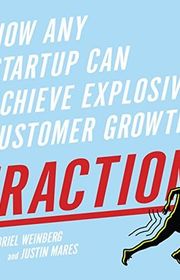
Traction: How Any Startup Can Achieve Explosive Customer Growth
For founders who have a product direction but lack a dependable route to customers. Its comparison of acquisition channels gives testing a clear structure, though specific tactics and platform examples need updating as markets and distribution tools change.
What it's about
Gabriel Weinberg and Justin Mares survey nineteen channels for attracting customers, from publicity and partnerships to paid advertising and sales. Their Bullseye framework explains how startups can compare possibilities, run focused tests, and identify promising routes to growth.

The Hard Thing About Hard Things
Building a Business When There Are No Easy Answers
For founders facing difficult leadership decisions rather than looking for encouragement alone. Horowitz gives personnel problems and crisis management unusually direct attention, though the venture-backed technology setting provides a selective view of the businesses founders actually run.
What it's about
Ben Horowitz draws on his experiences leading technology companies to discuss the difficult decisions involved in running a business. His advice covers leadership under pressure, personnel problems, competition, and the responsibilities that accompany the role of chief executive.
Also recommended by
22 people Peter Thiel recommended this book
Peter Thiel
"[The author] has written the first true guide for protecting a startup from self-sabotage." - Peter Thiel
Peter Thiel's recommendation of this book  Mark Zuckerberg recommended this book
Mark Zuckerberg
"For anyone insterested in building, growing, or leading a great company, this book is an incredibly valuable resource." - Mark Zuckerberg
Mark Zuckerberg's recommendation of this book  Peter Attia recommended this book
Peter Attia
One of Peter Attia's answers to "any books you feel would make your reading list?"
Peter Attia's recommendation of this book - Marc Andreessen recommended this book
Marc Andreessen
"Let’s just say, we started out relationship with vigorous disagreement, and we’ve continued that to this day." - Marc Andreessen
Marc Andreessen's recommendation of this book  Larry Page recommended this book
Larry Page
"An inspiring story of a business rebirth through sheer willpower." - Larry Page
Larry Page's recommendation of this book  Matt Mullenweg recommended this book
Matt Mullenweg
"Entertaining more than anything. I read [this book], I was like: I would never work for this guy. But entertaining and some good lessons." - Matt Mullenweg
Matt Mullenweg's recommendation of this book +16
More recommendations
- Andrew Ng
"A bit dark but it does cover a lot of useful territory on what building an organization is like." - Andrew Ng
- Drew Houston
"One of the great things that [the author] wrote in [this book] is the hardest part of being a CEO is managing your psychology." - Drew Houston
- Keith Rabois
"Reflects 2000-2003." - Keith Rabois
- Dustin Moskovitz
Dustin Moskovitz recommended this book during a Stanford lecture in 2014.
- Max Levchin
One of Max Levchin's answers to "what's your favourite business book you'd advise to young entrepreneurs?"
- Luis von Ahn
"I like this one, but it’s not for very new entrepreneurs." - Luis von Ahn
- Kathryn Minshew
Most Recommended Books reached out to Kathryn Minshew directly.
- Andrew Wilkinson
"One of the best business books I've picked up in years." - Andrew Wilkinson
- Tim Ferriss
"A great book." - Tim Ferriss
- Blake Scholl
"Good." - Blake Scholl
- Chris Dixon
Chris Dixon recommended this book on Twitter.
- Fred Wilson
"Chapter five in [this book] is possibly the best thing I've read about leading a tech company." - Fred Wilson
- Raoul Pal
"By far, the best, most brutally honest and incredibly useful book about the realities of starting and running a company." - Raoul Pal
- Jodie Cook
"Reframes your mind: hard doesn’t mean bad. Seeking the easy route is a trap." - Jodie Cook
- Michael Dell
"Candidly talks about the very real thrills and perils of starting a business."- Michael Dell
- Marty Cagan
"Trust me: if you're a leader in tech, the best thing you can do in 2014 for your company is to read [this book]." - Marty Cagan
- Andrew Ng

The E-Myth Revisited
Why Most Small Businesses Don't Work and What to Do About It
For small-business owners whose work depends too heavily on their own effort. Gerber makes the distinction between doing the work and designing the business clear, though the standardization emphasis fits repeatable operations more readily than every experimental startup.
What it's about
Michael Gerber argues that technical expertise does not automatically equip someone to run a small business. He distinguishes entrepreneurial, managerial, and technical responsibilities, outlining a systems-based approach designed to reduce a company’s dependence on its owner.
Also recommended by
7 people Tim Ferriss recommended this book
Tim Ferriss
"If you’re stuck in your own business, this book can help you get unstuck." - Tim Ferriss
Tim Ferriss's recommendation of this book  Dave Ramsey recommended this book
Dave Ramsey
Recommended on Dave Ramsey's website.
Dave Ramsey's recommendation of this book  Derek Sivers recommended this book
Derek Sivers
"Absolutely everyone who is an entrepreneur or wants to be one needs to read this book." - Derek Sivers
Derek Sivers's recommendation of this book  Dave Camarillo recommended this book
Dave Camarillo
"Was huge." - Dave Camarillo
Dave Camarillo's recommendation of this book  Tom Bilyeu recommended this book
Tom Bilyeu
Tom Bilyeu recommended this book on his website.
Tom Bilyeu's recommendation of this book  Michael Hyatt recommended this book
Michael Hyatt
Michael Hyatt recommended this book on his website.
Michael Hyatt's recommendation of this book +1
More recommendations
- Patrick Bet-David
Patrick Bet-David recommended this book on his website.
- Patrick Bet-David

For readers who learn through firsthand accounts and contrasting experiences. Livingston's interviews reveal messy beginnings that polished company histories often omit, though the successful technology founders and historical settings offer examples rather than a repeatable startup recipe.
What it's about
Jessica Livingston interviews founders of technology companies about their earliest days. Firsthand accounts from Apple, PayPal, Flickr, Hotmail, and other ventures explore initial ideas, unexpected discoveries, funding challenges, failures, and the work of building a company.
Also recommended by
5 people Paul Graham recommended this book
Paul Graham
"Probably the single most valuable book a startup founder could read." - Paul Graham
Paul Graham's recommendation of this book  Ryan Holiday recommended this book
Ryan Holiday
"Interviews with technology founders from one of the best investors of all time." - Ryan Holiday
Ryan Holiday's recommendation of this book  Alexis Ohanian recommended this book
Alexis Ohanian
"A bunch of really great interviews [Jessica] did with a bunch of just OGs of entrepreneurship." - Alexis Ohanian
Alexis Ohanian's recommendation of this book  Ev Williams recommended this book
Ev Williams
On the "books read" section of Ev Williams' GoodReads profile.
Ev Williams's recommendation of this book  Ron Conway recommended this book
Ron Conway
"Collection of interviews with founders of famous technology companies about what happened in the very earliest days." - Ron Conway
Ron Conway's recommendation of this book

For founders whose products depend on repeated customer use. Eyal gives product teams a compact framework for discussing habits, though the emphasis fits recurring behaviors more naturally than occasional purchases and leaves broader company-building questions outside its scope.
What it's about
Nir Eyal explains a four-stage model for designing products that encourage repeated use. Examples and practical guidance help founders, designers, marketers, and product managers examine how technology influences behavior and how customer habits develop.
Also recommended by
1 person Marc Goodman recommended this book
Marc Goodman
One of Marc Goodman's answers to "sources you've learned from in the last year?"
Marc Goodman's recommendation of this book

For founders building marketplaces, social products, or other businesses that depend on networks. Chen gives early participation and network growth focused attention, though the technology-platform examples are less directly useful when a product's value is largely independent of other users.
What it's about
Andrew Chen examines how products build network effects, gaining value as more people use them. Drawing on technology companies and startup experience, he offers frameworks for attracting an initial network, sustaining growth, and competing with established services.
Also recommended by
1 person Balaji Srinivasan recommended this book
Balaji Srinivasan
"Useful for anyone trying to bootstrap a new community or network, which is virtually every founder these days." - Balaji Srinivasan
Balaji Srinivasan's recommendation of this book

Obviously Awesome
How to Nail Product Positioning so Customers Get It, Buy It, Love It
For founders whose customers struggle to understand what makes the product valuable. Dunford turns positioning into a concrete sequence of choices, though the B2B technology emphasis needs adaptation for consumer products, services, or businesses with little customer evidence yet.
What it's about
April Dunford provides a process for positioning products so customers understand their distinctive value. She connects competitive alternatives, unique capabilities, customer needs, and market categories, showing how these choices support marketing and sales.

The $100 Startup
Reinvent the Way You Make a Living, Do What You Love, and Create a New Future
For readers exploring a small, independent business with modest initial resources. Guillebeau makes offers, customers, and personal skills feel approachable, though the selected success stories provide less guidance for capital-intensive products or venture-backed technology companies.
What it's about
Chris Guillebeau profiles people who built small businesses with modest startup funds. Their experiences illustrate how existing skills, a useful offer, and identifiable customers can become the basis of an independent livelihood.

For founders who want a detailed working reference for customer development. Blank and Dorf translate broad principles into checklists and structured activities, though the substantial volume is better suited to selective use than a quick first overview.
What it's about
Steve Blank and Bob Dorf provide a detailed guide to applying Customer Development when building a startup. Charts, checklists, and the Business Model Canvas organize experiments in identifying customers, testing assumptions, and developing a repeatable, scalable business.

Creativity, Inc.
Overcoming the Unseen Forces That Stand in the Way of True Inspiration
For founders building teams whose work depends on creative judgment. Catmull gives candor, collaboration, and organizational habits a concrete setting, though Pixar's resources and long development cycles differ substantially from those of a small early-stage company.
What it's about
Ed Catmull draws on the development of Pixar to explain how leaders can support creative teams. He examines risk, communication, collaboration, and organizational habits that help protect imaginative work while sustaining a successful business.
Also recommended by
8 people Ezra Klein recommended this book
Ezra Klein
"An amazing, amazing book." - Ezra Klein
Ezra Klein's recommendation of this book - Mark Zuckerberg recommended this book
Mark Zuckerberg
"I love reading first-hand accounts about how people build great companies like Pixar and nurture innovation and creativity." - Mark Zuckerberg
Mark Zuckerberg's recommendation of this book - Jason Calacanis recommended this book
Jason Calacanis
"Pixar has made some of the greatest stories of our time, but [the author]’s personal story, is perhaps the greatest story that has come out of Pixar." - Jason Calacanis
Jason Calacanis's recommendation of this book  Demis Hassabis recommended this book
Demis Hassabis
"About Pixar." - Demis Hassabis
Demis Hassabis's recommendation of this book - Alexis Ohanian recommended this book
Alexis Ohanian
"Must read." - Alexis Ohanian
Alexis Ohanian's recommendation of this book  Michael Mauboussin recommended this book
Michael Mauboussin
"Best business book I've read in a long time." - Michael Mauboussin
Michael Mauboussin's recommendation of this book +2
More recommendations
- Patrick O'Shaughnessy
"One of the most entertaining and useful business books I’ve ever read." - Patrick O'Shaughnessy
- Trung Phan
"About the Animation industry." - Trung Phan
- Patrick O'Shaughnessy

For readers who want the foundational customer-development argument in depth. Blank connects selling and learning before expansion, though the dense presentation and older examples make it a more demanding introduction than a shorter guide to customer conversations.
What it's about
Steve Blank introduces Customer Development as a way for startups to discover and test a workable business model. Customer feedback, experimentation, and iteration guide his approach to organizing sales, marketing, and product decisions before committing to expansion.
Also recommended by
2 people- Ron Conway recommended this book
Ron Conway
"Offers the practical and proven four-step Customer Development process for search and offers insight into what makes some startups successful and leaves some startups unsuccessful." - Ron Conway
Ron Conway's recommendation of this book  Ryan Hoover recommended this book
Ryan Hoover
"Too much (good) info but thankfully there's a summary in the Appendix." - Ryan Hoover
Ryan Hoover's recommendation of this book

For founders who want a structured approach to important hiring decisions. Smart and Street connect role expectations with interviews and references, though the formal process takes time and needs adaptation when a young company has limited recruiting resources.
What it's about
Geoff Smart and Randy Street present a structured approach to avoiding hiring mistakes. Their A Method combines clear expectations, candidate sourcing, focused interviews, and recruitment practices to help organizations identify people suited to the results a role requires.
Also recommended by
2 people Noah Kagan recommended this book
Noah Kagan
Noah Kagan recommended this book in the "Tools of Titans" book.
Noah Kagan's recommendation of this book - Alexis Ohanian recommended this book
Alexis Ohanian
"Great book!" - Alexis Ohanian
Alexis Ohanian's recommendation of this book

For founders whose role is changing as the company expands. Catlin and Matthews organize leadership challenges around stages of growth, though the broad patterns and older company examples require interpretation rather than treating each stage as a fixed rule.
What it's about
Katherine Catlin and Jana Matthews explore how entrepreneurs must adapt their leadership as companies expand. Stories from business founders illustrate initial, rapid, and continuous growth, highlighting changing responsibilities and warning signs on the journey toward becoming a CEO.
Sources
- 1
The 18 Best Startup Books for Founders in 2026
divbyzero.com
- 2
The Best Books for Founders in 2026: What Bootstrappers Actually Read
wearefounders.uk
- 3
Best Startup Books for Founders in 2026
zyner.io
- 4
100 Best Startup Books | Landon Howell
landonhowell.com
- 5
Best startup books on growth and go-to-market (2026)
alexmuresan.com
- 6
Recommended Books for Startups (298 books)
goodreads.com
- 7
14 Best Startup Books to Read
teambuilding.com
- 8
Startup books : r/HowToEntrepreneur
reddit.com
- 9
Dear startup founders: What is the one book you go back to repeatedly, especially when things get tough? I will not promote : r/startups
reddit.com


Edited by
Software engineer whose passion for tracking book recommendations from podcasts inspired the creation of MRB.
Lead investor at 3one4 Capital whose startup expertise and love for books helped shape MRB and its growth.
Comments
Spotted a missing book, a wrong order or a mistake? Tell us and we'll fix this page.
We're a reading guide, not the author or publisher, so we can't send books or pass on messages.