
8 Best Embryology Books
The best embryology books, ranked by how many expert sources recommend each one, with notes for medical students, exam revision and reproductive science.
Our take
Embryology explains how early development produces the structures studied in anatomy and how changes in that process can lead to congenital conditions. For students, the challenge is often understanding a sequence of movements and transformations rather than memorizing isolated facts. These books differ in how much explanation they provide and whether they are designed for a first course, later revision or specialist reproductive-science training.
Langman’s Medical Embryology offers a relatively concise clinical introduction. Before We Are Born emphasizes essentials, while The Developing Human and Larsen’s Human Embryology provide more extensive treatment. Carlson’s Human Embryology and Developmental Biology is useful when you want to pursue the mechanisms in greater depth. BRS Embryology and High-Yield Embryology work better after an initial understanding is in place. Textbook of Clinical Embryology serves a different purpose, focusing on assisted-reproduction science and laboratory practice. Start with the core text that fits your course, then use a review book to test and consolidate what you have learned.
8 books · 8 sources · Last updated
As an Amazon Associate, we earn from qualifying purchases (at no extra cost to you).
How to choose from this list
Skip to the full rankingIf you want a concise core introduction: Langman's Medical Embryology
If you want an illustrated essentials text: Before We Are Born
If you want a comprehensive clinical account: The Developing Human
If you want cellular and molecular detail: Larsen's Human Embryology → Human Embryology and Developmental Biology
If you are revising familiar material: BRS Embryology → High-Yield Embryology
If you are studying assisted-reproduction laboratory science: Textbook of Clinical Embryology
The 8 books, ranked
Ranked by how many expert sources name each book. Ties go to the book more people recommend.

Langman's Medical Embryology
For medical students who want a relatively concise core text with clear links to clinical conditions. Its balance of explanation and illustration makes it a manageable starting point, though molecular mechanisms receive less detail than in Larsen’s or Carlson’s texts.
What it's about
T. W. Sadler introduces human embryology with an emphasis on its clinical relevance. Diagrams, micrographs, clinical images, developmental summaries, and problems connect normal development with congenital conditions, supporting students in medicine and related health professions.

For medical students who want a comprehensive clinical account supported by developmental images and cases. Its organization connects normal development with congenital conditions, though its breadth takes more study time than an outline or essentials book.
What it's about
Keith Moore, T. V. N. Persaud, and Mark Torchia's eleventh edition explains normal and abnormal prenatal development. Organized by developmental stages and body systems, the illustrated textbook connects embryological processes with clinical cases, diagnostic images, and birth defects.

High-Yield Embryology
For students who want a compact review of key developmental concepts and their clinical connections. Its streamlined layout supports focused revision, though the older edition and limited explanations make it a supplement rather than a primary course text.
What it's about
Ronald Dudek condenses embryology topics for medical examination review. An outline format, tables, diagrams, clinical photographs, radiographs, and case studies connect developmental concepts with their clinical relevance, including coverage of early embryonic development.
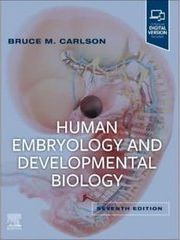
Human Embryology and Developmental Biology
For students who want detailed explanations of how developmental processes work at cellular and molecular levels. Its depth helps resolve questions left by shorter books, though it covers more than many introductory medical courses require.
What it's about
Carlson connects human embryonic development with the cellular and molecular processes that shape the body. Illustrations and clinical examples follow early development and organ formation, showing how changes in those mechanisms can produce congenital anomalies.

Larsen's Human Embryology
For students who want to connect anatomical changes with cellular and molecular mechanisms. Its integrated approach gives development explanatory depth, though the detail and terminology make it slower to work through than a concise essentials text.
What it's about
Gary Schoenwolf and his coauthors explain human embryonic development by integrating anatomy and histology with cellular and molecular mechanisms. Illustrations, clinical scenarios, and research discussions connect normal development with congenital anomalies and approaches to understanding their causes.

For students who want the essentials in an illustrated, clinically focused format. Its shorter treatment helps connect development with congenital conditions, though readers seeking detailed mechanisms will need a more comprehensive text alongside it.
What it's about
Keith Moore, T. V. N. Persaud, and Mark Torchia's tenth edition introduces normal and abnormal human development. Illustrations, clinical cases, and review questions connect embryology with birth defects, genetics, and the cellular processes that shape prenatal development.

BRS Embryology
For students who have studied the subject and want organized recall with practice questions. Its outline structure makes revision efficient, though the compressed explanations are less helpful when you are learning a developmental process for the first time.
What it's about
Ronald Dudek reviews human embryological development and its clinical implications in a concise outline format. Images of development and congenital malformations accompany chapter tests, explanations, and a comprehensive examination designed to support medical coursework and board preparation.

Textbook of Clinical Embryology
For readers training in reproductive science and assisted-reproduction laboratory work. Its coverage of culture methods, research and laboratory management fills a specialist need, though it is much less suitable as a first medical-school embryology text.
What it's about
Edited by Kevin Coward and Dagan Wells, this textbook connects reproductive science with assisted reproduction laboratory practice. Topics range from endocrinology and molecular biology to embryo culture, micromanipulation, research methods, laboratory management, and quality assurance.
Sources
- 1
Suggested Reading List
eshre.eu
- 2
MRC Year 1 Recommended Resources: Embryology
libguides.siumed.edu
- 3
Embryology Books
goodreads.com
- 4
Best Embryology Books and Resources
studybuddymd.com
- 5
Can anyone suggest a good book for first year Embryology?
reddit.com
- 6
Books for 1st year MBBS
reddit.com
- 7
Best Embryology Books and Resources
good-books.co.uk
- 8
88 Best Embryology Books of All Time
shortform.com










Edited by
Software engineer whose passion for tracking book recommendations from podcasts inspired the creation of MRB.
Lead investor at 3one4 Capital whose startup expertise and love for books helped shape MRB and its growth.
Comments
Spotted a missing book, a wrong order or a mistake? Tell us and we'll fix this page.
We're a reading guide, not the author or publisher, so we can't send books or pass on messages.