
12 Best PostgreSQL Books
The best PostgreSQL books, ranked by how many expert sources recommend each one, with notes on who each suits, from beginners to developers and administrators.
Our take
PostgreSQL books serve different readers. Someone learning to ask questions of data needs a different introduction from a developer building an application or an administrator responsible for backups and availability. The server version matters as well. Many underlying concepts endure, but commands, configuration choices, and supported features change, so a book’s edition is part of its usefulness.
Practical SQL introduces querying through real datasets. Learn PostgreSQL broadens the view to database design and practical use, while PostgreSQL 16 Administration Cookbook organizes operational tasks as recipes. For a deeper follow-up, Mastering PostgreSQL 17 connects advanced features with performance and reliability. The older specialist titles remain useful for understanding their versions and comparing approaches, rather than assuming their examples fit a newer installation unchanged. Start with your role and experience, then match the book’s technical context to the system you are studying.
12 books · 7 sources · Last updated
As an Amazon Associate, we earn from qualifying purchases (at no extra cost to you).
How to choose from this list
Skip to the full rankingIf you're learning SQL through data: Practical SQL → Learn PostgreSQL
If you're building PostgreSQL applications: Learn PostgreSQL → Mastering PostgreSQL 17
If you administer databases: PostgreSQL 16 Administration Cookbook → Mastering PostgreSQL 17
If you want to study server-side code: PostgreSQL Server Programming
The 12 books, ranked
Ranked by how many expert sources name each book. Ties go to the book more people recommend.
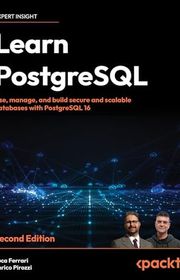
Learn PostgreSQL: Use, Manage, and Build Secure and Scalable Databases with PostgreSQL 16
For developers who know basic SQL and want a broad introduction to working with PostgreSQL. Ferrari and Pirozzi connect database design with practical features, though this second edition targets version 16 and is not an exhaustive operations reference.
What it's about
Luca Ferrari and Enrico Pirozzi introduce PostgreSQL through database design, SQL, data types, and practical administration. This second edition uses PostgreSQL 16 to connect application development with security, maintenance, and building databases that can grow.

For developers who want a compact overview connecting SQL with administration and extensions. Regina Obe and Leo Hsu cover substantial ground efficiently, though this PostgreSQL 10-era edition needs comparison with current documentation before applying operational details.
What it's about
Regina Obe and Leo Hsu introduce PostgreSQL administration and application development through practical examples. Coverage includes roles, backups, tables, indexes, SQL, database functions, query tuning, foreign data wrappers, and replication, focusing on features through PostgreSQL 10.

PostgreSQL Administration Essentials
For readers who want a compact introduction to the responsibilities of a database administrator. Schönig keeps recurring tasks in view, though the older examples and compressed treatment make a newer reference necessary for present-day operational work.
What it's about
Hans-Jürgen Schönig introduces essential PostgreSQL administration tasks, from installation and permissions to performance tuning. Chapters cover logs, backups, recovery, replication, and monitoring, with guidance on finding slow queries, missing indexes, and other database bottlenecks.

PostgreSQL for Data Architects
For developers interested in the connection between database structure and operational behavior. Maymala brings configuration, reliability, and query concerns together, though the broad treatment and older technical context limit its value as a current implementation guide.
What it's about
Jayadevan Maymala explains PostgreSQL architecture and practical database maintenance for developers and data architects. Topics include installation, configuration, logging, replication, backups, recovery, extensions, connection troubleshooting, and improving query performance through indexes and revised SQL.

PostgreSQL Replication
For administrators studying replication concepts and the tradeoffs behind distributing data. Schönig gives the subject a dedicated treatment, though this older edition predates important changes and should be used with version-matched documentation.
What it's about
Hans-Jürgen Schönig explains replication concepts and their practical use in PostgreSQL. The book examines synchronous and asynchronous approaches, sharding, data distribution, and theoretical limitations, helping administrators compare strategies for database availability, scalability, and resilience.

PostgreSQL Server Programming
For developers deciding what logic belongs inside PostgreSQL. The examples give functions, triggers, and server-side languages more room than general introductions, though PostgreSQL 9.4-era coverage requires checking later syntax, security guidance, and capabilities.
What it's about
Usama Dar and his coauthors explain how to extend PostgreSQL through server-side programming. Examples develop user-defined functions, triggers, debugging techniques, and database-layer integration, with coverage of PL/pgSQL, other programming languages, scaling, and PostgreSQL 9.4 features.

Troubleshooting PostgreSQL
For experienced administrators who prefer problem-oriented explanations to a broad introduction. Schönig connects symptoms with possible database causes, though the older version context means diagnoses and suggested remedies need validation against the actual server.
What it's about
Hans-Jürgen Schönig addresses common PostgreSQL problems for experienced database administrators. Practical coverage includes missing indexes, slow queries, locking, memory use, stored procedures, monitoring, filesystem issues, corruption, and replication, connecting diagnosis with performance and reliability improvements.
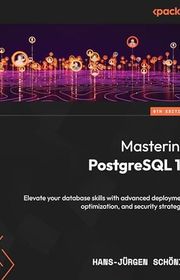
Mastering PostgreSQL 17: Elevate Your Database Skills with Advanced Deployment, Optimization, and Security Strategies
For experienced users who want to connect advanced PostgreSQL behavior with operational choices. Schönig gives transactions, tuning, and reliability substantial attention, though the assumed background and version 17 focus make this a follow-up rather than a first SQL book.
What it's about
Hans-Jürgen Schönig examines advanced PostgreSQL 17 development and administration. The guide connects transactions, indexing, query optimization, security, backup, and replication with practical choices for deploying and maintaining database applications under demanding workloads.

PostgreSQL 10 High Performance
Expert Techniques for Query Optimization, High Availability, and Efficient Database Maintenance
For administrators studying performance concepts through PostgreSQL 10 workloads. The coverage connects hardware, configuration, and query behavior, though version-specific settings and available features require translation before use on later servers.
What it's about
Enrico Pirozzi examines PostgreSQL 10 performance from hardware and operating-system settings to server configuration and queries. Monitoring, indexing, memory tuning, pooling, caching, partitioning, replication, and parallel queries illustrate ways to manage increasingly demanding database workloads.

PostgreSQL 16 Administration Cookbook: Solve Real-World Database Administration Challenges with 180+ Practical Recipes and Best Practices
For administrators who want task-oriented guidance for PostgreSQL 16. The recipes make targeted consultation easier than a continuous textbook, though readers still need to understand their environment and check differences on other server versions.
What it's about
This PostgreSQL 16 cookbook organizes administration around practical tasks. Recipes cover configuration, security, maintenance, monitoring, backup, recovery, and replication, giving database administrators examples to adapt while managing the reliability and performance of their systems.

For beginners who want to learn SQL by asking questions of real datasets. DeBarros makes analytical work concrete and purposeful, though the data-storytelling emphasis provides less coverage of production administration and server internals.
What it's about
Anthony DeBarros teaches SQL through real-world datasets and the search for stories within data. Using PostgreSQL, the guide progresses from queries and database design to statistics, cleaning, geographic analysis, and automation, emphasizing careful and accurate analytical work.

PostgreSQL
For readers maintaining older installations or studying a comprehensive historical treatment of PostgreSQL. Korry and Susan Douglas combine SQL and programming interfaces in depth, though PostgreSQL 8.0 coverage makes this unsuitable as a current setup manual.
What it's about
Korry and Susan Douglas provide a detailed guide to PostgreSQL and its SQL capabilities. Examples cover database objects, data types, transactions, server extensions, and client programming through several languages and interfaces, with coverage of PostgreSQL 8.0.
Sources
- 1
PostgreSQL: Books
postgresql.org
- 2
Best PostgreSQL Books for 2026: Admin, Tuning, Development
computingforgeeks.com
- 3
Postgresql Books
goodreads.com
- 4
Recommended resources to improve your knowledge of Databases and PostgreSQL
blog.anayrat.info
- 5
Best PostgreSQL Books For Teaching Yourself Database Management
whatpixel.com
- 6
29 Best PostgreSQL Books of All Time
shortform.com
- 7
Top 10 Books To Learn PostgreSQL Database
educba.com








Edited by
Software engineer whose passion for tracking book recommendations from podcasts inspired the creation of MRB.
Lead investor at 3one4 Capital whose startup expertise and love for books helped shape MRB and its growth.
Comments
Spotted a missing book, a wrong order or a mistake? Tell us and we'll fix this page.
We're a reading guide, not the author or publisher, so we can't send books or pass on messages.