
7 Best DSP Books
The best DSP books, ranked by how many expert sources recommend each one, with notes to help you choose intuitive introductions, coding practice, and theory.
Our take
Digital signal processing studies how sampled data can be analyzed, filtered, and transformed. The same foundations appear in audio, communications, measurement, and many other applications. A useful book should help you connect an operation such as convolution or a Fourier transform with the effect it has on a signal, rather than leaving the equations detached from the result.
The books here take different routes. The Scientist & Engineer's Guide to Digital Signal Processing emphasizes visual explanations, while Understanding Digital Signal Processing develops intuition alongside the mathematics. Think DSP starts from programming experiments in Python. The larger textbooks suit readers who want a more systematic theoretical foundation, and the microcontroller book focuses on implementation constraints. Signals, Systems and Inference brings probability into the picture. Start with the explanation style you can actively work through, then move to a rigorous text when you need deeper analysis.
7 books · 9 sources · Last updated
As an Amazon Associate, we earn from qualifying purchases (at no extra cost to you).
How to choose from this list
Skip to the full rankingIf you’re starting with little DSP background: The Scientist & Engineer's Guide to Digital Signal Processing → Understanding Digital Signal Processing
If you want to learn through Python: Think DSP
If you want a rigorous theoretical foundation: Understanding Digital Signal Processing → Discrete-Time Signal Processing
If you want probability and estimation: Signals, Systems and Inference
If you want a historical microcontroller implementation guide: Digital Signal Processing and the Microcontroller
The 7 books, ranked
Ranked by how many expert sources name each book. Ties go to the book more people recommend.

The Scientist & Engineer's Guide to Digital Signal Processing
For scientists and programmers who want a visual introduction with modest mathematical prerequisites. It makes the purpose of DSP techniques easier to grasp, but readers seeking proofs and a rigorous theoretical reference will need another text.
What it's about
Steven Smith introduces digital signal processing through visual explanations and practical examples with limited mathematical prerequisites. Coverage moves from convolution and Fourier analysis to digital filters, connecting these techniques with applications such as audio, images, compression, and neural networks.

Understanding Digital Signal Processing
For engineers and self-learners who want intuition alongside the equations. Lyons develops the meaning of DSP operations more patiently than a formal reference, but working through the mathematics still matters if you want to implement them confidently.
What it's about
Richard Lyons explains digital signal processing through intuitive examples and carefully developed mathematical ideas. The book introduces sampled signals, Fourier analysis, and digital filtering, helping readers connect the behavior of signal processing algorithms with the calculations used to implement them.
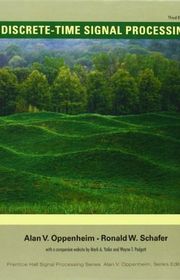
Discrete-Time Signal Processing
For students and engineers who already understand basic signals and systems. Its theorem-driven treatment gives more mathematical depth than the introductory guides here, but the compact explanations and exercises demand a strong foundation.
What it's about
Alan Oppenheim and Ronald Schafer develop discrete-time signal processing through mathematical analysis of signals and systems. Sampling, transforms, digital filtering, and related methods provide a rigorous basis for understanding why algorithms behave as they do.

For students ready for a substantial mathematical treatment of DSP. Its systematic coverage connects theory and algorithms in one textbook, but it assumes more preparation and persistence than the intuition-first introductions here.
What it's about
John Proakis and Dimitris Manolakis develop the principles and mathematical methods of digital signal processing. The textbook connects discrete-time signals and systems with transforms, filtering, and computational algorithms, providing a foundation for analyzing and implementing signal processing applications.
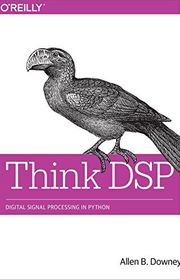
Think DSP
For programmers who want to explore DSP by running Python experiments. Its code-first approach makes results tangible early, but it assumes programming comfort and does not replace a full mathematical treatment.
What it's about
Allen Downey introduces signal processing through Python programs and notebooks. Readers examine sounds, spectra, filtering, and other operations by experimenting with working code, using programming skills to build intuition before tackling more abstract mathematical formulations.

Digital Signal Processing and the Microcontroller
For readers interested in how DSP algorithms meet small-processor constraints. Its implementation focus complements the theory books here, but the specific microcontroller and programming environment belong to an older hardware generation.
What it's about
Dale Grover and John Deller introduce digital signal processing through practical microcontroller implementations. Using accessible mathematics and examples built around a Motorola processor, they connect filters and Fourier techniques with the programming and hardware constraints involved in implementing working systems.

Signals, Systems and Inference
For readers who know basic signals and want to connect them with probability and inference. Its treatment broadens the subject beyond deterministic filtering, but random processes and estimation make it a more demanding starting point.
What it's about
Alan Oppenheim and George Verghese connect signals and systems with statistical inference. The text develops deterministic and random signal models, correlation, spectral analysis, filtering, estimation, and detection, showing how these tools support applications in communications, control, and related engineering fields.
Sources
- 1
What Resources Are Recommended for an Introduction to Signal Processing (DSP)?
dsp.stackexchange.com
- 2
Recommended DSP Books
reddit.com
- 3
Are there no good human friendly books on DSP?
reddit.com
- 4
Dsp Books
goodreads.com
- 5
DSP Books
dsprelated.com
- 6
Resources
dsp-workshop.nl
- 7
openlists/DSPResources: A list of open resources for learning and working with digital signal processing.
github.com
- 8
Learning Signal Processing
abera.tech
- 9
Comp.DSP FAQ: Part 1
bdti.com



Edited by
Software engineer whose passion for tracking book recommendations from podcasts inspired the creation of MRB.
Lead investor at 3one4 Capital whose startup expertise and love for books helped shape MRB and its growth.
Comments
Spotted a missing book, a wrong order or a mistake? Tell us and we'll fix this page.
We're a reading guide, not the author or publisher, so we can't send books or pass on messages.