
11 Best Cosmology Books
The best cosmology books, ranked by expert source recommendations, with notes to help you choose short introductions, cosmic histories, and deeper explanations.
Our take
Cosmology asks how the universe began, how it developed, and what its future might hold. Popular books approach those questions in different ways: some follow the discoveries that built the modern picture, some explain the evidence, and others explore the implications for space, time, life, or meaning. You do not need a physics degree to begin, but a short book can still contain ideas that take time to absorb.
Space at the Speed of Light offers a quick orientation. Big Bang follows the historical development of cosmology, while The Little Book of Cosmology concentrates on what observations can tell us. The First Three Minutes and A Brief History of Time are influential starting points whose publication context matters. For deeper conceptual questions, try The Fabric of the Cosmos. A Fortunate Universe examines fine-tuning, and Until the End of Time ranges beyond physics into meaning. Start with the short overview or the history, then choose the question you most want to follow.
11 books · 9 sources · Last updated
As an Amazon Associate, we earn from qualifying purchases (at no extra cost to you).
How to choose from this list
Skip to the full rankingIf you want a short first overview: Space at the Speed of Light
If you want the history of the evidence: Big Bang → The Little Book of Cosmology
If you want influential popular classics: The First Three Minutes → A Brief History of Time
If you want space and time explained more deeply: The Fabric of the Cosmos
If you want to examine scientific challenges: The Cosmic Revolutionary's Handbook
If you want physics and questions of meaning: A Fortunate Universe → Until the End of Time
The 11 books, ranked
Ranked by how many expert sources name each book. Ties go to the book more people recommend.

For readers who want a classic explanation of how the early-universe picture was assembled. Weinberg connects physical reasoning with observations, though later discoveries mean this should be read as a foundation rather than a complete current survey.
What it's about
Steven Weinberg explains the scientific model of the universe's earliest moments and the evidence supporting it. His account connects cosmic expansion, background radiation, and the formation of matter with the discoveries that shaped modern cosmology.
Also recommended by
1 person David Deutsch recommended this book
David Deutsch
David Deutsch recommended this book in his book "The Fabric of Reality."
David Deutsch's recommendation of this book
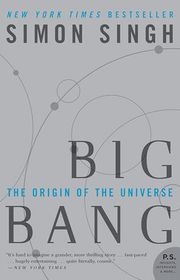
Big Bang: The Origin of the Universe
For readers who learn science best through the people, debates, and observations behind it. The historical narrative shows why cosmological ideas changed, though it emphasizes the development of the Big Bang picture rather than the newest research.
What it's about
Simon Singh traces the development of ideas about the universe, following the arguments and discoveries that led to Big Bang cosmology. The narrative connects scientists, observations, and rival explanations to show how a once-controversial account gained support.
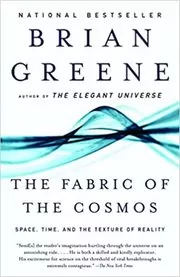
For readers curious about the physical meaning of space and time. Greene uses analogies to connect relativity with quantum questions, though the conceptual demands are substantial and some research discussions reflect the period when it was written.
What it's about
The Fabric of the Cosmos asks what space and time really are, moving from Newton's absolute stage to Einstein's spacetime and the strange behavior revealed by quantum theory. Greene uses everyday stories to unpack time's arrow, entanglement, and the foundations of reality.

A Brief History of Time
For readers who want an influential popular account of cosmic origins, black holes, and time. Its ambitious questions make a lasting introduction, though the concepts are harder than the short length suggests and later research needs separate reading.
What it's about
Stephen Hawking introduces questions about the universe's beginning, its possible fate, and the nature of time. He explains black holes, relativity, and quantum ideas for general readers, connecting familiar physical concepts with the puzzles of cosmology.
Also recommended by
2 people Richard Branson recommended this book
Richard Branson
Richard Branson recommended this book on his "70 must-read books" blog post.
Richard Branson's recommendation of this book  James Clear recommended this book
James Clear
"[One of] the 10 best nonfiction books of all-time." - James Clear
James Clear's recommendation of this book

For readers interested in why physical conditions allow life and what might follow from that. The dialogue across scientific and philosophical possibilities gives it a distinct focus, though fine-tuning arguments need to be distinguished from established observational results.
What it's about
Geraint F. Lewis and Luke A. Barnes examine why the universe's physical properties permit life, considering how different conditions might change that possibility. Their discussion connects particles, stars, and cosmic history with competing scientific, philosophical, and religious interpretations.

For readers who prefer a connected journey from cosmic origins to possible endings. The historical discoveries give the explanation narrative momentum, though future scenarios and passages anticipating new observations need to be read in their publication context.
What it's about
Paul Parsons follows the universe from the Big Bang to possible future endings, tracing discoveries that shaped modern cosmology. The narrative connects expanding space, fundamental physics, and cosmic history with questions about rebirth and other universes.

The Little Book of Cosmology
For readers who want a compact account grounded in observations of the cosmic microwave background. Its focus on measurement makes the evidence central, though the compressed explanations reward rereading more than a quick uninterrupted pass.
What it's about
Lyman Page explains how scientists measure the universe through observations of the cosmic microwave background. His compact introduction connects those measurements with cosmic age, geometry, and structure, while discussing unresolved questions about dark energy and the early universe.
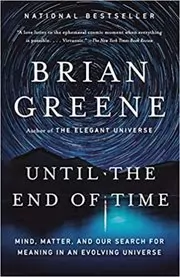
Until the End of Time
Mind, Matter, and Our Search for Meaning in an Evolving Universe
For readers who want cosmology connected with life, consciousness, and questions of meaning. The wide scope offers a different experience from an evidence-focused primer, though the philosophical and biological detours may frustrate readers seeking only cosmic history.
What it's about
Until the End of Time traces the story of the cosmos from the big bang through the formation of matter, stars, life, and consciousness, then looks ahead to distant futures. Greene weaves physics, biology, and culture into a reflection on how humans seek meaning.

For beginners who want an accessible tour from small-scale physics to the cosmic web. The breadth helps connect familiar questions with a larger picture, though the conversational overview provides less technical detail than a textbook.
What it's about
Paul M. Sutter places human existence within a broad tour of astrophysics, from particles and forces to galaxies and the cosmic web. Accessible explanations connect the universe's history with dark matter, dark energy, and its possible future.

Space at the Speed of Light
The History of 14 Billion Years for People Short on Time
For readers who want a brief first orientation rather than a long popular-science narrative. The short lessons make large questions manageable, though their compact format cannot develop the evidence or mathematical reasoning behind each topic in depth.
What it's about
Becky Smethurst introduces the universe through ten short illustrated lessons, explaining questions about gravity, black holes, dark matter, and the Big Bang. Her overview distinguishes evidence astronomers have gathered from mysteries that remain open to investigation.

For readers who want to understand what makes an alternative cosmological theory scientifically persuasive. Its emphasis on evidence and models clarifies how challenges work, though the playful premise is not a shortcut around learning the underlying physics.
What it's about
Luke A. Barnes and Geraint F. Lewis explain what it would take to challenge Big Bang cosmology successfully. Their guide examines scientific evidence, mathematical models, and research practices, showing how alternative ideas must engage with established observations.
Sources
- 1
The best books on Cosmology
fivebooks.com
- 2
Cosmology Bibliography
astro.ucla.edu
- 3
Readings | The Early Universe
ocw.mit.edu
- 4
Cosmology
goodreads.com
- 5
100 Best Cosmology Books of All Time
shortform.com
- 6
Book Recommendations on Modern Cosmology
reddit.com
- 7
Five Books on Relativity and Cosmology
preposterousuniverse.com
- 8
Cosmic reads: four great books that explore the Universe we live in
astronomynow.com
- 9
Books
page.scholar.princeton.edu










Edited by
Software engineer whose passion for tracking book recommendations from podcasts inspired the creation of MRB.
Lead investor at 3one4 Capital whose startup expertise and love for books helped shape MRB and its growth.
Comments
Spotted a missing book, a wrong order or a mistake? Tell us and we'll fix this page.
We're a reading guide, not the author or publisher, so we can't send books or pass on messages.