
15 Best Business Finance Books
The best business finance books, ranked by how many expert sources recommend each one, with notes to help owners and managers choose where to start with the numbers.
Our take
Business finance books help readers understand where money comes from, where it goes, and what the numbers can reveal about a company. The most useful starting point depends on the question you face. An owner trying to manage operating cash needs something different from a manager interpreting reports or an investor assessing a business. Some books here also explore the personal money habits that shape an owner's working life.
For a first introduction, Accounting for the Numberphobic explains the main statements in plain language, while How Finance Works connects financial concepts with broader business decisions. Profit First proposes a specific cash-allocation routine. Financial Intelligence emphasizes the assumptions behind reported figures, and Simple Numbers, Straight Talk, Big Profits! concentrates on operating indicators for smaller firms. The investing titles bring another perspective but do not replace company accounting knowledge. Start with Accounting for the Numberphobic if the terminology feels unfamiliar, then choose a book matched to your responsibilities.
15 books · 9 sources · Last updated
As an Amazon Associate, we earn from qualifying purchases (at no extra cost to you).
How to choose from this list
Skip to the full rankingIf you're new to company financial statements: Accounting for the Numberphobic → How to Read a Financial Report
If you manage a department: Financial Intelligence → How Finance Works
If you own a growing small business: Financial Intelligence for Entrepreneurs → Simple Numbers, Straight Talk, Big Profits!
If you want a cash-allocation routine: Profit First
If you want finance within a wider business overview: The Personal MBA
If you want an investor's view of company value: The Intelligent Investor
The 15 books, ranked
Ranked by how many expert sources name each book. Ties go to the book more people recommend.

Profit First
Transform Your Business from a Cash-Eating Monster to a Money-Making Machine
For small-business owners who want a concrete routine for allocating cash. Separate accounts make spending constraints more visible than a general financial overview, though the method still requires adapting allocations to the business's obligations and circumstances.
What it's about
Mike Michalowicz presents a cash management system that assigns money to profit before operating expenses. He explains using separate accounts and allocation routines to shape spending habits, combining implementation steps with examples from small business finances.

Your Money or Your Life
9 Steps to Transforming Your Relationship with Money and Achieving Financial Independence
For owners who want to examine how work, spending, and personal values connect. Its exercises address the household side of financial independence more directly than corporate texts, though they do little to explain company financial statements.
What it's about
Vicki Robin and Joe Dominguez offer a program for rethinking the relationship between earning, spending, and personal values. Exercises help readers examine financial habits, reduce expenses, build savings, and consider what constitutes enough for a satisfying life.
Also recommended by
3 people Mr. Money Mustache recommended this book
Mr. Money Mustache
"If you just get whatever the latest edition of that book is, it really teaches you a philosophy that’s pretty similar to mine." - MMM
Mr. Money Mustache's recommendation of this book  Ali Abdaal recommended this book
Ali Abdaal
"completely changed my relationship with money." - Ali Abdaal
Ali Abdaal's recommendation of this book  Roberto Blake recommended this book
Roberto Blake
"[One of my] 5 favorite personal finance books." - Roberto Blake
Roberto Blake's recommendation of this book

For readers interested in owners' personal spending habits and accumulated wealth. Its research challenges conspicuous images of success, though it concerns household behavior more than company financial management and reflects an older American sample.
What it's about
Thomas Stanley and William Danko examine the habits of wealthy Americans, contrasting accumulated wealth with high incomes and conspicuous spending. Their research explores budgeting, frugality, occupations, and family decisions, challenging familiar images of how millionaires live.
Also recommended by
2 people- Mr. Money Mustache recommended this book
Mr. Money Mustache
"The main thing it will do is give you reassurance that I am not actually making this shit up. I’m following a very time-honored formula for making you rich." - MMM
Mr. Money Mustache's recommendation of this book  Bernie Sanders recommended this book
Bernie Sanders
"I love [this book]. It talks about how it is a myth that most millionaires in America have inherited their money." - Bernie Sanders
Bernie Sanders's recommendation of this book

For beginners who want finance placed within the wider work of running a business. Its breadth connects money with sales, operations, and value creation, though each financial topic receives less depth than a dedicated guide.
What it's about
Josh Kaufman presents the core ideas behind running a business without attending business school. He explains value creation, marketing, sales, finance, and operations through practical concepts and mental models intended to clarify everyday business decisions.
Also recommended by
1 person Patrick O'Shaughnessy recommended this book
Patrick O'Shaughnessy
"If you dislike (most) business books like I do, but want to learn about the business of business, this book is a great tool." - Patrick O'Shaughnessy
Patrick O'Shaughnessy's recommendation of this book

For managers who need to question what financial reports mean. Its explanation of estimates and assumptions goes beyond recognizing statement headings, though learning the vocabulary still requires practice with real reports and business decisions.
What it's about
Karen Berman and Joe Knight, with John Case, explain finance for managers who need to use financial information. They connect statements, ratios, working capital, and investment returns with the assumptions behind accounting numbers, encouraging readers to question what reports actually reveal.

The Intelligent Investor
For readers approaching companies from a shareholder's perspective. The emphasis on value and disciplined judgment gives investment decisions a durable framework, though it is a dense investing book rather than a guide to operating cash flow.
What it's about
Benjamin Graham outlines a value-investing philosophy that distinguishes investing from speculation and emphasizes disciplined decision-making. He examines how investors can assess value, respond to market fluctuations, and use a margin of safety when considering purchases.
Also recommended by
7 people Warren Buffett recommended this book
Warren Buffett
"I obviously recommend, first and foremost, [this book]. Considered to be the 'Bible of Value Investing.'" - Warren Buffett
Warren Buffett's recommendation of this book  DJ Vlad recommended this book
DJ Vlad
"The single biggest influence on how I buy and sell stocks." - DJ Vlad
DJ Vlad's recommendation of this book  Kevin Rose recommended this book
Kevin Rose
"The foundation for investing." - Kevin Rose
Kevin Rose's recommendation of this book  Peter Mallouk recommended this book
Peter Mallouk
"A phenomenal book." - Peter Mallouk
Peter Mallouk's recommendation of this book  Bill Ackman recommended this book
Bill Ackman
"I found it fascinating." - Bill Ackman
Bill Ackman's recommendation of this book  Jamie Dimon recommended this book
Jamie Dimon
On Jamie Dimon's list of favorite books.
Jamie Dimon's recommendation of this book +1
More recommendations
- Ryan Petersen
"[Part of] my biz book canon." - Ryan Petersen
- Ryan Petersen
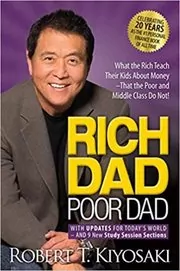
Rich Dad Poor Dad
What the Rich Teach Their Kids About Money That the Poor and Middle Class Do Not!
For readers seeking an accessible introduction to ownership and cash-flow thinking. The contrasting stories make basic ideas memorable, though the simplified categories and motivational approach offer less dependable operating detail than the accounting guides.
What it's about
Rich Dad, Poor Dad contrasts the money lessons Kiyosaki says he learned from his poor biological father and his rich mentor. Through simple stories he explains assets versus liabilities, cash flow, and why working only for a paycheck rarely leads to lasting wealth.
Also recommended by
3 people Will Smith recommended this book
Will Smith
Will Smith mentioned sharing this book with his son.
Will Smith's recommendation of this book  Anthony Pompliano recommended this book
Anthony Pompliano
"My favorite book of all time." - Anthony Pompliano
Anthony Pompliano's recommendation of this book  Patrick Bet-David recommended this book
Patrick Bet-David
Patrick Bet-David recommended this book on his website.
Patrick Bet-David's recommendation of this book

The Alchemy of Finance
For experienced readers interested in how market beliefs and prices interact. The reflexivity argument offers a distinctive alternative to simple valuation models, though the abstract discussion and historical trading experiment make it a demanding specialist choice.
What it's about
George Soros presents his theory of reflexivity, examining how investors' perceptions can influence the conditions they attempt to understand. He combines analysis of financial markets with a documented trading experiment to explore feedback, uncertainty, and investment decisions.
Also recommended by
2 people Garry Tan recommended this book
Garry Tan
"Be aware of reflexivity." - Garry Tan
Garry Tan's recommendation of this book  Paul Tudor Jones recommended this book
Paul Tudor Jones
"A timeless instructional guide of the marketplace." - Paul Tudor Jones
Paul Tudor Jones's recommendation of this book
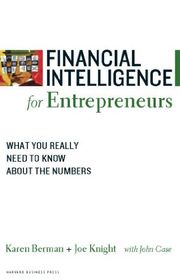
Financial Intelligence for Entrepreneurs
For entrepreneurs who want to interpret the numbers behind everyday business choices. It adapts financial literacy to ownership more directly than the manager edition, though the overlap makes reading both unnecessary for many beginners.
What it's about
Karen Berman and Joe Knight, with John Case, explain financial statements, ratios, cash flow, and investment returns for business owners. Examples show how accounting judgments affect reported results and how entrepreneurs can ask better questions about their businesses.

For managers who want a conceptual introduction to corporate finance. Cases and visual explanations connect the numbers with business choices more directly than personal-finance books, though deeper technical analysis requires further study and practice.
What it's about
Mihir Desai introduces corporate finance through case studies, visual explanations, and interactive exercises. Topics include company funding, cash flow, valuation, and capital markets, showing how financial choices affect performance and how managers can reason about the numbers behind business decisions.

For readers who want to understand how the main financial statements fit together. Its connected-report approach is more systematic than a collection of money tips, though the detail takes time to absorb without working through examples.
What it's about
John and Tage Tracy explain how income statements, balance sheets, and cash flow reports connect. Their guide examines revenue, expenses, capital, profits, and financial ratios, helping readers interpret a company's condition and recognize common misunderstandings about reported numbers.
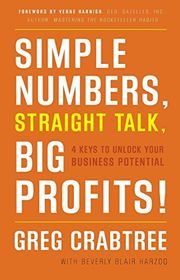
Simple Numbers, Straight Talk, Big Profits!
For owners of growing small businesses who want a compact set of operating metrics. The focus on labor, profitability, and cash gives decisions a concrete structure, though its benchmark-driven approach needs adapting to different business models.
What it's about
Greg Crabtree, with Beverly Blair Harzog, explains how small-business owners can use a focused set of financial indicators. The book connects owner compensation, labor productivity, profit, taxes, and cash with the challenges of running and growing a company.

For small-business owners intimidated by accounting language. The focus on a few connected financial reports makes the subject easier to approach than a corporate-finance text, though readers still need to apply the concepts to accurate records.
What it's about
Fotopulos explains the income statement, cash flow statement, and balance sheet in plain language for small-business owners. The guide connects these reports with practical decisions about profits, break-even points, cash flow, and the overall financial condition of a business.

Found Money
Simple Strategies for Uncovering the Hidden Profit and Cash Flow in Your Business
For owners who want to investigate where their business generates or consumes cash. The link between operating decisions and financial outcomes is more specific than general wealth advice, though the analysis depends on reliable business data.
What it's about
Steve Wilkinghoff examines how small-business activities translate into profit, investment returns, and cash flow. Examples and tools connect operating decisions with financial results, helping owners investigate where money is being generated or lost and identify possible improvements within their businesses.

Visual Finance
The One Page Visual Model to Understand Financial Statements and Make Better Business Decisions
For managers who learn more readily from diagrams than conventional accounting instruction. The single-page model makes relationships easier to discuss across departments, though its simplification cannot replace detailed records or a full understanding of reporting assumptions.
What it's about
Georgi Tsvetanov introduces a one-page visual model for understanding financial statements and business decisions. Written for managers outside finance, the book presents an alternative to conventional accounting instruction, aiming to make financial information easier to discuss and apply at work.
Sources
- 1
Best Books on Small Business Finance
danielsonservices.com
- 2
12 Best Business Finance Books to Read
teambuilding.com
- 3
Best Business Finance Books - Top 14 Books [Updated 2026]
wallstreetmojo.com
- 4
The Top 5 Reads For Mastering The Essentials of Business Finance
fivebooks.com
- 5
Business Finance Books
goodreads.com
- 6
Best Business/Finance Books To Read?
reddit.com
- 7
The Personal MBA Recommended Reading List - 99 Best Business Books
personalmba.com
- 8
6 Best Small Business Finance Books [expert recommendations]
cdcloans.com
- 9
What books do you recommend for someone to sharpen their FP&A sword?
reddit.com


Edited by
Software engineer whose passion for tracking book recommendations from podcasts inspired the creation of MRB.
Lead investor at 3one4 Capital whose startup expertise and love for books helped shape MRB and its growth.
Comments
Spotted a missing book, a wrong order or a mistake? Tell us and we'll fix this page.
We're a reading guide, not the author or publisher, so we can't send books or pass on messages.