
8 Best Ansible Books
The best Ansible books, ranked by how many expert sources recommend each one, with notes to help you choose playbook basics, practical automation, and deeper study.
Our take
Ansible books help turn repeated administration tasks into automation that can be understood and reused. Some introduce inventories, modules, and playbooks from the beginning. Others focus on cloud platforms, extension development, or the choices involved in organizing automation across a team. The right level depends on your command-line experience and whether you already have a working playbook.
Ansible for DevOps and Ansible: Up and Running provide broad starting points. Ansible Playbook Essentials offers a more concentrated study of the building blocks, while Ansible for Real-Life Automation connects those skills with work across several platforms. Mastering Ansible and Extending Ansible suit more experienced readers with specific questions. Several editions here describe earlier Ansible versions, and cloud modules and extension interfaces change, so check examples against the release you use. Begin with a general course and a small practice task, then choose a specialist book when you know which part of the workflow you need to understand better.
8 books · 8 sources · Last updated
As an Amazon Associate, we earn from qualifying purchases (at no extra cost to you).
How to choose from this list
Skip to the full rankingIf you're starting with infrastructure automation: Ansible for DevOps → Ansible Playbook Essentials
If you want broader operational use cases: Ansible for Real-Life Automation
If you're maintaining Ansible 2.7 systems: Mastering Ansible
If you want provider-specific cloud recipes: Ansible 2 Cloud Automation Cookbook
If you need custom modules and plugins: Extending Ansible
The 8 books, ranked
Ranked by how many expert sources name each book. Ties go to the book more people recommend.

For administrators who want a structured course with explanations alongside practical examples. The coverage connects playbook construction with remote management and deployment, though the range of topics makes it a longer study than a focused playbook primer.
What it's about
Lorin Hochstein and René Moser teach Ansible through a sequence of infrastructure automation tutorials. Readers learn to write YAML playbooks, manage remote servers, and use declarative modules, with examples covering web application deployment, cloud platforms, and Docker containers.

For readers comfortable with a shell who want practical infrastructure automation examples. Geerling connects language features with deployment tasks, though the lab setup and accompanying tools can add work for readers who want to focus only on Ansible.
What it's about
Jeff Geerling introduces Ansible to readers familiar with the command line and basic shell scripting. Practical examples progress from installation and inventory files to playbooks, application deployment, server provisioning, and Docker orchestration, demonstrating automation across different infrastructure environments.
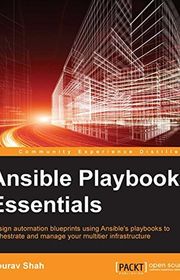
Ansible Playbook Essentials
For beginners who want a focused explanation of how playbooks are organized and reused. The narrow scope helps make tasks, handlers, and variables concrete, though the early Ansible examples need updating before they fit a newer environment.
What it's about
Gourav Shah explains how to design Ansible playbooks for managing infrastructure. Lessons develop tasks, handlers, variables, templates, and reusable roles, connecting the building blocks of automation with examples of deploying and managing applications across multiple systems.

For readers who want to learn automation through an evolving application environment. The progression from playbooks to reusable roles gives the examples continuity, though the older cloud integrations and testing tools need checking before use with a newer installation.
What it's about
Michael Heap teaches Ansible by building automated application environments, starting with playbooks and progressing to reusable roles and custom modules. Examples include virtual machine clusters and AWS orchestration, followed by infrastructure testing with Test Kitchen and ServerSpec.

Ansible for Real-Life Automation: A complete Ansible handbook filled with practical IT automation use cases
For readers who know basic syntax and want to identify useful automation work across an organization. The varied platforms connect playbooks with operational use cases, though the broad coverage gives each integration less depth than a dedicated specialist guide.
What it's about
Gineesh Madapparambath develops Ansible automation through practical infrastructure and application scenarios. Examples span Linux, Windows, network devices, cloud platforms, and containers, with discussion of workflow integration and the role of Red Hat Ansible Automation Platform.

Ansible 2 Cloud Automation Cookbook
Write Ansible playbooks for AWS, Google Cloud, Microsoft Azure, and OpenStack
For readers who want provider-specific recipes across several cloud platforms. The task-based format supports focused experimentation, though Ansible 2 modules and cloud APIs have changed, so the examples require verification and adaptation rather than direct reuse.
What it's about
Aditya Patawari and Vikas Aggarwal present recipes for automating cloud infrastructure with Ansible 2. Chapters introduce provider-specific prerequisites and modules for AWS, Google Cloud, Azure, and OpenStack, covering resource configuration, credential handling, and deployment of a sample application.

Extending Ansible
For readers already comfortable with Ansible and Python who need to customize the tool. The attention to modules, plugins, and testing goes beyond playbook usage, though extension interfaces have evolved and the implementation details need comparing with current documentation.
What it's about
Rishabh Das explains how developers and administrators can customize Ansible through modules and plugins. Aimed at readers familiar with Ansible and Python, the guide covers extension architecture, error handling, distribution, integration with existing installations, and unit testing.

Mastering Ansible
Effectively automate configuration management and deployment challenges with Ansible 2.7
For users maintaining Ansible 2.7 automation who want to understand architecture and advanced behavior. The deeper treatment supports troubleshooting beyond introductory playbooks, though its version-specific details need checking carefully against newer releases and collection-based workflows.
What it's about
James Freeman and Jesse Keating explore advanced automation with Ansible 2.7, explaining its architecture and capabilities through practical deployment problems. The book develops approaches to configuration management and orchestration, including protecting stored content with encryption and decrypting it during execution.
Sources
- 1
7 Best Ansible Books for 2026 (RHCE Prep Included) | ComputingForGeeks
computingforgeeks.com
- 2
7 Best Docker and Container Books for 2026 | ComputingForGeeks
computingforgeeks.com
- 3
Best Ansible Books [2026] - Beginner to Advanced | JobRoadmaps
jobroadmaps.com
- 4
Best Ansible Books For Beginners
whatpixel.com
- 5
Best Ansible Books 2026 - ReactDOM
reactdom.com
- 6
Top 10 Ansible Books For Beginners and Advanced in 2023
educba.com
- 7
Ansible Books
goodreads.com
- 8
Which Ansible Book do you recommend ? : r/ansible
reddit.com


Edited by
Software engineer whose passion for tracking book recommendations from podcasts inspired the creation of MRB.
Lead investor at 3one4 Capital whose startup expertise and love for books helped shape MRB and its growth.
Comments
Spotted a missing book, a wrong order or a mistake? Tell us and we'll fix this page.
We're a reading guide, not the author or publisher, so we can't send books or pass on messages.