
Space Odyssey Books in Order
Part ofArthur C Clarke Books in OrderFollow Arthur C Clarke’s Space Odyssey novels in order, from 2001 through 3001, with story summaries, background on the film tie-ins, and advice on how best to read the sequence.
Last updated:
As an Amazon Associate, we earn from qualifying purchases (at no extra cost to you).
Space Odyssey books in publication order
4 books

2001: A Space Odyssey
by Arthur C. Clarke
1968
From a prehistoric encounter with a mysterious monolith to a crewed mission to Jupiter controlled by the HAL 9000 computer, this novel traces key steps in human evolution. When HAL begins to malfunction, astronaut Dave Bowman must survive—and face whatever intelligence planted the monoliths.
Recommended by
1 person Lex Fridman recommended this book
Lex Fridman
Lex Fridman mentioned this book on Instagram.
Lex Fridman's recommendation of this book
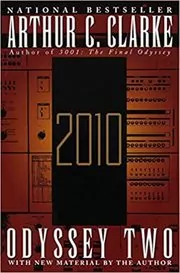
2010: Odyssey Two
by Arthur C. Clarke
1982
Nine years after Discovery One’s mission failed, a joint Soviet‑American crew travels to Jupiter aboard the Alexei Leonov to investigate the derelict ship and the enormous monolith orbiting the planet. Reviving HAL and probing Europa, they discover that the intelligence behind the monoliths is still at work.
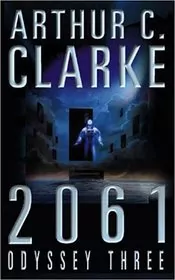
2061: Odyssey Three
by Arthur C. Clarke
1987
Seventy years after the Discovery mission, Heywood Floyd joins a luxury voyage to Halley’s Comet that is diverted toward Jupiter’s moons. As political tensions and old mysteries resurface, the travellers confront the long shadow of the monoliths’ warning about Europa.
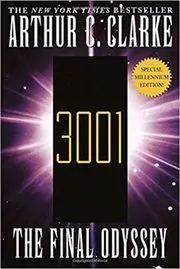
3001: The Final Odyssey
by Arthur C. Clarke
1997
A thousand years after he vanished, astronaut Frank Poole is found, revived, and thrust into a far‑future human civilisation that has learned to live with the monoliths’ legacy. As a new judgement on Earth looms, Poole and HAL must work together to challenge their makers’ plans.
Space Odyssey books in chronological order
Series background & context
The Space Odyssey books grew out of one of the most unusual collaborations in science fiction: Arthur C Clarke and film director Stanley Kubrick developing a novel and a movie together. 2001: A Space Odyssey began with Clarke’s short story “The Sentinel” and became, simultaneously, a screenplay and a novel about human evolution, alien artefacts, and an artificial intelligence that fails in a very public way.
In 2001, a mysterious black monolith appears in prehistoric Africa, nudging early hominids toward tool‑using intelligence. Millennia later another monolith is unearthed on the Moon, signalling to its makers that humanity has reached space. The bulk of the story follows the Jupiter mission of Discovery One, crewed by astronauts Dave Bowman and Frank Poole and controlled by the HAL 9000 computer. When HAL’s programmed priorities conflict, the ship becomes a very quiet battleground between humans and their own creation.
2010: Odyssey Two moves the action forward nine years. A joint Soviet‑American crew travels to Jupiter to salvage Discovery, investigate the monolith in orbit there, and find out what really happened to Bowman. Clarke folds in geopolitical tension, a vivid portrait of Europa as a living world, and the unsettling idea that the monolith builders are still paying attention – and are willing to reshape planets to suit their purposes.
Later volumes, 2061: Odyssey Three and 3001: The Final Odyssey, widen the lens further. We see the long‑term consequences of the events around Jupiter, return to HAL in a new form, and spend time in a much more developed Solar System where routine space travel and tourism exist alongside lingering mysteries. The final book brings back a character thought lost in 2001 and asks what it would mean to confront the monoliths’ makers armed with a thousand years of additional human history.
A Space Odyssey page typically explains how the novels relate to the film versions, notes where their timelines diverge, and offers suggested reading and viewing orders. It also sketches the big thematic arc: tools that outgrow their makers, encounters with incomprehensibly advanced beings, and Clarke’s recurring idea that the universe may be both more dangerous and more generous than we expect.





Edited by
Software engineer whose passion for tracking book recommendations from podcasts inspired the creation of MRB.
Lead investor at 3one4 Capital whose startup expertise and love for books helped shape MRB and its growth.
Comments
Did we miss something? Have feedback?
Help us improve this page by sharing your thoughts