
8 Best Poetry Writing Books
The best poetry writing books, ranked by expert source recommendations, with notes to help beginners and practicing poets choose craft guides, forms, and exercises.
Our take
Writing poetry involves listening to language as well as finding something to say. These books help with different parts of the work: understanding rhythm and form, discovering material, trying unfamiliar approaches, and revising a draft that has not yet found its shape. They suit curious beginners and poets who already write regularly but want a more deliberate practice.
A Poetry Handbook provides a compact introduction to craft. The Poet's Companion combines discussion with exercises, while The Practicing Poet asks readers to work more closely with model poems and specific techniques. For formal study, The Making of a Poem supplies examples of established forms, and Rules for the Dance concentrates on meter. Writing Poetry to Save Your Life and Bird by Bird give more attention to courage, persistence, and the obstacles that can prevent a draft from beginning.
Start with A Poetry Handbook, then use an exercise-based guide alongside regular reading and writing.
8 books · 8 sources · Last updated
As an Amazon Associate, we earn from qualifying purchases (at no extra cost to you).
How to choose from this list
Skip to the full rankingIf you're new to poetic craft: A Poetry Handbook → The Poet's Companion
If you already write and want focused practice: The Practicing Poet
If you want to study meter and forms: Rules for the Dance → The Making of a Poem → The Ode Less Travelled
If self-doubt keeps you from drafting: Bird by Bird → Writing Poetry to Save Your Life
The 8 books, ranked
Ranked by how many expert sources name each book. Ties go to the book more people recommend.

A Poetry Handbook
For beginners who want a concise explanation of how poems work at the level of sound and form. Oliver makes technical vocabulary approachable, but this is an introduction to craft rather than a large bank of prompts.
What it's about
Mary Oliver explains elements of poetic craft, including sound, rhythm, meter, rhyme, form, and diction. Using examples from other poets, she examines how choices in language help shape a poem's meaning and its effect on readers.

For writers who want technique and subject matter developed together through exercises. Its practical workshop approach gives you more to do than a brief handbook, but progress depends on drafting and revising beyond the chapter.
What it's about
Kim Addonizio and Dorianne Laux combine essays on poetic craft with writing exercises and suggestions for subject matter. Their guide connects technique with sources of inspiration, giving readers ways to explore language, develop material, and practice the work of writing poems.

For writers struggling with perfectionism, discouragement, or the habit of showing up. Its candid advice addresses the emotional work of writing, but much of the craft discussion concerns prose rather than poetry specifically.
What it's about
A modern classic on writing and life, filled with practical advice on how to tackle large tasks by breaking them down into small, manageable pieces. Lamott shares stories from her own creative struggles, offering encouragement to anyone who battles perfectionism or writer's block.
Also recommended by
10 people Tim Ferriss recommended this book
Tim Ferriss
"Fantastic book." - Tim Ferriss
Tim Ferriss's recommendation of this book  Daniel Pink recommended this book
Daniel Pink
"One of the greatest things ever." - Daniel Pink
Daniel Pink's recommendation of this book  Susan Cain recommended this book
Susan Cain
"I love [this book]. Such a good book." - Susan Cain
Susan Cain's recommendation of this book  Ryan Holiday recommended this book
Ryan Holiday
"Ostensibly about the art of writing, but really it too is about life and how to tackle the problems, temptations and opportunities life throws at us." - Ryan Holiday
Ryan Holiday's recommendation of this book  Matt Mullenweg recommended this book
Matt Mullenweg
"I love reading about writers and the process of writing." - Matt Mullenweg
Matt Mullenweg's recommendation of this book  Ramit Sethi recommended this book
Ramit Sethi
Ramit Sethi mentioned this book on "The Tim Ferriss Show" podcast.
Ramit Sethi's recommendation of this book +4
More recommendations
- Brian Koppelman
"Great." - Brian Koppelman
- Mark Bittman
"A really great writing book and it’s a good read." - Mark Bittman
- Mike Birbiglia
"I really like [this book]." - Mike Birbiglia
- Matt Haig
"My go-to gift or recommendation for anyone interested in writing, though it is as much a treatise on life as it is a creative-writing primer." - Matt Haig
- Brian Koppelman

For poets who know the basics and want a structured way to keep developing. Model poems and focused craft discussions turn reading into practice, but it works best with an existing willingness to analyze and revise.
What it's about
Edited by Diane Lockward, this poetry guide pairs brief craft essays with model poems, analysis, and writing prompts. Topics move from finding material and choosing words to sound, tone, revision, and manuscript preparation, encouraging poets to develop beyond introductory techniques.

Writing Poetry to Save Your Life
How To Find The Courage To Tell Your Stories
For writers held back by self-consciousness or uncertainty about using personal experience. Its encouragement helps make room for first drafts, but it offers less systematic instruction in form and meter than the technical guides.
What it's about
Maria Mazziotti Gillan encourages writers to trust their own stories and move past inhibitions about what poetry should be. Writing prompts emphasize instinct and personal experience, followed by revision that shapes a poem while preserving the energy of its first impulse.
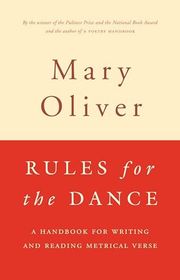
Rules for the Dance: A Handbook for Writing and Reading Metrical Verse
For readers who want to hear and understand the patterns behind metrical verse. Its focused treatment develops material introduced in A Poetry Handbook, but those interested chiefly in free verse may want a broader workshop first.
What it's about
Mary Oliver explains the rhythms and patterns of metrical poetry, covering the terminology used to describe stresses, feet, and lines. Examples and an accompanying anthology show how poets use formal structures to shape sound and meaning.

For readers who want to understand poetic forms through examples and close reading. Its anthology format connects rules with actual poems, but it is less exercise-driven than the workshop guides and takes sustained attention.
What it's about
Mark Strand and Eavan Boland introduce poetic forms through explanations, close readings, and an anthology of examples. Chapters explore forms such as sonnets, ballads, villanelles, and sestinas, tracing their histories and showing how poets use their constraints and possibilities.

For readers who enjoy learning formal technique by trying it themselves. Fry's exercises make meter and rhyme active tasks rather than definitions to memorize, but the emphasis on traditional forms is narrower than contemporary poetry as a whole.
What it's about
A friendly handbook for would‑be poets, this guide walks readers through metre, rhyme and form with clear explanations, exercises and Fry’s opinionated humour, aiming to give anyone the tools and confidence to write structured verse of their own.
Sources
- 1
5 Best Books on Writing Poetry
hookedtobooks.com
- 2
9 Essential Writing Books for Any Poet
readpoetry.com
- 3
Want To Write Poetry? Start With These 9 Books
bustle.com
- 4
5 of the best books on writing poetry
bbcmaestro.com
- 5
What are some good books on poetry?
poetryschool.com
- 6
Best Books on Writing Poetry (121 books)
goodreads.com
- 7
[HELP] What are the best books to learn about poetry?
reddit.com
- 8
[OPINION] Favorite books on creative writing + what should I read next?
reddit.com


Edited by
Software engineer whose passion for tracking book recommendations from podcasts inspired the creation of MRB.
Lead investor at 3one4 Capital whose startup expertise and love for books helped shape MRB and its growth.
Comments
Spotted a missing book, a wrong order or a mistake? Tell us and we'll fix this page.
We're a reading guide, not the author or publisher, so we can't send books or pass on messages.