
9 Best Optics Books
The best optics books, ranked by how many expert sources recommend each one, with notes for undergraduates, optical engineers, researchers, and technicians.
Our take
Optics ranges from the paths of rays through lenses to interference, diffraction, and the ways light interacts with matter. A first course needs physical explanation and problems; optical design calls for more attention to systems and imperfections; advanced theory requires a stronger mathematical foundation. Practical fiber-network work is a separate goal again, so the broadest textbook is not automatically the most useful choice.
Eugene Hecht’s Optics and the Pedrottis’ Introduction to Optics provide broad undergraduate routes. Introduction to Modern Optics offers a more compact treatment, while Fundamentals of Optics develops a traditional foundation. Readers ready for deeper mathematical work can move toward Principles of Optics or study wave-based imaging in Introduction to Fourier Optics. Modern Optical Engineering, 4th Ed. shifts the emphasis toward designing and evaluating optical systems. The FOA guide instead supports practical fiber-optic work. Start with an undergraduate text matched to your course and mathematical preparation before choosing a specialist reference.
9 books · 7 sources · Last updated
As an Amazon Associate, we earn from qualifying purchases (at no extra cost to you).
How to choose from this list
Skip to the full rankingIf you want a broad introductory course: Introduction to Optics
If you want a compact physical-optics text: Introduction to Modern Optics
If you want advanced classical theory: Principles of Optics
If you want wave-based imaging methods: Introduction to Fourier Optics
If you want optical-system design: Modern Optical Engineering, 4th Ed.
If you want fiber-network certification study: FOA Reference Guide to Fiber Optics
The 9 books, ranked
Ranked by how many expert sources name each book. Ties go to the book more people recommend.

Optics
For undergraduates who want broad coverage of optical phenomena with physical explanation and illustrations. Hecht gives a substantial foundation across topics, though the breadth and extended prose can make it harder to find a short answer quickly.
What it's about
Eugene Hecht combines optical theory with instrumentation and practical applications. His textbook develops a classical foundation while introducing photons, phasors and Fourier methods, using worked examples and illustrations to connect mathematical ideas with physical phenomena.

Principles of Optics
For advanced students and researchers who need a mathematical reference for classical optics. Born and Wolf develop theory in depth, though the formal treatment assumes substantial preparation and makes this a poor first introduction to the subject.
What it's about
Max Born and Emil Wolf develop a mathematical treatment of classical optics and electromagnetic light propagation. Interference, diffraction and scattering connect with imaging and tomography, providing an advanced reference for students and researchers studying optical phenomena.

Introduction to Optics
For students who prefer optical principles tied to instruments and applications. Pedrotti and his coauthors provide a broad course text with worked examples, though the range still requires mathematical preparation and sustained problem solving.
What it's about
Frank Pedrotti and his coauthors introduce geometrical, wave and modern optics with an emphasis on applications. The textbook examines the nature and measurement of light, connecting optical principles with the behavior of instruments and systems.

Fundamentals of Optics
For students who want a traditional grounding in geometrical and wave optics. Its treatment of lenses and physical phenomena supports a conventional course, though the older presentation and examples offer less emphasis on newer applications.
What it's about
Francis Jenkins and Harvey White develop the foundations of optics through the properties of light and the behavior of optical systems. Their textbook examines lenses, spherical surfaces and imaging, alongside wave phenomena including interference and diffraction.
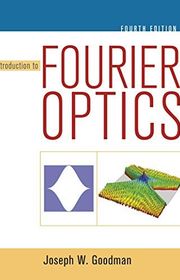
Introduction to Fourier Optics
For students ready to use mathematical tools to understand diffraction and imaging. Its focus provides a deeper framework for wave-based optical systems than a broad survey, though Fourier methods and linear-systems ideas require substantial preparation.
What it's about
Joseph W. Goodman develops optical imaging and diffraction through Fourier analysis and linear-systems methods. The treatment connects wave propagation, coherent and incoherent imaging, spatial filtering, and holography, giving students tools for analyzing optical information processing.

Introduction to Modern Optics
For students who want a compact treatment linking physical optics with quantum ideas. Fowles provides a manageable alternative to the largest textbooks, though the concise development assumes comfort with mathematics and leaves less space for extended explanation.
What it's about
Grant Fowles introduces classical physical optics and the quantum nature of light. Wave propagation, coherence, interference, diffraction and holography lead into optical spectra and lasers, providing a foundation for undergraduate physics and engineering study.
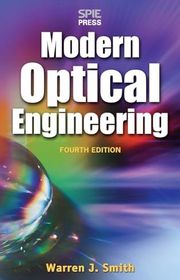
Modern Optical Engineering, 4th Ed.
For engineers who want to connect optical principles with actual system design and evaluation. Smith gives practical design concerns more room than a general physics text, though the reference-style detail is most useful after the fundamentals are familiar.
What it's about
Warren J. Smith explains the design and evaluation of optical systems through image formation, aberrations, ray tracing, and optical components. Practical discussions of fabrication, testing, and system performance connect the underlying principles with engineering decisions.

Optics
For undergraduate science and engineering students who want a wide survey from ray optics to lasers and fibers. Ghatak connects several models of light within one text, though the coverage demands more mathematical work than a qualitative introduction.
What it's about
Ajoy Ghatak introduces optics for undergraduate science and engineering students. Geometrical and wave optics connect with electromagnetic theory, quantum ideas, lasers and fiber optics, explaining light through complementary physical models and their applications.

For technicians and installers who want a practical introduction to fiber-optic networks and certification study. Its focus on components, testing, and installation distinguishes it from physics textbooks, though it is not a general course in optical theory.
What it's about
Jim Hayes introduces fiber-optic communications and the practical work of technicians, installers and designers. The guide covers transmission systems, fibers, cables, connectors, splicing, testing and network installation, supporting training for Fiber Optic Association certification.
Sources
- 1
The 8 Best Books on Optics
celsiuselements.com
- 2
Books on Optics
eckop.com
- 3
Syllabus | Optics
ocw.mit.edu
- 4
Recommended textbooks to learn about Optics
reddit.com
- 5
Which optics book would you recommend? Hetch vs Pedrotti vs Born and Wolf
reddit.com
- 6
Optics Books
goodreads.com
- 7
100 Best Optics Books of All Time
shortform.com








Edited by
Software engineer whose passion for tracking book recommendations from podcasts inspired the creation of MRB.
Lead investor at 3one4 Capital whose startup expertise and love for books helped shape MRB and its growth.
Comments
Spotted a missing book, a wrong order or a mistake? Tell us and we'll fix this page.
We're a reading guide, not the author or publisher, so we can't send books or pass on messages.