
10 Best Nonprofit Books
The best nonprofit books, ranked by how many expert sources recommend each one, with notes for founders, managers, board members, and people working for change.
Our take
Nonprofit work combines a mission with the practical demands of running an organization. Staff need clear responsibilities, boards need to understand their role, and supporters need a reason to participate. These books approach that work through management advice, communication, organizational research, personal experience, and arguments about how social change happens. They serve different needs, so a compelling memoir may not answer a question about supervising a team.
Managing to Change the World concentrates on everyday management, while Forces for Good looks beyond an organization’s own programs toward wider impact. The Networked Nonprofit emphasizes relationships and participation. Charity Case challenges conventional judgments about charities, and Emergent Strategy offers a more reflective approach to organizing and adaptation. The Blue Sweater provides a personal account of development work and patient investment. Start with the practical question facing your organization, then choose a broader book to examine the assumptions behind your approach.
10 books · 5 sources · Last updated
As an Amazon Associate, we earn from qualifying purchases (at no extra cost to you).
How to choose from this list
Skip to the full rankingIf you want a broad practical reference: Nonprofit Management 101
If you manage staff: Managing to Change the World → Joan Garry's Guide to Nonprofit Leadership
If you are joining a board: The Little Book of Boards
If you want wider organizational impact: Forces for Good → The Networked Nonprofit
If you want to question familiar assumptions: Charity Case → Emergent Strategy
The 10 books, ranked
Ranked by how many expert sources name each book. Ties go to the book more people recommend.

For leaders who want to think beyond improving their own organization’s services. Its six-practice framework connects mission with broader influence and networks, though findings drawn from selected high-impact organizations require adaptation to smaller groups.
What it's about
Leslie Crutchfield and Heather McLeod Grant identify six practices through their study of twelve influential nonprofits. This updated edition revisits those organizations and considers how smaller, locally focused groups can apply the findings to expand their impact beyond direct services.

For nonprofit managers who need practical help turning responsibilities into results. Its treatment of delegation, hiring, and accountability is more directly operational than the broader social-change books, though the results-focused approach needs fitting to organizational values.
What it's about
Alison Green and Jerry Hauser explain how nonprofit managers can translate an organization's mission into concrete results. Their guide covers goals, accountability, delegation, hiring, staff development, and performance problems, with an emphasis on building a clear and effective management culture.

For nonprofit communicators who want relationships and participation to shape their outreach. Its network-centered approach goes beyond posting promotional messages, though the platform examples are older and require updating for current online habits.
What it's about
Beth Kanter and Allison Fine explain how nonprofits can use social media to build relationships and work through broader networks. Their guide emphasizes transparency, participation, and collaboration, connecting online engagement with fundraising and organizational approaches to social change.

Charity Case
How the Nonprofit Community Can Stand Up For Itself and Really Change the World
For leaders and donors who want to question how charities are judged. Its challenge to conventional overhead thinking offers a provocative counterpoint to narrow efficiency measures, though it is an advocacy argument rather than an operational guide.
What it's about
Dan Pallotta argues that conventional judgments about charity overhead restrict nonprofits' ability to grow and tackle large problems. He proposes a Charity Defense Council using public education, advocacy, and legal defense to change how the nonprofit sector is understood and supported.
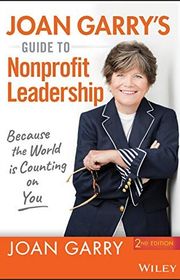
For executive directors and leaders balancing staff, boards, mission, and immediate problems. Its practical stories connect leadership dilemmas with concrete responses, though the broad coverage is less detailed than a reference devoted to one operational area.
What it's about
Joan Garry discusses the responsibilities and recurring challenges of nonprofit leadership. Stories and practical advice address boards, staff, fundraising, communication, and crises, with later editions expanding the guidance for smaller organizations and changing conditions.
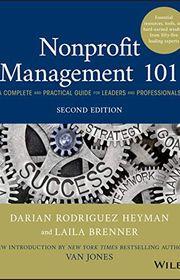
Nonprofit Management 101: A Complete and Practical Guide for Leaders and Professionals
For readers who want a broad desk reference covering the responsibilities of running a nonprofit. Its range of contributor expertise helps connect separate functions, though the handbook format gives less sustained depth than a specialist book.
What it's about
This edited handbook brings together nonprofit practitioners’ guidance on leading and operating an organization. Chapters address areas such as strategy, fundraising, communications, governance, and people management, offering frameworks and practical tools for nonprofit professionals.
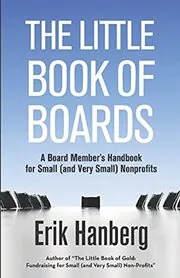
The Little Book of Boards
For new board members who want a plain explanation of their responsibilities. Its small-nonprofit focus makes meetings and the relationship with the executive director approachable, though it is an introduction rather than a comprehensive governance reference.
What it's about
A clear handbook for board members at small nonprofits who need practical help, not theory. Hanberg explains roles, meetings, governance, and the everyday working relationship between a board and an executive director.

The Blue Sweater
Bridging the Gap Between Rich and Poor in an Interconnected World
For readers who want to explore social change through a practitioner’s personal journey. Its stories make patient investment and listening concrete, though a memoir offers a particular perspective rather than a general nonprofit-management handbook.
What it's about
Jacqueline Novogratz recounts leaving banking to work against poverty and eventually establish Acumen. Her experiences in Africa, including encountering a sweater she once donated, lead her toward patient investment and a different understanding of development.
Also recommended by
1 person Seth Godin recommended this book
Seth Godin
"By a woman who has changed my life since the day I met her." - Seth Godin
Seth Godin's recommendation of this book

For organizers who want to think about relationships, adaptation, and collective change. Its reflective practices offer a different starting point from conventional management tools, though the nonlinear approach is less suited to readers seeking a fixed implementation plan.
What it's about
Inspired partly by Octavia Butler's fiction, adrienne maree brown explores how patterns in nature and human relationships can inform social change. Reflections and practical approaches invite activists to observe, adapt, and build collective action through interconnected, evolving systems.

The Lean Startup
How Today's Entrepreneurs Use Continuous Innovation to Create Radically Successful Businesses
For nonprofit teams testing a new service under uncertainty. Its experiments and feedback loops offer a disciplined way to question assumptions, though the startup and customer language must be adapted to mission, community accountability, and funder expectations.
What it's about
Eric Ries proposes developing businesses through repeated experiments, customer feedback, and validated learning. The book explains how entrepreneurs can test assumptions, measure progress, and adjust products and strategy under uncertainty rather than rely entirely on detailed initial plans.
Also recommended by
15 people Andrew Ng recommended this book
Andrew Ng
"Gives one specific tactic for innovating quickly." - Andrew Ng
Andrew Ng's recommendation of this book  Ben Horowitz recommended this book
Ben Horowitz
"Great." - Ben Horowitz
Ben Horowitz's recommendation of this book  Dustin Moskovitz recommended this book
Dustin Moskovitz
"At Asana, we've been lucky to benefit from [the author]'s advice firsthand; this book will enable him to help many more entrepreneurs answer the tough questions about their business." - Dustin Moskovitz
Dustin Moskovitz's recommendation of this book  Jason Calacanis recommended this book
Jason Calacanis
"You need to read [this book]." - Jason Calacanis
Jason Calacanis's recommendation of this book  Kevin Systrom recommended this book
Kevin Systrom
"The principles from [this book], I still apply today." - Kevin Systrom
Kevin Systrom's recommendation of this book  Marc Andreessen recommended this book
Marc Andreessen
"[The author] has created a science where previously there was only art. A must read for every serious entrepreneur—and every manager interested in innovation." - Marc Andreessen
Marc Andreessen's recommendation of this book +9
More recommendations
- Mark Cuban
One of the 7 books Mark Cuban credits his success to.
- Mike Maples, Jr.
"[I was] lucky enough to have a front-row seat at the birth of these ideas." - Mike Maples, Jr.
- Tim O’Reilly
"[This book] isn't just about how to create a more successful entrepreneurial business, it's about what we can learn from those businesses to improve virtually everything we do." - Tim O’Reilly
- Chris Dixon
Chris Dixon recommended this book on Twitter.
- Raoul Pal
Raoul Pal recommended this book on Twitter.
- Sheryl Sandberg
"Provides a great inside look at how the tech industry approaches building products and businesses." - Sheryl Sandberg
- Steve Blank
"A 'must have' for your shelf." - Steve Blank
- Marty Cagan
"Buy it." - Marty Cagan
- Patrick Bet-David
Patrick Bet-David recommended this book on his website.
- Mark Cuban
Sources




Edited by
Software engineer whose passion for tracking book recommendations from podcasts inspired the creation of MRB.
Lead investor at 3one4 Capital whose startup expertise and love for books helped shape MRB and its growth.
Comments
Spotted a missing book, a wrong order or a mistake? Tell us and we'll fix this page.
We're a reading guide, not the author or publisher, so we can't send books or pass on messages.