
12 Best MongoDB Books
The best MongoDB books, ranked by how many expert sources recommend each one, with notes for choosing introductions, data modeling, aggregation, and operations guides.
Our take
MongoDB books address several different tasks: learning document operations, designing data around an application's needs, building aggregation pipelines, and operating a database reliably. A broad introduction can connect those topics, but it cannot replace a specialist reference when a particular query or scaling problem becomes important. Your programming background and the version you use should guide the choice.
MongoDB Fundamentals offers a hands-on beginning, while MongoDB: The Definitive Guide covers a wider range of development and administration concepts. Data Modeling for MongoDB concentrates on planning data structures, and Practical MongoDB Aggregations focuses on pipelines. For operational questions, compare Mastering MongoDB 6.x with High Performance with MongoDB. Several other books here describe much earlier releases; their conceptual explanations can still help, but their commands, drivers, and setup instructions need checking. Start with a general guide, then choose the specialist book that matches the problem you are trying to solve.
12 books · 8 sources · Last updated
As an Amazon Associate, we earn from qualifying purchases (at no extra cost to you).
How to choose from this list
Skip to the full rankingIf you're new to MongoDB: MongoDB Fundamentals → MongoDB
If you want a lesson-based introduction: NoSQL with MongoDB in 24 Hours
If you need to design documents: Data Modeling for MongoDB → MongoDB Applied Design Patterns
If you need stronger aggregation skills: Practical MongoDB Aggregations
If you manage larger workloads: Mastering MongoDB 6.x → High Performance with MongoDB
If you prefer a JavaScript application project: Web Development with MongoDB and NodeJS
The 12 books, ranked
Ranked by how many expert sources name each book. Ties go to the book more people recommend.

For developers and administrators who want a broad reference connecting application use with distributed operation. Its coverage makes it useful beyond a first tutorial, though the older examples and commands need checking against the version you actually run.
What it's about
This guide introduces MongoDB’s document model and develops techniques for querying, indexing, aggregation, and transactions. Later sections address replication, sharding, security, monitoring, backups, and deployment, serving both application developers and database administrators.

For developers interested in how document design connects to a working application. The examples give concepts a practical setting, though this edition explicitly covers MongoDB 3.0 and requires substantial translation for current tools and deployment practices.
What it's about
Kyle Banker and his coauthors introduce MongoDB 3.0 and its document-oriented model through development examples. The guide covers data modeling, queries, indexing, aggregation, text searching, replication, sharding, and deployment for scale and availability.

For developers choosing how to represent recurring application problems as documents. Copeland links design choices with concrete use cases, though the older APIs and code examples need updating rather than copying directly into a current project.
What it's about
Rick Copeland connects MongoDB design patterns with concrete business problems. Python and JavaScript examples demonstrate approaches to ecommerce, content management, advertising, social networks, analytics, and online games, emphasizing document embedding and flexible schemas.
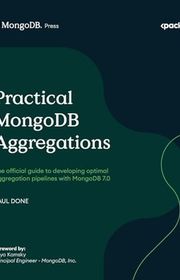
Practical MongoDB Aggregations
For developers who know basic queries and want to build more effective aggregation pipelines. Done connects worked examples with optimization principles, though the narrow focus makes this a companion to general MongoDB instruction rather than a first database book.
What it's about
Paul Done explains how to build aggregation pipelines for transforming, analyzing, and combining MongoDB data. Worked examples connect pipeline design with efficiency, covering practical approaches to data manipulation and features available through MongoDB 7.0.

For developers who need to make data assumptions explicit before implementation. Hoberman's template-based modeling approach brings discipline to flexible documents, though readers seeking quick database commands may find the conceptual and logical modeling stages slow.
What it's about
Steve Hoberman explains why MongoDB projects still need data modeling despite flexible document structures. A template-based approach connects conceptual, logical, and physical models, clarifies data assumptions, and develops the techniques through a case study.
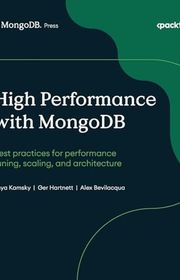
High Performance with MongoDB
For practitioners who already use MongoDB and need to diagnose performance problems. Its focused treatment connects schema, queries, and operational behavior, though the advanced scope assumes working knowledge and access to a workload you can investigate.
What it's about
MongoDB specialists examine performance across document design, indexes, queries, storage, and distributed operation. Practical cases and diagnostic approaches show how different layers interact, helping readers investigate bottlenecks and make informed choices about scaling and architecture.
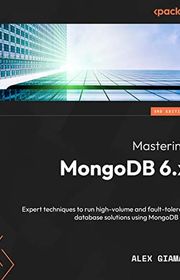
Mastering MongoDB 6.x
For developers and administrators ready to connect modeling, scaling, and resilience. Giamas's newer edition updates the existing 4.x treatment for MongoDB 6.x, though it still targets a particular release and needs comparison with current documentation.
What it's about
Alex Giamas explores development and administration with MongoDB 6.x, including data modeling, queries, indexing, replication, and sharding. The guide connects performance and availability concerns with practical deployment decisions for applications handling larger workloads.

MongoDB Basics
For readers who want a compact introduction using Python examples. Its limited scope makes the document model approachable, though the early MongoDB context makes it better for foundational reading than for following present-day installation or operational procedures.
What it's about
Peter Membrey and his coauthors introduce MongoDB as a document-oriented alternative to relational databases. The guide covers installation, data modeling, navigation and queries, geospatial indexing, and storing files with GridFS using Python examples.

For newcomers who want hands-on exercises and an Atlas-oriented starting point. The progression from document operations to a larger project gives practice a destination, though the tooling and interface instructions reflect the book's publication period.
What it's about
This practical introduction begins with MongoDB Atlas and develops skills through exercises using realistic datasets. Topics include document operations, aggregation, indexing, replication, authorization, backups, and charts, culminating in a project based on a bike-sharing application.

For beginners who prefer a sequence of manageable lessons with quizzes and exercises. Dayley offers a clear route across development and administration topics, though the title's twenty-four-hour structure describes lesson organization rather than a realistic promise of mastery.
What it's about
Brad Dayley introduces MongoDB through twenty-four lessons supported by examples, quizzes, and exercises. The guide covers NoSQL data design, database operations, application access through several programming languages, administration, replication, sharding, and optimization.

Web Development with MongoDB and NodeJS
For JavaScript developers who learn by building an application. The walkthrough connects MongoDB with server routes, templates, and testing, though the older NodeJS ecosystem means dependencies and APIs need review before attempting the examples today.
What it's about
Mithun Satheesh and his coauthors build a web application using NodeJS and MongoDB. The walkthrough covers environment setup, an Express server, templates, data persistence, reusable controllers, automated tests, and options for cloud deployment.

MongoDB Complete Guide
For readers who prefer a single reference spanning commands, graphical tools, and administration. Sharma's broad practical coverage offers several entry points, though the range leaves less space for the detailed reasoning of specialist modeling or performance books.
What it's about
Manu Sharma builds from MongoDB setup and basic commands to querying, indexing, and aggregation. Practical demonstrations also cover Compass, administration, monitoring, security, backups, replication, and sharding for developers and server administrators.
Sources
- 1
5 Best MongoDB Books for Beginners & Developers - Programming Cube
programmingcube.com
- 2
12 Best MongoDB Books For Teaching Yourself
whatpixel.com
- 3
Best MongoDB books 2026 - ReactDOM
reactdom.com
- 4
7 Best MongoDB Books for 2026 | ComputingForGeeks
computingforgeeks.com
- 5
MongoDB Reading List (14 books)
goodreads.com
- 6
Best MongoDB Books [2026] - Beginner to Advanced | JobRoadmaps
jobroadmaps.com
- 7
Top 10 MongoDB Books You Should Read in 2023
educba.com
- 8
MongoDB Books
mongodb.com






Edited by
Software engineer whose passion for tracking book recommendations from podcasts inspired the creation of MRB.
Lead investor at 3one4 Capital whose startup expertise and love for books helped shape MRB and its growth.
Comments
Spotted a missing book, a wrong order or a mistake? Tell us and we'll fix this page.
We're a reading guide, not the author or publisher, so we can't send books or pass on messages.