
17 Best Criminal Law Books
The best criminal law books, ranked by how many expert sources recommend each one, with notes for students and readers studying doctrine, courts, and punishment.
Our take
Criminal law books serve different purposes. Study texts explain offenses, responsibility, and defenses within a particular legal system. Casebooks teach through judicial decisions and questions. Other books examine prosecution, policing, incarceration, and the people affected by those institutions. Those wider accounts add context, but they do not provide the same kind of instruction as a doctrinal textbook.
For a US law course, Understanding Criminal Law offers explanations alongside assigned cases, while The Glannon Guide to Criminal Law adds question practice. Criminal Law is a fuller hornbook reference. Students of England and Wales need different materials, such as Simester and Sullivan’s Criminal Law, and should check the edition against their syllabus. For general reading, Just Mercy brings legal defense into personal focus, while The New Jim Crow and Locked In present different arguments about incarceration. Some verified study editions are older, so confirm the publication year, jurisdiction, required materials, and any digital access before buying. Start with a course-matched text for study or a focused narrative for context.
17 books · 7 sources · Last updated
As an Amazon Associate, we earn from qualifying purchases (at no extra cost to you).
How to choose from this list
Skip to the full rankingIf you're beginning a US criminal law course: Understanding Criminal Law → Criminal Law (Examples & Explanations)
If you want a US explanatory reference: Principles of Criminal Law → Criminal Law
If you want multiple-choice practice: The Glannon Guide to Criminal Law
If your US course assigns a casebook: Criminal Law and Its Processes
If you're studying England and Wales criminal law: Simester and Sullivan’s Criminal Law → Blackstone's Statutes on Criminal Law
If you want context on US punishment: Just Mercy → The New Jim Crow → Locked In
The 17 books, ranked
Ranked by how many expert sources name each book. Ties go to the book more people recommend.
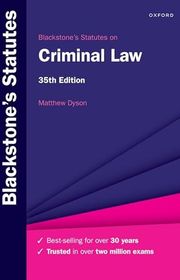
Blackstone's Statutes on Criminal Law
For students of England and Wales law who need selected legislation alongside a textbook. The unannotated format supports statutory reading, but the verified 35th edition dates from 2025, so confirm the required year and assessment rules before buying.
What it's about
Edited by Dyson, this volume collects selected criminal legislation for study and reference. The unannotated format allows readers to consult statutory wording alongside their course materials, with the selection and coverage tied to the particular edition and academic year.
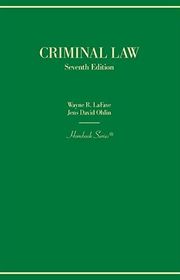
Criminal Law
For US law students who want a substantial explanatory reference across the core subject. Its breadth supports deeper consultation than a short outline, but the size and detail make it less suitable for a quick first overview.
What it's about
LaFave and Ohlin’s hornbook examines substantive criminal law, including the purposes of punishment, offense elements, responsibility, defenses, and forms of participation. The seventh edition provides extended explanation intended to complement case-based study rather than follow one particular coursebook.
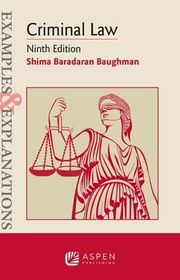
Criminal Law (Examples & Explanations)
For US students who learn by applying a rule and then reviewing the reasoning. The examples provide active practice beyond an outline, but reading the answers too soon can hide gaps, and the book should supplement assigned materials.
What it's about
Baughman’s ninth edition combines explanations of criminal law with hypothetical fact patterns and worked analysis. Questions ask readers to identify and connect issues, providing opportunities to test doctrinal understanding and practice applying principles in situations resembling law-school examination problems.
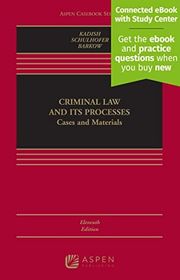
Criminal Law and Its Processes
For US students and teachers who want doctrinal cases placed within sustained policy debate. The theoretical questions invite close discussion, but readers looking for a straightforward rule summary may need a separate explanatory supplement alongside the assigned chapters.
What it's about
Kadish, Schulhofer, and Barkow present substantive criminal law through cases, commentary, and policy questions. The eleventh edition examines criminalization, punishment, responsibility, and defenses while asking how legal rules operate as instruments of social control and individual accountability.
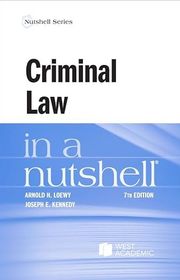
Criminal Law in a Nutshell
For US students seeking a compact orientation or a quick review of the subject’s structure. Its concise format helps with the larger framework, but compression leaves less room for disputed cases and detailed arguments than a full treatise.
What it's about
Loewy and Kennedy survey substantive criminal law in a compact reference format. Sections address punishment, offense elements, particular crimes, defenses, burdens of proof, and group criminality, offering an overview of the subject and questions about the limits of criminal liability.
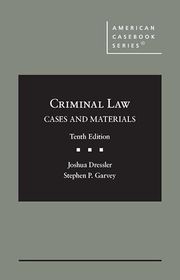
Criminal Law: Cases and Materials
For US law students whose course uses case-based discussion of substantive liability. Notes and questions connect decisions with competing policy arguments, but the substantial reading load and structure work best when matched with an instructor’s assigned syllabus.
What it's about
Dressler and Garvey organize cases, notes, and questions around the foundations of substantive criminal law. Common-law doctrines and Model Penal Code approaches appear alongside controversies about punishment, culpability, defenses, and the application of criminal rules to difficult factual situations.
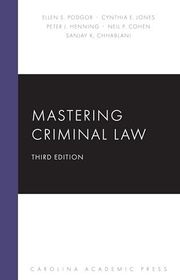
Mastering Criminal Law
For US law students who want an organized review linking principles with examples. Its broad course coverage supports consolidation, but readers still need their assigned cases and a clear sense of which jurisdiction’s approach their instructor expects.
What it's about
This study text explains the structure of criminal liability through principles and practical examples. It addresses statutory interpretation, offenses, participation, defenses, and sentencing, helping students organize topics encountered in a substantive criminal law course and apply them to problems.
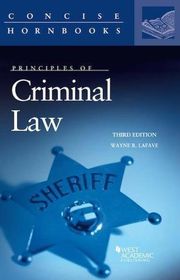
Principles of Criminal Law
For US students who want a more compact explanatory reference than the full hornbook. Its focus on principles supports selective consultation, but the verified edition is older, so check course requirements and later developments before relying on its detail.
What it's about
LaFave’s concise hornbook surveys criminal responsibility, justification, excuse, inchoate offenses, and accomplice liability. It also considers issues such as causation and conspiracy, organizing substantive criminal law around principles that students can connect with cases and classroom discussions.
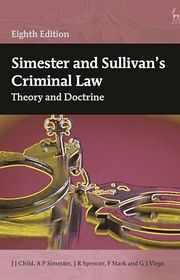
Simester and Sullivan’s Criminal Law
For students of England and Wales criminal law who want doctrine examined alongside theory. The analytical depth supports critical study, but the verified eighth edition was published in 2022, so check your syllabus and subsequent legal changes.
What it's about
This account of English criminal law combines explanation of offenses and defenses with examination of their theoretical foundations. The eighth edition addresses undergraduate topics, asking readers to connect legal doctrine with arguments about responsibility, justification, and the purposes of punishment.
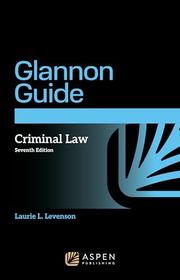
The Glannon Guide to Criminal Law
For US students who want to check understanding through multiple-choice questions and explanations. The hypothetical problems make application central, but the format complements doctrinal reading and does not replace practicing the assessment style required by your course.
What it's about
Levenson reviews criminal law concepts through explanations, hypothetical problems, and multiple-choice questions. The guide asks students to apply rules to facts and then examines the reasoning behind the answers, linking content review with practice in legal analysis.
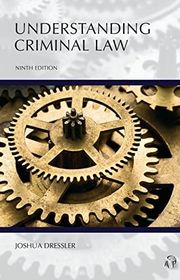
Understanding Criminal Law
For US law students who want explanations to accompany an assigned casebook. Its doctrinal organization helps connect scattered cases with general principles, but it is a course supplement and must be matched with the jurisdiction and edition your class uses.
What it's about
Dressler explains substantive criminal law through the elements of offenses, responsibility, and defenses. The text discusses common-law and Model Penal Code approaches, giving students a framework for connecting casebook readings, classroom arguments, and the analysis of hypothetical facts.
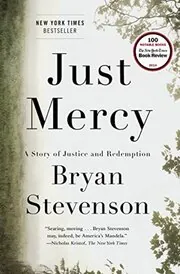
For general readers who want to understand legal defense through individual lives. The personal narrative makes institutional problems concrete, but its Alabama and death-penalty focus offers less systematic coverage of legal rules than the study texts.
What it's about
As a young lawyer in Alabama, Bryan Stevenson takes on the case of Walter McMillian, a Black man wrongly sentenced to death. From that case, he builds a humane, unsettling portrait of bias, punishment, and the people crushed by the justice system.
Also recommended by
4 people Howard Schultz recommended this book
Howard Schultz
"Perhaps one of the most powerful and important stories of our time." - Howard Schultz
Howard Schultz's recommendation of this book  Cory Booker recommended this book
Cory Booker
"Takes you out of where you probably are and lets you look into a window of aspects of our society that are really important." - Cory Booker
Cory Booker's recommendation of this book  Richard Branson recommended this book
Richard Branson
Richard Branson recommended this book on his "70 must-read books" blog post.
Richard Branson's recommendation of this book  Kathryn Minshew recommended this book
Kathryn Minshew
"A wildly good book." - Kathryn Minshew
Kathryn Minshew's recommendation of this book

For readers who want an argument about race, punishment, and the lasting consequences of conviction in the United States. Its structural perspective gives doctrine social context, but it is an advocacy analysis with a historical focus rather than a textbook.
What it's about
Michelle Alexander argues that mass incarceration and the War on Drugs perpetuate racial caste in America. Her analysis examines how a formally colorblind criminal justice system targets Black communities and creates lasting barriers after conviction.
Also recommended by
4 people J. Cole recommended this book
J. Cole
J. Cole mentioned reading this book on The Fayetteville Observer.
J. Cole's recommendation of this book  Mark Zuckerberg recommended this book
Mark Zuckerberg
"I've been interested in learning about criminal justice reform for a while, and this book was highly recommended by several people I trust." - Mark Zuckerberg
Mark Zuckerberg's recommendation of this book  Bill Gates recommended this book
Bill Gates
"Offers an eye-opening look into how the criminal justice system unfairly targets communities of color, and especially Black communities." - Bill Gates
Bill Gates's recommendation of this book  Sunny Hostin recommended this book
Sunny Hostin
Sunny Hostin recommended this book on Twitter.
Sunny Hostin's recommendation of this book

For readers interested in how punitive policies developed within Black communities and political leadership. Its historical attention complicates simple explanations of incarceration, but the Washington, DC focus and earlier policy setting limit generalization to every jurisdiction.
What it's about
James Forman Jr. examines why many Black officials and communities supported punitive crime policies from the 1970s onward. Combining history with public-defender experience, he investigates the pressures behind these decisions and their consequences for mass incarceration.
Also recommended by
1 person Ezra Klein recommended this book
Ezra Klein
Ezra Klein recommended this book on Twitter.
Ezra Klein's recommendation of this book

For readers interested in homicide investigation and the consequences of inadequate responses to violence. The close reporting gives policing a human and institutional context, but one Los Angeles investigation cannot stand in for a national account of criminal law.
What it's about
Jill Leovy follows a murder investigation in South Los Angeles, centering the work of detective John Skaggs. Her reporting examines the lives surrounding the killing and argues that inadequate responses to homicide contribute to violence in neglected communities.

For readers who want to test familiar explanations of mass incarceration against a different analysis. Its attention to prosecutors provides a useful counterpoint, but the data and policy argument reflect their publication period rather than current conditions everywhere.
What it's about
John Pfaff challenges familiar explanations for mass incarceration, including the centrality of drug offenses and private prisons. Drawing on criminal justice data, he argues that prosecutorial decisions deserve greater attention when diagnosing prison growth and considering meaningful reform.

For readers interested in how identification practices gained authority within criminal justice. The historical approach connects techniques with institutions and assumptions, but it is background scholarship rather than a current guide to forensic methods or evidentiary rules.
What it's about
Simon Cole traces the development of criminal identification, from photographs and bodily measurements to fingerprints and DNA. His history connects these methods with institutions and social assumptions, examining how claims about identifying individuals became embedded in policing and bureaucracy.
Sources
- 1
Criminal Law Reading Lists 2025-2026
mcbridesguides.com
- 2
Criminal Law Treatises: UK
libguides.library.cityu.edu.hk
- 3
Criminal Law Study Aids
lib.uchicago.edu
- 4
1L Resources, Tips & Tools: Criminal Law
guides.brooklaw.edu
- 5
What Casebook to use for Criminal Law
reddit.com
- 6
Criminal Law Books
goodreads.com
- 7
Books for Criminal Justice Professionals
criminaljusticedegreehub.com








Edited by
Software engineer whose passion for tracking book recommendations from podcasts inspired the creation of MRB.
Lead investor at 3one4 Capital whose startup expertise and love for books helped shape MRB and its growth.
Comments
Spotted a missing book, a wrong order or a mistake? Tell us and we'll fix this page.
We're a reading guide, not the author or publisher, so we can't send books or pass on messages.