
10 Best Classical Mechanics Books
The best classical mechanics books, ranked by expert source recommendations, with notes on prerequisites, problem solving, and undergraduate or graduate study.
Our take
Classical mechanics studies motion, forces, energy, and the principles that connect them. Learning it involves more than recognizing equations: you need to decide which description of a system makes a problem manageable. These books range from broad introductory physics to demanding treatments of Lagrangian and Hamiltonian mechanics, so mathematical preparation matters as much as interest in the subject.
For a compact route into mathematical physics, try The Theoretical Minimum. Kleppner and Kolenkow’s An Introduction to Mechanics builds Newtonian problem-solving skills, while Taylor’s Classical Mechanics offers a broader intermediate course. Morin’s Introduction to Classical Mechanics suits readers who want challenging exercises and detailed solutions. Later, Goldstein’s Classical Mechanics provides advanced coverage, and The Variational Principles of Mechanics explores the reasoning behind analytical methods. Mathematical Methods of Classical Mechanics takes the geometric route. Start with a book whose exercises you can attempt, then move to a more abstract treatment once the foundations feel secure.
10 books · 10 sources · Last updated
As an Amazon Associate, we earn from qualifying purchases (at no extra cost to you).
How to choose from this list
Skip to the full rankingIf you want a compact mathematical introduction: The Theoretical Minimum
If you need a first mechanics course: An Introduction to Mechanics → Classical Mechanics (John R. Taylor)
If you want demanding problem practice: Introduction to Classical Mechanics
If you want guided analytical calculations: No-Nonsense Classical Mechanics
If you are preparing for graduate theory: Classical Mechanics (Herbert Goldstein) → Mechanics
If you want the underlying mathematical structure: The Variational Principles of Mechanics → Mathematical Methods of Classical Mechanics
The 10 books, ranked
Ranked by how many expert sources name each book. Ties go to the book more people recommend.

Classical Mechanics
For advanced students preparing for graduate mechanics and theoretical physics. The breadth of analytical methods makes it useful for sustained reference, though the formal development assumes previous mechanics and considerable mathematical fluency.
What it's about
Herbert Goldstein develops advanced classical mechanics through variational principles, Lagrangian and Hamiltonian formulations, and canonical transformations. The second edition also examines rigid-body motion and relativistic mechanics, providing a mathematical foundation for further study in theoretical physics.
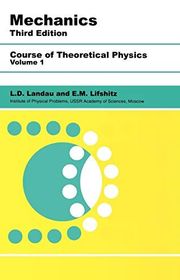
Mechanics: Volume 1
For experienced students who want a concise development centered on action principles. The economical reasoning highlights the structure of mechanics, though omitted intermediate steps make it a difficult choice for a first independent course.
What it's about
Landau and Lifshitz develop classical mechanics from the principle of least action. Their compact treatment covers conservation laws, motion, oscillations, rigid bodies, canonical equations, and adiabatic invariants, connecting physical principles with mathematical methods for analyzing mechanical systems.

Classical Mechanics
For undergraduates moving beyond introductory physics into analytical mechanics. The explanations and varied exercises support a broad intermediate course, though calculus and a willingness to solve problems are essential to getting the benefit.
What it's about
John Taylor builds on introductory physics to develop classical mechanics, from conservation laws and oscillations to Lagrangian and Hamiltonian methods. Chapters on rigid bodies, chaos, and continuum mechanics accompany problems ranging from short exercises to computational projects.
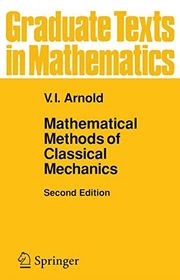
Mathematical Methods of Classical Mechanics
For mathematically confident readers who want the geometric structure behind mechanics. Manifolds, phase spaces, and dynamical systems connect familiar equations to a wider framework, though the abstract viewpoint demands more preparation than a conventional undergraduate course.
What it's about
Vladimir Arnold presents classical mechanics through geometry, developing Newtonian, Lagrangian, and Hamiltonian approaches alongside manifolds and differential forms. Oscillations, rigid-body motion, dynamical systems, and perturbation methods show how geometric ideas organize the analysis of physical motion.
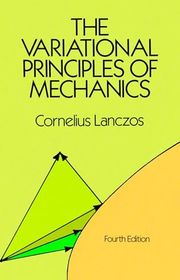
The Variational Principles of Mechanics
For students who want to understand why variational methods unify mechanics. The historical and conceptual development gives formal techniques a clear purpose, though it requires mathematical preparation and does not replace a broad introductory problem course.
What it's about
Cornelius Lanczos develops analytical mechanics through variational principles and the ideas of Euler, Lagrange, Hamilton, and Jacobi. Mathematical arguments, historical context, and problems explain the foundations of the subject and the relationships among its principal formulations.

An Introduction to Mechanics
For students with calculus who want a demanding foundation in Newtonian mechanics. The challenging problems sharpen physical reasoning, though this is a substantial first course rather than a quick introduction to Lagrangian and Hamiltonian methods.
What it's about
Daniel Kleppner and Robert Kolenkow introduce undergraduate mechanics through mathematical explanations, worked examples, and challenging problems. The text develops Newtonian motion, momentum, energy, rotation, and related topics, helping students apply fundamental principles to varied physical situations.

For students who learn most from wrestling with difficult problems and then studying solutions. The extensive worked material reveals problem-solving strategies, though the demanding exercises can frustrate readers who still need a gentler first explanation.
What it's about
David Morin combines a mechanics textbook with an extensive collection of problems and detailed solutions. Coverage moves from Newton’s laws, energy, and momentum to Lagrangian methods, rotating systems, and relativity, with exercises designed to deepen mathematical and physical understanding.

For self-learners who want to begin doing mathematical physics rather than read only analogies. The compact treatment connects mechanics with essential mathematics, though you will need to work through equations and seek further practice.
What it's about
Leonard Susskind and George Hrabovsky introduce classical mechanics and the mathematics needed to study physics. Their primer uses explanations and exercises to build a foundation for further learning, emphasizing the equations behind physical ideas rather than analogy alone.
Also recommended by
1 person Eric Weinstein recommended this book
Eric Weinstein
Eric Weinstein tweet about books that mattered enough to him.
Eric Weinstein's recommendation of this book

For learners who want to see how Newtonian, Lagrangian, and Hamiltonian mechanics connect. Annotated calculations make intermediate steps visible, though the guided presentation works best alongside independent problem practice and a fuller course text.
What it's about
Jakob Schwichtenberg introduces classical mechanics through Newtonian, Lagrangian, and Hamiltonian approaches. Annotated calculations, diagrams, and explanations connect these frameworks with fundamental equations and theorems, showing how to analyze mechanical systems and how the different formulations relate.

Physics for Scientists and Engineers with Modern Physics
For science and engineering students who need a broad physics foundation before specializing in mechanics. Worked examples place mechanical ideas within a wider curriculum, though much of the book covers subjects beyond this list’s focus.
What it's about
Raymond Serway and John Jewett present physics for science and engineering students through explanations, illustrations, and worked examples. The tenth edition emphasizes problem solving with exercises designed for individual study and classroom discussion, alongside coverage of modern physics.
Sources
- 1
The 14 Best Classical Mechanics Books of Any Level
celsiuselements.com
- 2
100 Best Classical Mechanics Books of All Time
shortform.com
- 3
Best Classical Mechanics books for You
physicsread.com
- 4
A Physics Book List
math.ucr.edu
- 5
Reference texts for PHYS 505
faculty.washington.edu
- 6
Books
maths.tcd.ie
- 7
[books] Can anyone help me with good classical mechanic books ?
reddit.com
- 8
Good Grad level Mechanics textbooks?
reddit.com
- 9
Classical Mechanics (MMath)
goodreads.com
- 10
PHYS 3102, Mechanics II, Spring semester 2026 - Classical mechanics online
phys.uconn.edu






Edited by
Software engineer whose passion for tracking book recommendations from podcasts inspired the creation of MRB.
Lead investor at 3one4 Capital whose startup expertise and love for books helped shape MRB and its growth.
Comments
Spotted a missing book, a wrong order or a mistake? Tell us and we'll fix this page.
We're a reading guide, not the author or publisher, so we can't send books or pass on messages.