
16 Best Game Development Books
The best game development books, ranked by how many expert sources recommend each, with notes on skill level and whether you need design or coding guidance.
Our take
Making a game involves several kinds of work: deciding what players do, building systems that respond, testing the experience, and bringing a project to release. A design book can improve your questions about play without teaching you to code. An engine reference can explain implementation while saying much less about whether the resulting game is enjoyable.
Game Design Workshop offers exercises for learning through prototypes and playtests. The Art of Game Design supplies perspectives for examining those prototypes, while Game Feel concentrates on control and response. Programmers can turn to Game Programming Patterns for code organization or Game Engine Architecture for a deeper view of engine systems. Unity in Action provides a project course for readers who already program, and GAMEDEV includes the business and release questions that technical guides often leave aside. Start with a small project and choose the book that addresses your next obstacle; design study and implementation become more useful when you can test them together.
16 books · 8 sources · Last updated
As an Amazon Associate, we earn from qualifying purchases (at no extra cost to you).
How to choose from this list
Skip to the full rankingIf you want to learn design through practice: Game Design Workshop → The Art of Game Design
If you want to understand game design theory: A Theory of Fun for Game Design → Rules of Play
If you want to improve player control: Game Feel
If you program and want to learn Unity: Unity in Action
If you want to understand engine software: Game Programming Patterns → Game Engine Architecture
If you want to understand production pressures: Blood, Sweat, and Pixels → GAMEDEV
The 16 books, ranked
Ranked by how many expert sources name each book. Ties go to the book more people recommend.

Game Programming Patterns
For programmers whose game code is becoming difficult to change. Its focused patterns explain useful architectural tradeoffs more directly than an engine overview, though applying every pattern indiscriminately can add complexity instead of removing it.
What it's about
Robert Nystrom presents reusable programming patterns for managing the complexity of game software. Independent chapters cover game loops, components, scripting behavior, spatial organization, and performance, explaining how architectural choices can make code easier to maintain and optimize.

For aspiring video game designers who want an illustrated introduction to the decisions behind a finished game. Its approachable examples make production concepts tangible, though it offers less theoretical depth than a design textbook and does not teach programming.
What it's about
Scott Rogers guides readers from initial game ideas to production through illustrated explanations of levels, controls, enemies, and design documents. This second edition expands coverage of mobile and console games, monetization, and challenges across stages of development.

For designers who need better questions to ask about a game in progress. The lenses offer many ways to examine player experience, though the broad coverage works best when you apply selected ideas to prototypes rather than read passively.
What it's about
Jesse Schell introduces game design through a collection of lenses, each offering questions that reveal a different perspective on a game. He connects principles from board games, sports, and video games with practical guidance on creating, testing, and improving player experiences.
Also recommended by
1 person Ryan Hoover recommended this book
Ryan Hoover
"Although it's about gaming, the learnings and tactics in the book can be applied to any product. It's really about psychology and how people think." - Ryan Hoover
Ryan Hoover's recommendation of this book

A Theory of Fun for Game Design
For designers who want to think about why play and learning can feel rewarding. Its illustrated argument offers a compact conceptual starting point, though it provides fewer concrete production exercises than a workshop-style design course.
What it's about
Raph Koster examines why games are enjoyable through ideas about learning, pattern recognition, and human behavior. Illustrated arguments connect game design with broader questions about meaning and creativity, with this second edition updating research and reflecting on the medium's development.

Game Engine Architecture
For programmers who want to understand how engine systems fit together beneath an editor. Its architectural breadth connects technical subjects that shorter books treat separately, though the depth assumes programming confidence and is excessive for simply finishing a first small game.
What it's about
Jason Gregory's third edition explains the theory and practice behind game engine software, drawing on development experience at major studios. The book examines how engine systems fit together and the technical foundations needed to understand their architecture.

For designers trying to improve how movement and interaction respond to a player. Its focus on control and sensation addresses details broad design surveys can overlook, though the exercises are most useful when you have a playable prototype to adjust.
What it's about
Steve Swink examines the sensations produced when players interact with virtual worlds, treating control and response as design elements. Explanations and exercises explore how changing a game's variables affects the experience of movement, interaction, and physical presence.

For readers who want a vocabulary for examining games as systems, experiences, and cultural objects. Its conceptual depth supports serious design study, though the substantial theoretical treatment is slower to apply than a practical exercise book.
What it's about
Katie Salen and Eric Zimmerman develop a framework for understanding game design through rules, play, and culture. Concepts and examples span digital and traditional games, examining how systems, player choices, and social contexts create meaningful experiences.

Blood, Sweat, and Pixels
The Triumphant, Turbulent Stories Behind How Video Games Are Made
For aspiring developers who want a realistic sense of production pressures before planning a large project. Its reported stories make schedules, uncertainty, and collaboration tangible, though it offers accounts to learn from rather than a repeatable development method.
What it's about
Jason Schreier investigates the difficult development of games including Stardew Valley, Destiny, and Dragon Age: Inquisition. Interviews and reporting reveal how creative ambitions collide with technical problems, deadlines, corporate decisions, and the personal costs of prolonged production.

For designers, teachers, or teams who want to practice ideas without waiting for code or art. The non-digital challenges make experimentation quick, though you still need additional skills to turn those lessons into a complete video game.
What it's about
Brenda Brathwaite and Ian Schreiber develop game design skills through non digital exercises and creative challenges. Activities encourage brainstorming and practical experimentation, giving aspiring designers, professionals, and teachers opportunities to practise concepts without building complete electronic games.
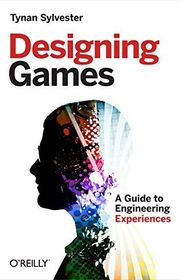
Designing Games
For designers who want to connect individual mechanics with the experiences they create. Its sustained reasoning provides a more unified framework than a collection of separate lenses, though it asks you to translate principles into your own prototypes.
What it's about
Tynan Sylvester examines game design as the work of shaping player experiences. Discussions of mechanics, emotion, decision making, and development processes connect abstract principles with the practical choices involved in building, evaluating, and improving a game.

For beginners who want to learn design by making and testing things. Its exercises turn player-centered iteration into a practical routine without requiring code, though completing the work takes more effort than reading a collection of design ideas.
What it's about
Tracy Fullerton presents game design as an iterative process centered on players, using exercises that require no programming or artistic expertise. This fourth edition examines game systems and the creative methods used to develop, test, and refine ideas.

Programming Game AI by Example
For programmers who want concrete examples of agents making decisions and navigating game worlds. Its practical treatment of classic techniques complements a general architecture book, though the older code and tools will need adaptation for a modern project.
What it's about
Mat Buckland demonstrates game artificial intelligence through C++ examples. Topics include state machines, steering behaviors, pathfinding, team coordination, goal driven agents, scripting, perception, and fuzzy logic, with projects showing how these techniques work together.

For programmers who want to learn Unity by making several example games. Its project progression connects editor work with gameplay code, though it assumes prior programming knowledge and requires an edition that matches your development environment.
What it's about
Joe Hocking introduces Unity to readers who already have programming experience through a series of example games. C# projects cover movement, custom artificial intelligence, user interfaces, and the workflow for building and deploying games.

For programmers who need a mathematical foundation for engine work. Its focused treatment of vectors, transformations, and geometry goes deeper than an application tutorial, though the abstract material requires active problem solving and comfort with mathematical notation.
What it's about
Eric Lengyel's first volume explains mathematics used in game engines and virtual simulations, beginning with vectors, matrices, transforms, and geometry. Grassmann and geometric algebra then provide additional ways to understand relationships that conventional mathematical treatments can obscure.

For Unity users who already know the basics and want to solve individual implementation problems. Its recipe structure makes targeted lookup easier than a linear course, though engine changes mean examples may require adjustment rather than direct copying.
What it's about
Recipes address recurring problems in Unity game development, pairing each problem with a solution and discussion. Coverage includes 2D and 3D graphics, physics, character animation, artificial intelligence, input, audio, scripting, and user interfaces.

For independent developers who need to think beyond implementation toward funding, marketing, and release. Its account of bringing one game to market gives production decisions context, though one developer's experience cannot predict another game's commercial results.
What it's about
Wlad Marhulets draws on developing DARQ to explain the stages of making and releasing an independent game. The guide covers preparation, development, funding, legal and business questions, marketing, publishers, distribution, and launch.
Sources
- 1
Best Game Development Books in 2026: 25+ Essential Reads (Beginner to Pro)
generalistprogrammer.com
- 2
10 Essential Video Game Design Books
gamedesigning.org
- 3
What gamedev books helped you the most?
reddit.com
- 4
Gamedevs, what literature do you actually recommend?
reddit.com
- 5
Game Development Books
goodreads.com
- 6
Level Up: The 18 Best Game Development Books
thectoclub.com
- 7
100 Best Game Development Books of All Time (Updated for 2026)
shortform.com
- 8
The Very Best Game Development Books in 2026 (Beginner to Advanced)
gameindustrycareerguide.com




Edited by
Software engineer whose passion for tracking book recommendations from podcasts inspired the creation of MRB.
Lead investor at 3one4 Capital whose startup expertise and love for books helped shape MRB and its growth.
Comments
Spotted a missing book, a wrong order or a mistake? Tell us and we'll fix this page.
We're a reading guide, not the author or publisher, so we can't send books or pass on messages.