
15 Best Change Management Books
The best change management books, ranked by how many expert sources recommend each one, with notes on leadership, individual transitions and practical methods.
Our take
Organizational change involves more than announcing a new structure or installing a system. People need to understand what is changing, decide how to respond and develop different ways of working. Books on the subject approach those challenges from several directions: leadership strategy, individual psychology, practical adoption methods and the wider organization itself.
Leading Change provides a sequence for organizing transformation, while The Heart of Change develops the human side through cases. Managing Transitions focuses on the adjustment people experience, and ADKAR offers a framework for examining individual adoption. For a wider comparison, Making Sense of Change Management surveys different models. Switch connects change with motivation and circumstances, while Reinventing Organizations asks more fundamental questions about how work is organized.
Start with the book closest to your problem. Choose a leadership framework for an initiative you must organize, a transition-focused book for understanding responses, or a broader reference when you need to compare approaches.
15 books · 8 sources · Last updated
As an Amazon Associate, we earn from qualifying purchases (at no extra cost to you).
How to choose from this list
Skip to the full rankingIf you want a quick shared introduction: Our Iceberg Is Melting
If you're leading an organizational transformation: Leading Change → The Heart of Change
If you want to understand people’s adjustment: Managing Transitions → Switch
If you want to diagnose individual adoption: ADKAR → Change Management
If you want to compare models in depth: Making Sense of Change Management → The Theory and Practice of Change Management
If you must coordinate through a crisis: You're It
The 15 books, ranked
Ranked by how many expert sources name each book. Ties go to the book more people recommend.

For managers who want to understand why people struggle even when a planned change appears sensible. Its distinction between external events and psychological transition adds a humane perspective, though it is less concerned with project governance and technical delivery.
What it's about
William and Susan Bridges examine the psychological transitions that accompany workplace changes such as restructuring and mergers. The guide offers managers ways to understand employees' responses, clarify their purpose and role, and support people while they adjust to new circumstances.

Leading Change
For leaders who need a clear sequence for organizing a substantial transformation. Its emphasis on urgency, coalitions and institutionalizing change provides a usable structure, though applying the stages requires adaptation to local constraints rather than treating them as a checklist.
What it's about
John Kotter explains why organizational transformations often fail and presents an eight-stage approach to leading change. Examples address urgency, a guiding coalition, a shared vision, early achievements, and embedding new practices so improvements endure.

For teams that want a quick shared language before discussing a change initiative. Its short fable makes Kotter’s framework easy to remember, though the simplified situation offers little help with competing interests, limited resources or difficult organizational politics.
What it's about
When a penguin discovers that his colony’s iceberg is melting, convincing the others to act proves difficult. This business fable uses their response to illustrate John Kotter’s eight-step change framework and the challenges of adapting together under uncertainty.

For practitioners who want a compact model for diagnosing where individual adoption is stuck. Its staged vocabulary connects communication, training and reinforcement, though a single framework cannot explain every political, cultural or structural obstacle in an organization.
What it's about
Jeff Hiatt introduces the ADKAR model for understanding individual and organizational change. The framework connects awareness, desire, knowledge, ability, and reinforcement with practical activities such as communication, coaching, and training, helping readers identify obstacles within a change initiative.

HBR's 10 Must Reads on Change Management
For managers who want several perspectives without committing first to a large textbook. Its article format makes different arguments easy to compare, though the pieces do not form one continuous method and some ideas overlap other books here.
What it's about
Ten Harvard Business Review articles examine how organizations implement change and why those efforts can fail. Topics include creating urgency, gaining commitment, challenging established practices, securing resources, and leading people through a transition.
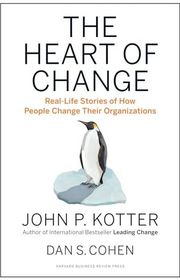
The Heart of Change
For readers who know Kotter’s framework and want to see the human work behind it. Its case-based emphasis on feelings and behavior complements the sequence in Leading Change, though the selected success stories are illustrations rather than a guaranteed recipe.
What it's about
John Kotter and Dan Cohen use organizational stories to examine how people change their behavior. The book develops Kotter’s eight-step approach through examples emphasizing what employees see and feel, connecting leadership action with commitment during transformation.

For readers who want to connect motivation, reasoning and the surrounding conditions that shape behavior. Its varied examples make change feel more approachable, though it offers a broad behavioral lens rather than a complete organizational implementation method.
What it's about
Chip and Dan Heath examine why lasting change is difficult, focusing on tension between rational intentions and emotional habits. Stories from workplaces, communities, and everyday life illustrate approaches for aligning motivation and creating conditions for change.
Also recommended by
3 people Adam Grant recommended this book
Adam Grant
"My all-time favorite book on change." - Adam Grant
Adam Grant's recommendation of this book  Andrew Wilkinson recommended this book
Andrew Wilkinson
"Such a great book." - Andrew Wilkinson
Andrew Wilkinson's recommendation of this book  Michael Hyatt recommended this book
Michael Hyatt
Michael Hyatt recommended this book on his website.
Michael Hyatt's recommendation of this book

Who Moved My Cheese?
An A-Mazing Way to Deal with Change in Your Work and in Your Life
For readers who want a very brief introduction to reactions when familiar circumstances disappear. Its simple fable is easy to discuss together, though the focus on adapting can overlook legitimate objections and the responsibilities of those directing a change.
What it's about
Spencer Johnson uses a simple parable to explore reactions to change in work and personal life. The story encourages readers to recognize shifting circumstances, examine fear, and develop a more adaptable approach to an uncertain future.
Also recommended by
2 people Dave Ramsey recommended this book
Dave Ramsey
Recommended on Dave Ramsey's website.
Dave Ramsey's recommendation of this book  Daymond John recommended this book
Daymond John
One of Daymond John's answers to "most-gifted or recommeded books?"
Daymond John's recommendation of this book

For managers and sponsors who need an introduction to the people work around implementation. Its connection between individual adoption and management responsibilities helps clarify roles, though the Prosci-centered approach offers less comparison with competing methods.
What it's about
Jeff Hiatt and Timothy Creasey introduce the human aspects of organizational change through Prosci's methodology. They connect individual transitions with management responsibilities, explaining how sponsorship, communication, coaching, and resistance management fit into a broader effort to implement new ways of working.

Making Sense of Change Management
A Complete Guide to the Models, Tools and Techniques of Organizational Change
For readers who want to compare frameworks before selecting an approach. Its attention to individuals, teams and organizations gives a broader map than a single-model book, though the range can feel dense without a specific change problem in mind.
What it's about
Esther Cameron and Mike Green compare models and approaches to organizational change, connecting theory with practical techniques. Examples and exercises help students and managers consider how individuals, teams, and leaders respond to change and choose methods suited to their circumstances.

The Theory and Practice of Change Management
For students and practitioners who want a sustained connection between change theory and action. Its process framework, cases and exercises support deeper study, though the textbook density makes it slower to use than a concise field guide.
What it's about
John Hayes presents organizational change through a process-based framework that connects management theory with practical action. Research, case studies, and experiential exercises examine the stages of change, giving students and practitioners tools for assessing situations and planning their responses.

Managing Change, Creativity and Innovation
For students and managers who want change connected with creativity and innovation. Its multiple theoretical perspectives and international cases encourage examining assumptions, though the academic treatment is more demanding than a quick guide to running an initiative.
What it's about
Patrick Dawson and Constantine Andriopoulos examine organizational change as a process connected with creativity and innovation. The textbook combines theoretical perspectives, international case studies, and practical guidance to explore how organizations develop new ideas and respond to changing conditions.

For leaders who suspect their own behavior is undermining an announced transformation. Its emphasis on modeling change and earning emotional commitment redirects attention toward management, though the executive stories provide less procedural detail than a practitioner handbook.
What it's about
Al Comeaux argues that lasting organizational change requires leaders to change their own behavior and engage employees emotionally. Drawing on executive experience and research, he uses stories to examine leadership involvement, employee commitment, and the limits of imposing change through transactions alone.

Reinventing Organizations
A Guide to Creating Organizations Inspired by the Next Stage of Human Consciousness
For readers questioning whether conventional hierarchy is the right starting point for their organization. Its alternative organizing principles widen the discussion beyond managing a project, though the developmental framing and selected examples invite critical comparison rather than straightforward imitation.
What it's about
Frederic Laloux proposes an alternative approach to organizing work, drawing on organizations that depart from conventional management hierarchies. His framework explores self-management, wholeness, and evolving purpose, connecting these practices with his account of changing human consciousness and organizational development.

For leaders who must coordinate across boundaries during uncertainty or crisis. Its attention to networks and shared action adds a perspective beyond planned internal transformation, though the emergency-response examples require translation into ordinary workplace situations.
What it's about
Leonard Marcus and his coauthors introduce meta-leadership through research and experiences of crisis response. They examine how leaders understand complex situations, connect across organizational boundaries, and coordinate people and networks, applying these ideas to major emergencies and everyday challenges.
Sources
- 1
Top 15 Books on Change Management (2026 edition)
rebelsguidetopm.com
- 2
Top 10 Change Management Books
insights.btoes.com
- 3
Top Ten Books on Change Management
changemanagementinsight.com
- 4
12 Best Change Management Books to Read
teambuilding.com
- 5
Recommended Resources
hr-origin.mit.edu
- 6
Change Management Books
goodreads.com
- 7
Looking for book suggestions
reddit.com
- 8
Change Management Resources
hr.ucdavis.edu





Edited by
Software engineer whose passion for tracking book recommendations from podcasts inspired the creation of MRB.
Lead investor at 3one4 Capital whose startup expertise and love for books helped shape MRB and its growth.
Comments
Spotted a missing book, a wrong order or a mistake? Tell us and we'll fix this page.
We're a reading guide, not the author or publisher, so we can't send books or pass on messages.