
12 Best Blockchain Books
The best blockchain books, ranked by how many expert sources recommend each one, with guidance for beginners, developers, and readers interested in governance.
Our take
Blockchain books range from explanations of shared transaction records to arguments about money, business, and institutional trust. Understanding those differences helps you choose a useful starting point. A guide to Bitcoin programming answers different questions from a book about the legal consequences of smart contracts, and neither should be read as proof that every proposed application will succeed.
Blockchain Basics avoids code and mathematics, while The Basics of Bitcoins and Blockchains connects the technology with financial concepts. Developers can move toward Mastering Bitcoin or Mastering Ethereum, paying close attention to edition dates and changes in the underlying systems. Blockchain and the Law examines questions about accountability and governance that technical explanations alone cannot settle. More optimistic accounts sit alongside the criticism in Attack of the 50 Foot Blockchain.
Begin with the introduction that matches your background, then choose technical detail, economic argument, or governance analysis according to the questions you want to answer.
12 books · 8 sources · Last updated
As an Amazon Associate, we earn from qualifying purchases (at no extra cost to you).
How to choose from this list
Skip to the full rankingIf you're starting without technical knowledge: Blockchain Basics → The Basics of Bitcoins and Blockchains
If you want to understand Bitcoin code: Mastering Bitcoin
If you want to study smart contracts: Mastering Ethereum → Blockchain and the Law
If you want to examine trust and governance: The Truth Machine → Blockchain and the Law
If you want contrasting perspectives: Blockchain Revolution → Attack of the 50 Foot Blockchain
The 12 books, ranked
Ranked by how many expert sources name each book. Ties go to the book more people recommend.

For developers who want to understand Bitcoin transactions, keys, and network operation in detail. Its technical examples go well beyond introductory analogies, though the listed edition predates later developments and should be read with current documentation.
What it's about
Andreas M. Antonopoulos introduces Bitcoin and explains its underlying blockchain for readers developing applications or studying the technology. The guide covers wallets, keys, addresses, transactions, and mining, connecting introductory concepts with technical examples of how the network operates.

For readers interested in the monetary argument behind Bitcoin rather than blockchain implementation. Its forceful economic position makes a useful contrast to broader technology accounts, though it is advocacy and gives limited space to competing interpretations.
What it's about
Saifedean Ammous places Bitcoin within a history of money, from early exchange media to gold and government currencies. Drawing on Austrian economics, he argues that Bitcoin's limited supply offers an alternative to central banking and inflationary monetary systems.
Also recommended by
3 people Nassim Taleb recommended this book
Nassim Taleb
"Bitcoin is an excellent idea." - Nassim Taleb
Nassim Taleb's recommendation of this book  Raoul Pal recommended this book
Raoul Pal
"Will help you understand why [Bitcoin] is so unique and why it is so valuable - and why it is the hardest form of money." - Raoul Pal
Raoul Pal's recommendation of this book  Max Keiser recommended this book
Max Keiser
"Took my knowledge of money, and therefore #Bitcoin, to new highs." - Max Keiser
Max Keiser's recommendation of this book

For developers moving from general blockchain concepts to smart contracts and decentralized applications. Its implementation focus makes it more useful than business introductions, though this edition predates major Ethereum changes and needs substantial supplementation with current documentation.
What it's about
Andreas M. Antonopoulos and Gavin Wood explain Ethereum as a platform for decentralized computing. This practical guide introduces the concepts and development skills involved in building smart contracts and decentralized applications on Ethereum and related virtual-machine blockchains.
Also recommended by
1 person Preston Pysh recommended this book
Preston Pysh
Preston Pysh recommended this book on Twitter.
Preston Pysh's recommendation of this book

Blockchain Revolution
How the Technology Behind Bitcoin Is Changing Money, Business, and the World
For business readers who want a broad argument for blockchain applications beyond money. Its accessible examples encourage thinking across industries, though the optimistic predictions need to be separated from evidence of what has actually been adopted.
What it's about
Don and Alex Tapscott explore blockchain's potential beyond digital currency, considering uses in business, public records, and governance. Their analysis explains the technology behind distributed ledgers and argues that it could reshape how people exchange value and establish trust.

The Basics of Bitcoins and Blockchains
An Introduction to Cryptocurrencies and the Technology that Powers Them
For beginners who want financial and technical concepts explained together. Its measured progression connects the mechanics of transactions with the purpose of money, though the broad introduction offers less depth than the programming guides.
What it's about
Antony Lewis introduces cryptocurrencies and the technology behind them for readers without prior financial or technical knowledge. Step-by-step explanations cover Bitcoin, transactions, mining, and blockchain systems, connecting their mechanics with the broader history and functions of money.

For readers interested in how shared ledgers might change institutions and economic relationships. Its reporting gives the discussion a human dimension, though ambitious claims about future applications require more skepticism than a technical manual might prompt.
What it's about
Michael J. Casey and Paul Vigna explain blockchain technology and examine its possible uses beyond digital currency. They explore claims that it can change control over data, assets, and identity, while considering institutional resistance, job losses, and other social consequences.
Also recommended by
1 person Balaji Srinivasan recommended this book
Balaji Srinivasan
"An accessible explanation of how blockchains allow us to establish certain kinds of truths even in adversarial environments." - Balaji Srinivasan
Balaji Srinivasan's recommendation of this book

For readers examining smart contracts, governance, and the limits of automated rules. Its legal perspective challenges the idea that code removes institutions, though the analysis is conceptual and predates substantial changes in regulation and practice.
What it's about
Primavera De Filippi and Aaron Wright examine how blockchain applications interact with legal and governmental authority. They discuss smart contracts, decentralized transactions, and automated rules, arguing that the technology's productive use requires new regulatory approaches and legal thinking.

The Blockchain Developer
For programmers who want exposure to building projects across several blockchain platforms. Its practical orientation distinguishes it from business overviews, though older platform examples and tooling make it an unreliable guide to a current development setup.
What it's about
Elad Elrom guides developers through designing, building, testing, and securing decentralized blockchain projects. Practical code examples cover platforms including Bitcoin, Ethereum, NEO, EOS, and Hyperledger, alongside front-end wallets, maintenance, and considerations extending beyond cryptocurrency applications.
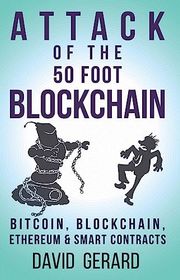
Attack of the 50 Foot Blockchain
For readers who want a skeptical counterweight to expansive claims about blockchain. Its attention to failed projects and speculative behavior tests optimistic narratives, though its combative tone and early examples limit its usefulness as a current technical reference.
What it's about
David Gerard examines Bitcoin, Ethereum, smart contracts, and efforts to apply blockchain technology to business. His skeptical account follows early projects, speculative markets, and recurring promotional claims, asking how their practical results compare with the promises made for them.

For readers who want the underlying logic explained without programming or mathematical notation. Its sequence of analogies makes a useful first step before technical study, though developers will soon need more precise implementation detail.
What it's about
Daniel Drescher explains blockchain technology in 25 steps using pictures, analogies, and metaphors. Written without code or mathematical formulas, the guide connects the system's components and limitations with the problems it addresses and potential business applications.
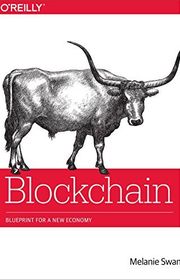
Blockchain: Blueprint for a New Economy
For readers interested in the early ambitions for blockchain beyond payments. Its wide ranging scenarios provide historical context for later debates, though many are speculative proposals rather than demonstrated applications or practical implementation guidance.
What it's about
Melanie Swan surveys proposed uses of blockchain technology across finance, business, government, and other institutions. The book considers how distributed systems might support new ways to record ownership, coordinate activity, and organize economic and social relationships.

For readers interested in how tokens were framed as an investment category. Its valuation and portfolio perspective differs from the technical guides, though the early market examples and investment assumptions need careful reassessment against later experience.
What it's about
Chris Burniske and Jack Tatar examine cryptocurrencies and related tokens as an emerging investment category. They connect blockchain history with valuation, portfolio construction, speculative bubbles, exchanges, and storage, offering a framework for evaluating assets rather than focusing solely on bitcoin.
Sources
- 1
14 Best Blockchain Books, According to Experts
builtin.com
- 2
Best blockchain books worth reading
crypto.news
- 3
6 of the Best Crypto and Bitcoin Books in 2026
ledger.com
- 4
Blockchain Books
goodreads.com
- 5
Recommended books to start learning blockchain principles and web3 fundaments
reddit.com
- 6
Books/courses recommendations for learning Blockchain Core dev?
reddit.com
- 7
Top 5 Books to Learn About Blockchain
investopedia.com
- 8
The Best Books on Blockchain
fivebooks.com







Edited by
Software engineer whose passion for tracking book recommendations from podcasts inspired the creation of MRB.
Lead investor at 3one4 Capital whose startup expertise and love for books helped shape MRB and its growth.
Comments
Spotted a missing book, a wrong order or a mistake? Tell us and we'll fix this page.
We're a reading guide, not the author or publisher, so we can't send books or pass on messages.