
Yuval Noah Harari Books in Order
This page lists Yuval Noah Harari books in order, with brief summaries, series background and reading-order tips for Sapiens, Homo Deus, 21 Lessons and more.
Last updated: 1 new book added
As an Amazon Associate, we earn from qualifying purchases (at no extra cost to you).
Yuval Noah Harari books in publication order
14 books

Renaissance Military Memoirs
by Yuval Noah Harari
2004
An academic study of Renaissance soldiers’ autobiographical writings, exploring how they understood war, honour, comradeship, violence and death. Harari uses these memoirs to show how early modern warfare shaped personal identity and ideas about the emerging modern state.
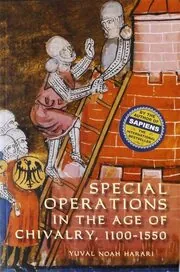
Special Operations in the Age of Chivalry
by Yuval Noah Harari
2007
Harari uncovers the hidden world of medieval special operations, from castle infiltrations and abductions to assassination plots and acts of treason. Drawing on vivid case studies, he shows how small, covert actions could reshape wars in the age of chivalry.

The Ultimate Experience
by Yuval Noah Harari
2008
A scholarly history of how soldiers and societies came to see battle as a life-changing revelation rather than just a test of courage. Using war memoirs from 1450 to 2000, Harari traces how this idea reshaped modern politics, culture and military thought.
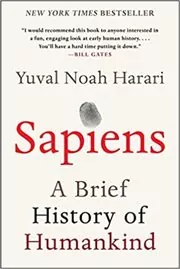
Sapiens
by Yuval Noah Harari
2011
Harari condenses 70,000 years of human history into a single narrative, tracing how Homo sapiens rose from apes on the savannah to planet-shaping forces. He focuses on shared myths, empires, money, religion and science, and asks whether all this progress made us happier.
Recommended by
32 people Joe Rogan recommended this book
Joe Rogan
"It really puts in perspective how bizarre human beings are. It’s an awesome overview of our species." - Joe Rogan
Joe Rogan's recommendation of this book  Bill Gates recommended this book
Bill Gates
"I would recommend this book to anyone interested in a fun, engaging look at early human history." - Bill Gates
Bill Gates's recommendation of this book 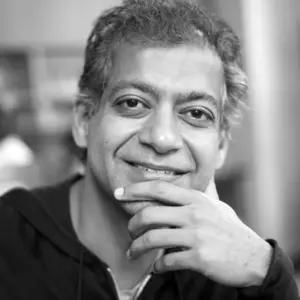 Naval Ravikant recommended this book
Naval Ravikant
"Best book I've read in [2015]." - Naval Ravikant
Naval Ravikant's recommendation of this book  Lex Fridman recommended this book
Lex Fridman
"Basically one of the things we've created here is we've imagined ideas that we all share." - Lex Fridman
Lex Fridman's recommendation of this book  Mark Zuckerberg recommended this book
Mark Zuckerberg
"A big history narrative of human civilization." - Mark Zuckerberg
Mark Zuckerberg's recommendation of this book  Peter Attia recommended this book
Peter Attia
One of Peter Attia's answers to "any books you feel would make your reading list?"
Peter Attia's recommendation of this book +26
More recommendations
- Ashton Kutcher
"The brainy book I seem to be sharing or talking about the most lately." - Ashton Kutcher
- Whitney Cummings
"A great book about [how] we’ve evolved and why we have anxiety." - Whitney Cummings
- Richard Branson
"I just love the style of his writing." - Richard Branson
- Ray Dalio
Ray Dalio mentioned this book on "The Tim Ferriss Show" podcast.
- Vinod Khosla
"A previous favorite." - Vinod Khosla
- James Cameron
"It explains human behavior and why we are the way we are in human civilization from soup to nuts. And I’ve read it now a couple of times. It’s a pretty astonishing book." - James Cameron
- Demis Hassabis
"There's not many times where I read a book and come out with 20 new ideas I hadn't thought about before, and [this book] made me think like that." - Demis Hassabis
- Keith Rabois
Keith Rabois recommended this book on a Medium blog post.
- Daniel Ek
"Both sobering and conservatively optimistic in equal measure." - Daniel Ek
- Reid Hoffman
"A grand theory of humanity." - Reid Hoffman
- Sam Kass
Sam Kass recommended this book in the "Tools of Titans" book.
- Sebastian Junger
"I’m going to give [this book] over and over again to everyone I know." - Sebastian Junger
- Kishore Biyani
"Fascinating because of its multi-disciplinary approach towards understanding human society, our behaviour and our future." - Kishore Biyani
- Ryan Shea
One of Ryan Shea's 4 answers to "what is the book (or books) you’ve given most as a gift?"
- Melinda Gates
Melinda Gates recommended this book on Likewise.com.
- Bill Gurley
"I really enjoyed [this book]." - Bill Gurley
- Karlie Kloss
"An amazing book on the beginning of humanity." - Karlie Kloss
- Anthony Pompliano
"[One of the] best books I read in 2017." - Anthony Pompliano
- Changpeng Zhao
"Gives me a greater perspective about how humans emerged and why we behave the way we do." - Changpeng Zhao
- PewDiePie
"Tells the major revolutions of human history." - PewDiePie
- Patrick O'Shaughnessy
"Provides a concise history of humankind and outlines why we have the psychology we do today." - Patrick O'Shaughnessy
- Chris Evans
"Truly mind-blowing. It’s changed the way I look at almost everything. I can’t endorse it enough." - Chris Evans
- Simon Mayo
"Love this book still." - Simon Mayo
- Penn Jillette
Penn Jillette mentioned this book in a New York Times interview.
- Mark Manson
Mark Manson recommended this book on his website.
- James Clear
"[One of] the 10 best nonfiction books of all-time." - James Clear
- Ashton Kutcher
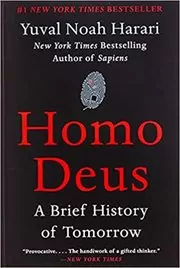
Homo Deus
by Yuval Noah Harari
2017
In this follow-up to Sapiens, Harari looks forward rather than back, asking what happens when humans start to redesign bodies, brains and societies. He explores dreams of immortality, algorithmic control and dataism, and what they might mean for freedom and meaning.
Recommended by
8 people- Bill Gates recommended this book
Bill Gates
"A thoughtful look at what may be in store for humanity." - Bill Gates
Bill Gates's recommendation of this book - Naval Ravikant recommended this book
Naval Ravikant
"Didn't finish it. Good book but not as seminal as Sapiens." - Naval Ravikant
Naval Ravikant's recommendation of this book  Vinod Khosla recommended this book
Vinod Khosla
"Not that I agree with all of it, but it is still mind-bending speculation about our future." - Vinod Khosla
Vinod Khosla's recommendation of this book  Richard Branson recommended this book
Richard Branson
Richard Branson recommended this book on his "70 must-read books" blog post.
Richard Branson's recommendation of this book  Raoul Pal recommended this book
Raoul Pal
Raoul Pal recommended this book on Twitter.
Raoul Pal's recommendation of this book  Tai Lopez recommended this book
Tai Lopez
"Badass book." - Tai Lopez
Tai Lopez's recommendation of this book +2
More recommendations
- Penn Jillette
Penn Jillette mentioned this book in a New York Times interview.
- Mark Manson
Mark Manson recommended this book on his website.
- Penn Jillette
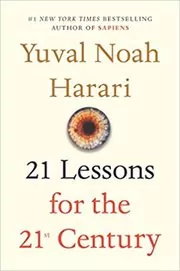
21 Lessons for the 21st Century
by Yuval Noah Harari
2018
This collection of essays turns Harari’s big-history lens on today’s world, from automation and surveillance to nationalism, fake news and personal resilience. Each chapter asks practical questions about how to stay sane, ethical and informed in the 21st century.
Recommended by
5 people- Joe Rogan recommended this book
Joe Rogan
"A great book." - Joe Rogan
Joe Rogan's recommendation of this book - Bill Gates recommended this book
Bill Gates
"A guide to worrying in the 21st century." - Bill Gates
Bill Gates's recommendation of this book  Jack Dorsey recommended this book
Jack Dorsey
"[The] last chapter is around meditation." - Jack Dorsey
Jack Dorsey's recommendation of this book  Fareed Zakaria recommended this book
Fareed Zakaria
"Wide-ranging, speculative look at the world today and where it is going -- fascinating big think." - Fareed Zakaria
Fareed Zakaria's recommendation of this book - Vinod Khosla recommended this book
Vinod Khosla
"An important examination into today’s most pressing political, technological, social, and existential issues as we move into the unchartered territory of the future." - Vinod Khosla
Vinod Khosla's recommendation of this book

Money
by Yuval Noah Harari
2018
Drawn from Sapiens and Homo Deus, this short volume traces how money evolved from ancient coins to global digital systems. Harari asks why we trust pieces of paper and numbers on screens, and how future technologies might transform that shared belief.
Sapiens, Volume 1: The Birth of Humankind
by Yuval Noah Harari
2020
This first graphic adaptation of Sapiens follows a cartoon version of Harari and a cast of sidekicks as they investigate our deep past. With full-colour art and humour, it explains the rise of Homo sapiens and what set us apart from other human species.
Sapiens, Volume 2: The Pillars of Civilization
by Yuval Noah Harari
2021
Volume 2 turns to the Agricultural Revolution, asking why farming made work harder and societies less equal. Through playful scenes and clear diagrams, the book shows how wheat, writing, kingdoms and organised religion reshaped human life and laid the pillars of civilisation.
Unstoppable Us, Volume 1: How Humans Took Over the World
by Yuval Noah Harari
2022
Written for curious kids and families, this illustrated book shows how an ordinary ape species managed to take over the planet. Harari uses stories, jokes, maps and timelines to explain how language, cooperation and imagination turned humans into ‘unstoppable’ animals.

Nexus
by Yuval Noah Harari
2024
Harari surveys the long history of information networks, from campfire stories and sacred texts to newspapers, social media and artificial intelligence. He argues that whoever controls these networks shapes power and belief, and asks how AI could transform or destabilize that fragile system.
Sapiens: A Graphic History, Volume 3 - The Masters of History
by Yuval Noah Harari
2024
The third graphic volume asks who really drives history: kings and conquerors, bureaucrats and bankers, or the stories societies tell about themselves. It blends bold visuals, satire and big questions to explore power, ideology and the forces that keep changing our world.
Unstoppable Us, Volume 2: Why the World Isn't Fair
by Yuval Noah Harari
2024
This second Unstoppable Us book follows humans from small farming villages to the first cities and kingdoms. Harari explains how laws, taxes, class and empire made the world both more organised and less fair, inviting young readers to question what fairness really means.
Unstoppable Us, Volume 3
by Yuval Noah Harari
2026
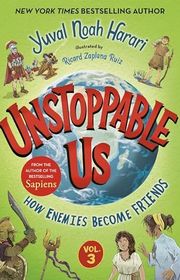
Harari introduces young readers to the encounters that connected ancient civilizations through trade, travel, empire, and religion. Maps and illustrations accompany an exploration of how strangers became neighbors, how conflicts arose, and what allowed former enemies to cooperate.
Where to start with Yuval Noah Harari
If you want Harari’s big-picture human story: Sapiens → Homo Deus → 21 Lessons for the 21st Century.
If you’re curious about technology, data and AI: Homo Deus → Nexus.
If you prefer short, focused reading: Money → 21 Lessons for the 21st Century.
If you’re reading with kids or tweens (~9–14): Unstoppable Us, Volume 1: How Humans Took Over the World → Unstoppable Us, Volume 2: Why the World Isn't Fair.
If you love visual storytelling and comics: Sapiens, Volume 1: The Birth of Humankind → Sapiens, Volume 2: The Pillars of Civilization → Sapiens: A Graphic History, Volume 3 - The Masters of History.
Yuval Noah Harari sub-series and character series
A Brief History books in order
Explore this seriesSapiens: A Graphic History books in order
Explore this series

Sapiens, Volume 2: The Pillars of Civilization
by Yuval Noah Harari
2021Sapiens: A Graphic History, Book 2
Sapiens: A Graphic History, Volume 3 - The Masters of History
by Yuval Noah Harari
2024Sapiens: A Graphic History, Book 3
Sapiens: A Graphic History books in chronological order
Sapiens, Volume 2: The Pillars of Civilization
by Yuval Noah Harari
2021Sapiens: A Graphic History, Book 2Sapiens: A Graphic History, Volume 3 - The Masters of History
by Yuval Noah Harari
2024Sapiens: A Graphic History, Book 3
Unstoppable Us books in order
Explore this series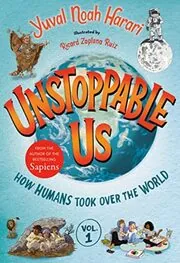
Unstoppable Us, Volume 1: How Humans Took Over the World
by Yuval Noah Harari
2022Unstoppable Us, Book 1
Unstoppable Us books in chronological order
Unstoppable Us, Volume 1: How Humans Took Over the World
by Yuval Noah Harari
2022Unstoppable Us, Book 1
Yuval Noah Harari collections, short stories, and related book types
Non-Fiction
Author bio
Yuval Noah Harari is an Israeli historian and writer whose books zoom out to look at the whole human story. He likes simple questions with huge scope: how did we become the dominant species on Earth, and what might replace us next?
He was born in Israel in 1976 and grew up in a secular Jewish family in and around Haifa. As a teenager he was drawn to history and ideas more than to politics or business. He went on to study history and international relations at the Hebrew University of Jerusalem in the 1990s, specialising in medieval and military history.
Harari completed a doctorate at the University of Oxford in 2002, writing about Renaissance military memoirs under the supervision of historian Steven Gunn. After postdoctoral work, he joined the faculty of the Hebrew University of Jerusalem, where he has taught world and military history. His first books were dense academic studies of war, identity and battlefield experience in late medieval and early modern Europe.
Only later did he turn that training into the sweeping, accessible style that made him famous.
In the early 2000s Harari began teaching a large survey course on the history of humankind. Those lectures slowly evolved into Sapiens: A Brief History of Humankind, first published in Hebrew in 2011 and in English a few years later. The book follows Homo sapiens from prehistoric foragers through the Agricultural and Scientific Revolutions, arguing that our real superpower is the ability to believe shared stories about things like gods, nations and money. Sapiens went on to reach a worldwide audience, selling millions of copies and being translated into many languages.
Two companion books expanded that project. Homo Deus: A Brief History of Tomorrow looks forward, exploring how biotechnology, algorithms and data‑driven systems could let humans chase happiness, redesign bodies and perhaps make themselves obsolete. 21 Lessons for the 21st Century comes back to the present, collecting essays on work, nationalism, religion, truth and education in an age of rapid technological change.
Harari has also reworked his ideas for new audiences. The graphic‑novel trilogy Sapiens: A Graphic History turns his big arguments into colourful comics, while the Unstoppable Us series introduces middle‑grade readers to the long arc of human history. His 2024 book Nexus: A Brief History of Information Networks from the Stone Age to AI traces how stories, bureaucracies, media and now artificial intelligence have tied people together and reshaped power.
Across these works, certain themes repeat. Harari is fascinated by the boundary between biology and culture, the way humans use fiction to organise societies, and the trade‑offs between freedom, order and truth. He often writes in short, pointed chapters that mix historical case studies with speculation about where we may be heading.
Outside the classroom and the page, Harari leads a relatively quiet life. He lives with his husband and manager, Itzik Yahav, and has spoken openly about being gay, vegan and sceptical of organised religion. Since encountering Vipassana meditation around 2000, he has kept up a strict practice, meditating for hours each day and spending long periods each year on silent retreat. He has said that the focus and distance he gains on retreat are part of how he writes about such large, unsettling questions.
Harari now divides his time between teaching, research, writing and public talks. Together with Yahav he co‑founded Sapienship, a social‑impact project that uses books, courses and media to push long‑term thinking about global challenges such as technology, war and climate. Whether you agree with his arguments or not, his work is meant as an invitation to zoom out, question easy stories and think a bit more carefully about the future we are building.






Edited by
Software engineer whose passion for tracking book recommendations from podcasts inspired the creation of MRB.
Lead investor at 3one4 Capital whose startup expertise and love for books helped shape MRB and its growth.
Comments
Did we miss something? Have feedback?
Help us improve this page by sharing your thoughts