
Unstoppable Us Books in Order
Part ofYuval Noah Harari Books in OrderSee the Unstoppable Us series by Yuval Noah Harari in order, with kid-friendly summaries, age hints and background on this illustrated history of how humans took over the world.
Last updated: 1 new book added
As an Amazon Associate, we earn from qualifying purchases (at no extra cost to you).
Unstoppable Us books in publication order
3 books
Unstoppable Us, Volume 1: How Humans Took Over the World
by Yuval Noah Harari
2022
Written for curious kids and families, this illustrated book shows how an ordinary ape species managed to take over the planet. Harari uses stories, jokes, maps and timelines to explain how language, cooperation and imagination turned humans into ‘unstoppable’ animals.
Unstoppable Us, Volume 2: Why the World Isn't Fair
by Yuval Noah Harari
2024
This second Unstoppable Us book follows humans from small farming villages to the first cities and kingdoms. Harari explains how laws, taxes, class and empire made the world both more organised and less fair, inviting young readers to question what fairness really means.
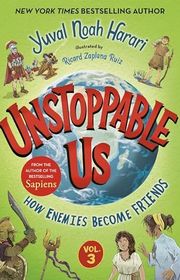
Unstoppable Us, Volume 3
by Yuval Noah Harari
2026
Harari introduces young readers to the encounters that connected ancient civilizations through trade, travel, empire, and religion. Maps and illustrations accompany an exploration of how strangers became neighbors, how conflicts arose, and what allowed former enemies to cooperate.
Unstoppable Us books in chronological order
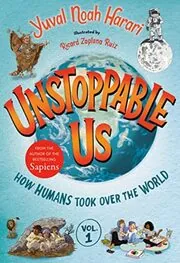
Unstoppable Us, Volume 1: How Humans Took Over the World
by Yuval Noah Harari
2022Unstoppable Us, Book 1
Series background & context
Unstoppable Us is Yuval Noah Harari’s way of telling the human story to younger readers. The books keep his big questions and sweeping timelines, but translate them into clear language, short chapters and bright illustrations that work for families and classrooms.
Volume 1, How Humans Took Over the World, starts with a puzzle. Humans are not particularly strong or fast, yet we now shape the planet more than any other animal. Harari walks kids through early human evolution, the use of fire, the spread of language and the moment our ancestors began to cooperate in large groups. The focus is less on memorising dates and more on seeing how imagination and teamwork became our real superpowers.
Volume 2, Why the World Isn't Fair, picks up the story when hunting bands begin to settle down. It follows the shift from foragers to farmers, then on to villages, cities and early kingdoms. Along the way, Harari explains how surplus food, taxes, writing and laws allowed some people to gain more power than others – and why that made daily life safer for some and harsher for many. The title question, about fairness, hangs over the whole book and invites kids to keep arguing with the story as they read.
Throughout the series, the pages are packed with maps, diagrams, timelines and cartoon scenes. Harari works with illustrator Ricard Zaplana Ruiz to show big ideas visually: a crowd of chatting humans contrasted with silent animals, or a simple village slowly turning into a bustling city. Sidebars and jokes help to break up hard topics like inequality, slavery and war so that they are honest but still age‑appropriate.
Unstoppable Us treats kids as serious thinkers. Harari frequently pauses to ask readers what they would have done in a particular situation, or how they would feel if they lived under certain rules. The books make it clear that history is not just something that happened long ago; it is a chain of choices by people not so different from us.
If you are already familiar with Sapiens, you will recognise many of the themes, just with fewer technical terms and more pictures. If you are starting here, the series works as a complete introduction to human history on its own, and it can easily lead curious readers toward Harari’s other work as they get older.











Edited by
Software engineer whose passion for tracking book recommendations from podcasts inspired the creation of MRB.
Lead investor at 3one4 Capital whose startup expertise and love for books helped shape MRB and its growth.
Comments
Did we miss something? Have feedback?
Help us improve this page by sharing your thoughts