
Bryan Stevenson Books in Order
Browse Bryan Stevenson books in order, with quick summaries, reading order help, where to start tips, and background on his work in justice and the law.
Last updated:
As an Amazon Associate, we earn from qualifying purchases (at no extra cost to you).
Bryan Stevenson books in publication order
3 books
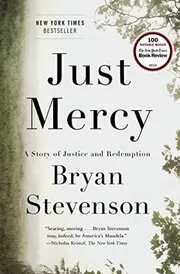
Just Mercy
by Bryan Stevenson
2014
As a young lawyer in Alabama, Bryan Stevenson takes on the case of Walter McMillian, a Black man wrongly sentenced to death. From that case, he builds a humane, unsettling portrait of bias, punishment, and the people crushed by the justice system.
Recommended by
4 people Howard Schultz recommended this book
Howard Schultz
"Perhaps one of the most powerful and important stories of our time." - Howard Schultz
Howard Schultz's recommendation of this book  Cory Booker recommended this book
Cory Booker
"Takes you out of where you probably are and lets you look into a window of aspects of our society that are really important." - Cory Booker
Cory Booker's recommendation of this book  Richard Branson recommended this book
Richard Branson
Richard Branson recommended this book on his "70 must-read books" blog post.
Richard Branson's recommendation of this book  Kathryn Minshew recommended this book
Kathryn Minshew
"A wildly good book." - Kathryn Minshew
Kathryn Minshew's recommendation of this book
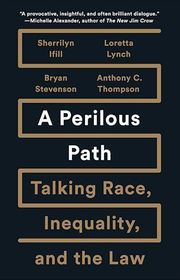
A Perilous Path
by Bryan Stevenson
2018
In this brief, conversation-driven book, Bryan Stevenson joins Sherrilyn Ifill, Loretta Lynch, and Anthony C. Thompson to talk about race, power, and the law in America. It turns a public discussion into a clear, serious look at inequality and reform.
%20-%20A%20True%20Story%20of%20the%20Fight%20for%20Justice.jpg)
Just Mercy (Adapted for Young Adults)
by Bryan Stevenson
2018
Stevenson adapts his memoir for younger readers, following his early legal work and his fight to free Walter McMillian, a Black man wrongly sentenced to death. It is an accessible, urgent look at injustice, mercy, and the people the system fails.
Where to start with Bryan Stevenson
If you want the essential Bryan Stevenson book: Just Mercy → A Perilous Path
If you're reading with teens or in a classroom: Just Mercy (Adapted for Young Adults) → Just Mercy
If you want a shorter discussion first: A Perilous Path → Just Mercy
Bryan Stevenson collections, short stories, and related book types
Non-Fiction
Standalone Bryan Stevenson books
Author bio
Bryan Stevenson was born in Milton, Delaware, and grew up in rural southern Delaware at a time when the legacy of segregation still shaped daily life. Church mattered in his family, and so did music. As a boy he played piano and sang in the choir, and those early experiences helped shape the moral language that runs through both his legal work and his writing.
He has always sounded a little like a teacher, even when he is talking like a lawyer.
Stevenson studied philosophy at Eastern University in Pennsylvania, graduating in 1981. He then went to Harvard, earning both a law degree and a master's in public policy in 1985. After school he moved south, joined the Southern Center for Human Rights in Atlanta, and started representing people on death row and others who had almost no real access to justice.
In 1989 he founded the Equal Justice Initiative in Montgomery, Alabama. What began as a small nonprofit law office grew into a major force in fights over the death penalty, wrongful convictions, abusive prison conditions, and the punishment of children in adult courts. Under Stevenson's leadership, EJI won major legal rulings, including a 2012 Supreme Court decision that barred mandatory life-without-parole sentences for children and a 2019 ruling protecting condemned prisoners with dementia.
He built that career case by case, client by client.
Since 1998, Stevenson has also taught at New York University School of Law, where he eventually became a University Professor. Teaching fits him. So does public speaking. Both are extensions of the same basic habit: taking big, painful systems and explaining them through individual human stories.
That is what made Just Mercy such a breakthrough when it appeared in 2014. The book follows Stevenson's fight to free Walter McMillian, a Black man wrongly sentenced to death in Alabama, but it is broader than one case. It also brings readers into the lives of children prosecuted as adults, people with mental illness, and prisoners the system found easy to ignore. The book later became a feature film, and it also won major nonfiction awards.
He returned to the material for Just Mercy (Adapted for Young Adults), reshaping it for younger readers without softening the central questions. He also joined Sherrilyn Ifill, Loretta Lynch, and Anthony C. Thompson for A Perilous Path, a short book drawn from a public conversation about race, inequality, and the law. Readers often connect with Stevenson because he writes plainly, moves quickly, and never loses sight of the person inside the case file.
Success did not turn him into a full-time pundit.
Across his work, the same themes keep showing up: mercy, dignity, racial bias, poverty, and the danger of treating punishment as the answer to everything. He helped lead the creation of Montgomery's Legacy Museum, National Memorial for Peace and Justice, and Freedom Monument Sculpture Park, projects that connect today's justice system to the longer history of slavery, lynching, and segregation. His work has been recognized with honors including a MacArthur Fellowship and the National Humanities Medal. He still leads EJI, still teaches, and still asks the same hard question: what do we owe people when the world has already decided they do not matter?








Edited by
Software engineer whose passion for tracking book recommendations from podcasts inspired the creation of MRB.
Lead investor at 3one4 Capital whose startup expertise and love for books helped shape MRB and its growth.
Comments
Did we miss something? Have feedback?
Help us improve this page by sharing your thoughts