
Astropolis Books in Order
Part ofSean Williams Books in OrderExplore the Astropolis series by Sean Williams in order, with book summaries, far-future series background, and guidance on the best place to begin.
Last updated:
As an Amazon Associate, we earn from qualifying purchases (at no extra cost to you).
Astropolis books in publication order
3 books
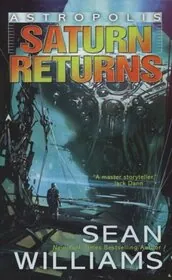
Saturn Returns
by Sean Williams
2007
Imre Bergamasc now rules the Returned Continuum, but his grip on the galaxy is far from secure. Dissidents, saboteurs, and old enemies threaten to pull his hard-won order apart.
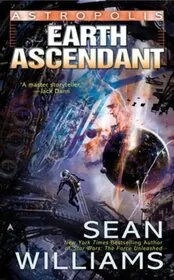
Earth Ascendant
by Sean Williams
2008
Two hundred years after an apparent murder plot and the fall of the Continuum, Imre Bergamasc returns. His rebirth could reshape the galaxy, if his enemies do not destroy him first.
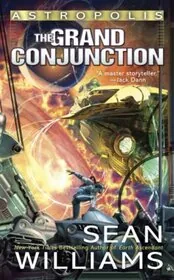
The Grand Conjunction
by Sean Williams
2009
Hundreds of thousands of years after Imre's abdication, the Host rules a galaxy that only looks peaceful. Revolution is brewing, and Imre's return may be the spark that sets everything off.
Astropolis books in chronological order
Series background & context
Astropolis is Sean Williams in full space-opera mode. The scale is vast, the timelines are wild, and the ideas come thick and fast. These books take place deep in humanity's future, in a galaxy shaped by impossible transport systems, political collapse, post-human power, and the long shadow of one man, Imre Bergamasc.
Imre is the closest thing the series has to a fixed center.
That does not mean the books stay small or simple. In Saturn Returns, Cenotaxis, Earth Ascendant, and The Grand Conjunction, Williams keeps widening the frame. He works with empires, rebels, long-lived systems, and the consequences of control over movement itself. Who gets to move across the stars? Who controls the networks that make civilization possible? And what happens when those networks fail, fracture, or fall into the wrong hands?
The series is interested in power on every level. There is personal power, political power, technological power, and the strange power that comes from simply outlasting everyone else. Imre's story is tangled up with all of that. He is ruler, victim, survivor, symbol, and problem, sometimes all at once. Around him are rivals, dissidents, saboteurs, and future societies that have inherited his world whether they asked for it or not.
What readers should expect is not cozy character fantasy in space. Astropolis likes big swings. The books jump across time, reveal buried histories, and ask you to keep up with grand structures as well as individual motives. At the same time, Williams does not let the setting become abstract. There are always people caught inside the machinery, trying to live, scheme, or resist.
The tone is more cerebral than some military SF, but it is not slow. There are chases, betrayals, reversals, and plenty of pressure. What makes the series distinctive is how often action is tied to an idea. A battle matters because of who controls the future. A disappearance matters because of what it does to a whole transport system. A return matters because history itself has not finished with the person who vanished.
If you enjoy far-future science fiction that thinks on a grand scale, Astropolis has a lot to offer. It is dense in places, but purposefully so. The reward is a galaxy that feels old, layered, and unstable, with every shortcut carrying a price.
These are books about movement, memory, and authority. In other words, exactly the sort of big, restless questions Williams likes best.








Edited by
Software engineer whose passion for tracking book recommendations from podcasts inspired the creation of MRB.
Lead investor at 3one4 Capital whose startup expertise and love for books helped shape MRB and its growth.
Comments
Did we miss something? Have feedback?
Help us improve this page by sharing your thoughts