
8 Best Robotics Books
The best robotics books, ranked by how many expert sources recommend each one, with notes to help you choose practical builds, theory, and reference.
Our take
Robotics combines mechanisms, electronics, sensing, programming, and decisions about how a machine should move. A first project can make those connections tangible, while an engineering text explains the mathematics behind them. Choosing between the two matters more than looking for one book that promises to cover every level.
Learn Robotics with Raspberry Pi and Learn Robotics Programming introduce physical projects and Python code. Robot Building for Beginners puts more emphasis on components, tools, and construction. For formal study, Modern Robotics develops mechanics, planning, and control, while Introduction to Autonomous Mobile Robots connects movement with sensing and navigation. Probabilistic Robotics goes deeper into uncertainty, localization, and mapping. The Springer Handbook of Robotics serves a different purpose as a wide technical reference.
Start with a project if you need hands-on experience, or a structured textbook if you already have the mathematical background. Check the edition and required hardware before following a software-dependent build.
8 books · 7 sources · Last updated
As an Amazon Associate, we earn from qualifying purchases (at no extra cost to you).
How to choose from this list
Skip to the full rankingIf you want a first Raspberry Pi project: Learn Robotics with Raspberry Pi
If you want Python-based robot behavior: Learn Robotics Programming
If you want electronics and construction basics: Robot Building for Beginners
If you're ready for mechanics and control: Modern Robotics
If you want autonomous navigation: Introduction to Autonomous Mobile Robots → Probabilistic Robotics
If you need a broad technical reference: Springer Handbook of Robotics
The 8 books, ranked
Ranked by how many expert sources name each book. Ties go to the book more people recommend.
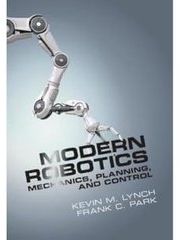
Modern Robotics
For engineering students who want a coherent mathematical treatment of robot motion. Its geometric approach links mechanics with planning and control, though readers without linear algebra and calculus will need preparation before working through the derivations.
What it's about
Kevin Lynch and Frank Park explain robot configurations, kinematics, dynamics, motion planning, and control using a geometric framework. Exercises and computational examples connect the mathematical treatment with manipulators and mobile systems, supported by companion learning resources.

Probabilistic Robotics
For students working on localization, mapping, and uncertain sensor information. Its probabilistic framework develops the reasoning behind important algorithms, though the mathematical treatment assumes comfort with probability, linear algebra, and programming rather than beginner-level construction skills.
What it's about
Sebastian Thrun, Wolfram Burgard, and Dieter Fox explain how robots can act when sensing and knowledge are uncertain. Mathematical derivations, algorithms, examples, and exercises cover probabilistic perception, localization, mapping, and decision making in autonomous robotic systems.

Springer Handbook of Robotics
For researchers and engineers who need a wide reference across robotics specialties. Its many contributors provide breadth that a single textbook cannot match, though its size and technical depth make it unsuitable for learning the subject from scratch.
What it's about
Edited by Bruno Siciliano and Oussama Khatib, this handbook surveys robotics foundations, mechanisms, sensing, planning, and control. Contributions extend into mobile and distributed systems, human interaction, and applications beyond industrial automation, providing a broad research and engineering reference.

Introduction to Autonomous Mobile Robots
For students who want to connect mobile-robot hardware with perception and navigation. Its integrated survey provides a useful foundation before specialist texts, though it requires mathematical preparation and offers less direct help with a particular hobby kit.
What it's about
Roland Siegwart and his coauthors explain the mechanical, sensory, and computational foundations of autonomous mobile robots. Chapters connect locomotion and kinematics with perception, localization, motion planning, and control, supported by mathematical treatment and exercises.
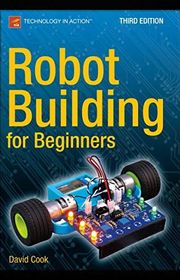
Robot Building for Beginners
For hobbyists who want to understand parts and tools while constructing a working robot. Its practical electronics focus complements the software-led Raspberry Pi books, though buying components and working through assembly require time, workspace, and patience.
What it's about
David Cook introduces the tools, components, and construction techniques used in amateur robotics. A guided robot project connects explanations of electronics, motors, sensors, and mechanical assembly, helping readers understand how individual parts work together in a functioning machine.

Learn Robotics Programming
Build and Control Autonomous Robots Using Raspberry Pi 3 and Python
For makers who want to learn by integrating a Raspberry Pi robot with Python code. Its progression connects sensors, motors, and behavior, though the specified hardware and software need checking against the edition and your equipment.
What it's about
Danny Staple guides readers through building and programming a Raspberry Pi robot with Python. Projects add motors, distance sensing, line following, encoders, computer vision, and remote control, while explaining the electronics and debugging needed to integrate these capabilities.

Learn Robotics with Raspberry Pi
Build and Code Your Own Moving, Sensing, Thinking Robots
For beginners who want a guided, physical robot project with Python programming. Its stepwise build makes electronics and behavior concrete, though you need the specified components and may have to adapt instructions for newer Raspberry Pi software.
What it's about
Matt Timmons-Brown teaches robotics by building a two-wheeled Raspberry Pi robot and programming it in Python. Projects introduce electronics and sensors, then develop obstacle avoidance, line following, camera-based object tracking, and additions such as lights and sound.

For readers wanting a broad, lightly technical orientation before selecting a project or course. Its range introduces the vocabulary and components of robotics, though the beginner-to-expert subtitle overstates what a general overview can deliver.
What it's about
Peter Mckinnon introduces robotics through its history, hardware, electronics, and programming. The book discusses controllers, motors, sensors, and robot construction, progressing toward practical examples such as obstacle avoidance and specialized robot designs.
Sources
- 1
Robotics Books
goodreads.com
- 2
12 Best Robotics Textbooks (October 2026) Guide & Comparison
smashingrobotics.com
- 3
Books - IEEE RAS TC on Optimization for Robotics
tcoptrob.org
- 4
RSF Top 10 Robot Education Textbooks
robottoday.com
- 5
What is textbook for Robotics Design, Modeling and Control that serves as a strong industry piece that every engineer should have on their shelf as reference?
reddit.com
- 6
Best books for people just getting into robotics?
reddit.com
- 7
15 Of The Best Robotics Books For Beginners
littlerobotshop.com










Edited by
Software engineer whose passion for tracking book recommendations from podcasts inspired the creation of MRB.
Lead investor at 3one4 Capital whose startup expertise and love for books helped shape MRB and its growth.
Comments
Spotted a missing book, a wrong order or a mistake? Tell us and we'll fix this page.
We're a reading guide, not the author or publisher, so we can't send books or pass on messages.