
9 Best ReactJS Books
The best ReactJS books, ranked by how many expert sources recommend each, with notes on beginner tutorials, Hooks, application design, and who each book suits.
Our take
React books differ in how they connect JavaScript, components, and application behavior. Some guide you through building a working interface; others explain individual concepts or investigate problems that become visible only in larger applications. A foundation in HTML, CSS, and JavaScript makes these books easier to use. Edition choice also matters because setup tools, libraries, and recommended patterns change.
The Road to React offers a project-centered introduction, while React Key Concepts supports focused study and revision. Learning React connects the library with functional programming, but its original and later editions cover different material. Fullstack React, React in Action, and React Quickly develop broader application examples whose tooling should be checked before following along. Learn React Hooks provides a more specific focus on reusable stateful behavior. Once you have built an application, Advanced React helps examine rendering and performance in greater depth. Start with a tutorial suited to your experience, then apply each chapter in your own small project.
9 books · 8 sources · Last updated
As an Amazon Associate, we earn from qualifying purchases (at no extra cost to you).
How to choose from this list
Skip to the full rankingIf you're new to React: The Road to React
If you want concise concept explanations: React Key Concepts
If you want functional programming context: Learning React
If you prefer application examples: React Quickly → Fullstack React
If you're studying Hooks: Learn React Hooks
If you already build React apps: Advanced React
The 9 books, ranked
Ranked by how many expert sources name each book. Ties go to the book more people recommend.

For learners who prefer building one application while introducing concepts in a practical order. The exercises connect React with everyday JavaScript, though readers seeking a broad reference or an in-depth account of React's internals will need a companion.
What it's about
Robin Wieruch teaches React by guiding readers through building an application from setup to deployment. Chapters introduce core features alongside exercises, then develop practical capabilities such as searching, sorting, and pagination while connecting React concepts with JavaScript.

For JavaScript developers who want React explained through functional programming and component design. Its conceptual foundation offers more than isolated recipes, though the original Redux-focused edition differs substantially from later editions and should be chosen carefully.
What it's about
Alex Banks and Eve Porcello teach React development using JavaScript and functional programming concepts. Hands-on guidance explores building components, understanding how React works in the browser, and creating interfaces that respond to changes in application data.

For developers who want a substantial collection of application examples and related tools. Its breadth connects fundamentals with professional concerns, though the ecosystem and tooling have changed enough that older examples require comparison with current documentation.
What it's about
Anthony Accomazzo and colleagues teach React through simple and complex examples that connect its framework with related tools. The guide develops foundations for building web applications while addressing the testing and optimization needed to work with React professionally.
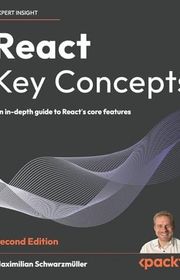
React Key Concepts: An in-depth guide to React's core features
For developers who want concise explanations and exercises that consolidate React's central ideas. The organization suits reviewing concepts between projects, though readers should select the relevant edition and expect less sustained project immersion than a single-application tutorial.
What it's about
Maximilian Schwarzmüller explains React through components, props, state, events, Hooks, and application structure. Examples and exercises connect the core ideas, while the updated edition extends the discussion to server components, actions, routing, and related application patterns.

For JavaScript developers who learn through worked examples and project development. Its practical progression makes interface construction tangible, though readers should check the edition because the original and later treatment reflect different React APIs and development tools.
What it's about
Azat Mardan introduces React through examples, tutorials, and a substantial project developed across the book. Instruction builds on existing JavaScript and web development knowledge, connecting components and data flow with techniques for constructing interactive application interfaces.

Advanced React: Deep dives, investigations, performance patterns and techniques
For developers who already build React applications but want clearer explanations of rendering and performance behavior. Its investigations connect common bugs with underlying mechanisms, though it assumes practical experience and is not a general introduction or full-stack course.
What it's about
Nadia Makarevich examines React rendering, reconciliation, component composition, memoization, Context, refs, and effects. Problem-led examples explore why applications behave as they do and compare patterns for addressing performance issues, stale closures, and data-fetching problems.

For developers who know React and want focused practice with state, effects, and reusable Hooks. Its refactoring examples make the shift from classes concrete, though library integrations and some patterns in the original edition need checking against current guidance.
What it's about
Daniel Bugl explains React Hooks for developers already familiar with React. Examples show how to manage state and effects, combine Hooks, use Context, and refactor class components, with additional discussion of integrating state management tools such as Redux and MobX.

React in Action
For developers who want a worked introduction that connects components with fuller application concerns. The practical progression offers useful context, though its older React and state-management patterns need interpretation before being applied to a new project.
What it's about
Mark Tielens Thomas introduces React through practical examples of components, rendering, data flow, forms, and routing. The book also examines testing, third-party libraries, Redux state management, and server-side rendering, connecting core concepts with fuller web application development.

For readers who want a compact roadmap connecting web fundamentals with React and interview preparation. Its broad orientation can help organize study, though the abbreviated treatment provides less depth than a sustained application tutorial or dedicated reference.
What it's about
Sleepless Yogi offers a roadmap from basic HTML to advanced React development through concise explanations and examples. The guide includes coding practices, debugging advice, interview preparation, and project steps intended to help readers apply web development concepts in practical work.
Sources
- 1
Top 6 Books to learn React.js for Beginners in 2026 - Best of Lot
java67.com
- 2
7 Best React Books For Beginners & Seniors [2024]
alvarotrigo.com
- 3
Top 7 Best Books to Learn React JS
geeksforgeeks.org
- 4
Top Books on React JS Every Software Developer Should Read in 2024
turing.com
- 5
Learn React Js - Top Books and Tutorials
educba.com
- 6
Reactjs Books
goodreads.com
- 7
Best React Courses, Books & Materials [2026]
jobroadmaps.com
- 8
What's the best book on ReactJS?
reddit.com







Edited by
Software engineer whose passion for tracking book recommendations from podcasts inspired the creation of MRB.
Lead investor at 3one4 Capital whose startup expertise and love for books helped shape MRB and its growth.
Comments
Spotted a missing book, a wrong order or a mistake? Tell us and we'll fix this page.
We're a reading guide, not the author or publisher, so we can't send books or pass on messages.