
11 Best Libertarian Books
The best libertarian books, ranked by how many expert sources recommend each one, with notes to help beginners and experienced readers choose where to start.
Our take
Libertarian books ask where personal freedom ends and political authority begins. Some build their case around individual rights and consent. Others explain markets, criticize state intervention, or explore how people might cooperate voluntarily. The books here also differ in form: a novel can make a political ideal vivid, while an economic treatise or a history gives you a different way to examine it.
For economic background, Economics in One Lesson offers a shorter entry point than Human Action or Man, Economy, and State with Power and Market. For a New Liberty: The Libertarian Manifesto develops a broader political argument. No Treason: The Constitution of No Authority presses the question of consent, while Democracy in America examines the institutions and habits that can protect liberty within democratic society. Read Radicals for Capitalism: A Freewheeling History of the Modern American Libertarian Movement for context on the people and disputes behind the ideas. Start with the question that interests you, then compare authors who give different answers.
11 books · 8 sources · Last updated
As an Amazon Associate, we earn from qualifying purchases (at no extra cost to you).
How to choose from this list
Skip to the full rankingIf you're new to economic arguments: Economics in One Lesson → Basic Economics
If you want to examine political consent: No Treason → For a New Liberty
If you want deeper economic theory: Human Action → Man, Economy, and State with Power and Market
If you prefer fiction: The Moon Is a Harsh Mistress → Atlas Shrugged
If you want historical context: Democracy in America → Radicals for Capitalism
The 11 books, ranked
Ranked by how many expert sources name each book. Ties go to the book more people recommend.

For readers who want the theoretical foundations behind Austrian economic arguments. Its framework links purposeful action with markets and intervention, though the length and abstract reasoning make it demanding as a first economics book.
What it's about
Ludwig von Mises presents a broad account of economics grounded in purposeful human action. The treatise develops his Austrian economic framework and defense of capitalism, moving from basic principles to more complex economic questions.
Also recommended by
3 people Charles Koch recommended this book
Charles Koch
"[One of four books] where I learned how the world works." - Charles Koch
Charles Koch's recommendation of this book  Mark Spitznagel recommended this book
Mark Spitznagel
"A monumental economics treatise from 1949." - Mark Spitznagel
Mark Spitznagel's recommendation of this book  Rand Paul recommended this book
Rand Paul
On Rand Paul's website's "reading suggestions for students" section.
Rand Paul's recommendation of this book
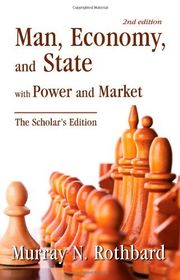
Man, Economy, and State with Power and Market
For readers prepared to study Austrian economics in depth rather than sample introductory arguments. Its extended treatment connects economic principles with intervention, though the combined volume requires a substantial commitment of time and concentration.
What it's about
Rothbard develops an account of production, exchange, prices, money, and economic coordination from individual action. This combined edition includes Power and Market, which applies his framework to taxation, regulation, and other forms of government intervention.
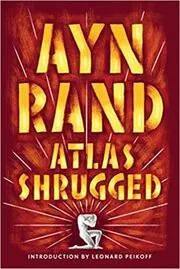
Atlas Shrugged
For readers interested in the moral case for individual achievement through a novel of ideas. Its sustained focus on producers distinguishes it from policy books here, but long speeches and stark characters demand patience.
What it's about
As the economy buckles under political controls, railroad executive Dagny Taggart and steelmaker Hank Rearden try to keep the country running while its best minds vanish. The mystery of John Galt hangs over every crisis.
Also recommended by
23 people Elon Musk recommended this book
Elon Musk
"A counterpoint to communism and useful as such, but should be tempered with kindness." - Elon Musk
Elon Musk's recommendation of this book  Steve Jobs recommended this book
Steve Jobs
Steve Wozniak said he thinks Steve Jobs mentioned this book and it really was a guide in his life.
Steve Jobs's recommendation of this book  Peter Thiel recommended this book
Peter Thiel
"When I first read [Ayn Rand's books] in the late 80s, it felt pretty crazy. And in the last decades, it's in many ways felt much more correct." - Peter Thiel
Peter Thiel's recommendation of this book  Shah Rukh Khan recommended this book
Shah Rukh Khan
One of Shah Rukh Khan's favorite novels.
Shah Rukh Khan's recommendation of this book  Joe De Sena recommended this book
Joe De Sena
"Loved [this book]. Read often." - Joe De Sena
Joe De Sena's recommendation of this book  Peter Diamandis recommended this book
Peter Diamandis
"Something I’ve read multiple times to get me in the mindset of not letting anything stand in my way" - Peter Diamandis
Peter Diamandis's recommendation of this book +17
More recommendations
- Ev Williams
On the "books read" section of Ev Williams' GoodReads profile.
- Gabby Reece
"[I read this book when] I was 15, and I gave [it] to a lot of people because it shifted how I looked at certain things." - Gabby Reece
- Travis Kalanick
Travis Kalanick mentioned this book in a Washington Post interview.
- Brian Armstrong
"Celebrate the creators in the world (even when they struggle). They may be more valuable than we think." - Brian Armstrong
- Amelia Boone
"When I read [this book] in my teens, Dagny Taggart’s character spoke to me on a level I’d never experienced with any other novel." - Amelia Boone
- Bob Metcalfe
"My favorite book." - Bob Metcalfe
- Blake Scholl
"Far and away my favorite book." - Blake Scholl
- Fred Wilson
Fred Wilson recommended this book on his blog.
- Phil Jackson
"I consider it philosophical." - Phil Jackson
- John Carmack
"If you can't see its archetypes in the world around you, you aren't paying attention." - John Carmack
- Mark Cuban
"I'll read it again. So there goes another 3 weeks of me reading it for the tenth time." - Mark Cuban
- Ray Dalio
"Regarding economics, if you haven’t read [this author] lately, I suggest that you do." - Ray Dalio
- Austen Allred
"I really liked it." - Austen Allred
- Russell Brunson
"It is so good!!!" - Russell Brunson
- Paul Krugman
"About a fantasy world whose unrealism can seriously warp your personality and outlook." - Paul Krugman
- Rand Paul
On Rand Paul's website's "reading suggestions for students" section.
- Patrick Bet-David
Patrick Bet-David recommended this book on his website.
- Ev Williams

For beginners who want a short framework for evaluating economic policy. Its repeated attention to indirect consequences makes the reasoning easy to practice, though the argument presents a strongly market-oriented perspective.
What it's about
Henry Hazlitt introduces economic ideas through critiques of policies and common assumptions. Writing from a free-market perspective, he examines government intervention and argues for considering the wider consequences of economic decisions.
Also recommended by
7 people Naval Ravikant recommended this book
Naval Ravikant
"Great book. Required reading." - Naval Ravikant
Naval Ravikant's recommendation of this book  Ben Shapiro recommended this book
Ben Shapiro
"[If you read this book and "Basic Economics"] you'll know more than all or your classmates combined about the basic workings of free markets and economics." - Ben Shapiro
Ben Shapiro's recommendation of this book  Ryan Petersen recommended this book
Ryan Petersen
Ryan Petersen mentioned this book on Twitter.
Ryan Petersen's recommendation of this book - Mark Spitznagel recommended this book
Mark Spitznagel
"If I am able to get my children to read only one economics text in their lifetime, God forbid, it would be [this book]." - Mark Spitznagel
Mark Spitznagel's recommendation of this book  Changpeng Zhao recommended this book
Changpeng Zhao
"There are few books that better encapsulate the inner workings of economics than this one." - Changpeng Zhao
Changpeng Zhao's recommendation of this book  Peter Schiff recommended this book
Peter Schiff
Peter Schiff recommended this book on his website.
Peter Schiff's recommendation of this book +1
More recommendations
- Rand Paul
On Rand Paul's website's "reading suggestions for students" section.
- Rand Paul
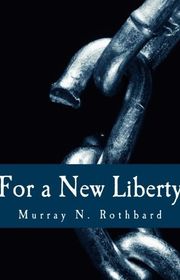
For a New Liberty: The Libertarian Manifesto
For readers seeking a systematic case for a society organized around voluntary exchange. It carries libertarian principles into practical institutions, though its rejection of the state is more radical than limited-government approaches.
What it's about
Murray Rothbard develops a libertarian argument from individual rights and property to social institutions. He considers how services associated with government might operate through voluntary arrangements, making the book a sustained statement of his anarchist position.
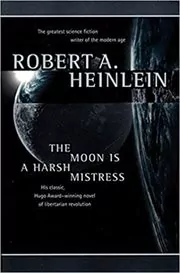
The Moon Is a Harsh Mistress
For readers who would rather explore freedom through science fiction than a political treatise. Its imagined society makes competing ideas tangible, though a revolutionary adventure cannot establish whether those arrangements would work in practice.
What it's about
On Luna, a penal colony turned rough‑and‑ready society, a self‑aware computer and a handful of rebels plot independence from Earth. Their revolution plays out through underground organizing, orbital mechanics, and debates about what real freedom and self‑government might look like.
Also recommended by
6 people- Elon Musk recommended this book
Elon Musk
One of Elon Musk's favorite books about space.
Elon Musk's recommendation of this book  Paul Graham recommended this book
Paul Graham
"Made me want to work on AI, which led to Lisp." - Paul Graham
Paul Graham's recommendation of this book  John Carmack recommended this book
John Carmack
John Carmack mentioned this book on Twitter.
John Carmack's recommendation of this book  Bill Gates recommended this book
Bill Gates
"Probably the [science fiction book] I read the most when I was younger." - Bill Gates
Bill Gates's recommendation of this book  Christopher Sommer recommended this book
Christopher Sommer
"I’m a big fan of [the author]." - Christopher Sommer
Christopher Sommer's recommendation of this book  Ryan Shea recommended this book
Ryan Shea
Ryan Shea recommended this book on his website.
Ryan Shea's recommendation of this book

Radicals for Capitalism
A Freewheeling History of the Modern American Libertarian Movement
For readers who want to understand how American libertarianism developed through people and institutions. Its historical approach helps explain disagreements within the movement, though its United States focus offers limited coverage of other traditions.
What it's about
Brian Doherty traces the modern American libertarian movement through its influential thinkers and activists. Research and interviews connect their unconventional lives with the movement's changing ideas and its place in American political history.
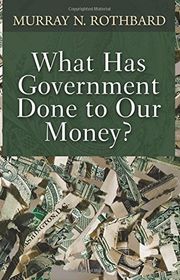
What Has Government Done to Our Money?
For readers who want a short introduction to Rothbard’s view of money and banking. Its narrow focus is easier to approach than his economic treatise, though its argument favors commodity money rather than surveying competing monetary theories.
What it's about
Murray Rothbard explains his account of money’s origins, monetary exchange, banking, and government control over currency. The essay connects changes in monetary institutions with his broader argument for markets and against state management of money.

Democracy in America
For readers asking how democratic equality can coexist with personal liberty. Its attention to associations and majority power broadens the discussion beyond markets, though nineteenth-century observations need interpretation rather than direct application today.
What it's about
Alexis de Tocqueville examines American society and democratic institutions through observations from his travels. His analysis considers equality, majority power, civil associations, religion, and individualism, exploring both the opportunities of democratic life and the dangers it poses to liberty.
Also recommended by
2 people Patrick Collison recommended this book
Patrick Collison
Patrick Collison labeled this book "particularly great."
Patrick Collison's recommendation of this book  Patrick Bet-David recommended this book
Patrick Bet-David
Patrick Bet-David recommended this book on his website.
Patrick Bet-David's recommendation of this book

For readers ready to question the foundations of political consent. Its direct challenge to constitutional authority goes further than arguments for limited government, though the nineteenth-century American setting requires some historical context.
What it's about
Lysander Spooner argues that the United States Constitution cannot bind people who have never personally consented to it. His essay challenges claims of political authority and examines whether voting or paying taxes constitutes voluntary agreement.
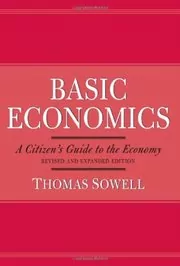
Basic Economics
For newcomers who want economic concepts explained without equations or graphs. Its wide range of examples offers more introductory breadth than a short political essay, though the argument consistently favors market solutions.
What it's about
Written for general readers, this book explains core economic ideas—scarcity, prices, profits and losses, trade, and inflation—without graphs or equations. Sowell uses examples from everyday life and history to show how different systems encourage prosperity or waste.
Also recommended by
1 person- Ben Shapiro recommended this book
Ben Shapiro
"[If you read this book and "Economics in One Lesson"] you'll know more than all or your classmates combined about the basic workings of free markets and economics." - Ben Shapiro
Ben Shapiro's recommendation of this book
Sources
- 1
Learn Liberty | Centre for Liberty
centreforliberty.org
- 2
What are some good books on libertarianism
reddit.com
- 3
Best Libertarian Books on Liberty, Economics, and the State
spreadgreatideas.org
- 4
Best Libertarian Books (391 books)
goodreads.com
- 5
Literature - Scottish Libertarian Party
scottishlibertarians.com
- 6
What are some of the Essential Libertarian books?
reddit.com
- 7
The Best Books on Libertarianism - Five Books Expert Recommendations
fivebooks.com
- 8
The 10 Best Libertarian Books for Beginners - Art for Liberty
artforliberty.com




Edited by
Software engineer whose passion for tracking book recommendations from podcasts inspired the creation of MRB.
Lead investor at 3one4 Capital whose startup expertise and love for books helped shape MRB and its growth.
Comments
Did we miss something? Have feedback?
Help us improve this page by sharing your thoughts