
11 Best iOS Development Books
The best iOS development books, ranked by how many expert sources recommend each one, with notes for beginners and developers choosing Swift and app guides.
Our take
Learning iOS development involves both a programming language and the frameworks that turn code into a working app. These books separate into Swift courses, guided application projects and specialist discussions of interfaces or architecture. Before choosing, check whether you want UIKit or SwiftUI and whether the book’s Swift and Xcode versions match the tools you plan to use.
iOS 26 Programming for Beginners offers a recent UIKit-based project route. SwiftUI for Masterminds centers on SwiftUI, while Thinking in SwiftUI helps developers with previous app experience understand the declarative approach. Swift Programming: The Big Nerd Ranch Guide concentrates on language foundations; Advanced Swift goes further into abstraction and implementation. App Architecture compares ways to organize components and state. Older guides such as iOS 15 Programming Fundamentals with Swift can still explain platform concepts, but their code and tool instructions require verification.
Start with a guided project if you need a working first app, or strengthen your Swift foundations before moving to interface and architecture books.
11 books · 8 sources · Last updated
As an Amazon Associate, we earn from qualifying purchases (at no extra cost to you).
How to choose from this list
Skip to the full rankingIf you want a guided UIKit project: iOS 26 Programming for Beginners
If you want a SwiftUI course: SwiftUI for Masterminds
If you're moving from UIKit to SwiftUI: Thinking in SwiftUI
If you need stronger Swift foundations: Swift Programming: The Big Nerd Ranch Guide → Advanced Swift
If you're comparing application structures: App Architecture
If you want detailed platform foundations: iOS 15 Programming Fundamentals with Swift
The 11 books, ranked
Ranked by how many expert sources name each book. Ties go to the book more people recommend.
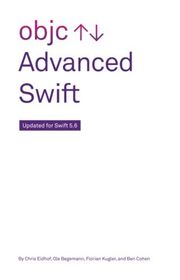
Advanced Swift
For programmers ready to examine Swift beyond introductory syntax. Its movement between generics, protocols and lower-level behavior encourages deeper language understanding, but the linked Swift 5.6 edition requires consulting current documentation for newer features.
What it's about
Chris Eidhof and coauthors examine advanced Swift concepts, ranging from generics and protocols to lower-level programming concerns. Examples explore how language features support different levels of abstraction, helping experienced readers reason about implementation choices and Swift’s underlying behavior.
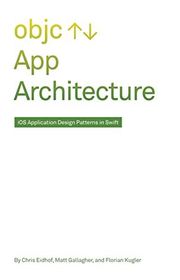
App Architecture
For developers who want to compare architectural choices through implementations of shared problems. Its multiple-pattern approach makes tradeoffs visible, but it assumes app-building experience and predates newer SwiftUI-specific architecture and observation practices.
What it's about
Chris Eidhof, Matt Gallagher and Florian Kugler examine how iOS applications organize components, communication and state. Five architectural patterns are explained conceptually and through implementation, allowing readers to compare familiar approaches with more experimental alternatives for structuring application code.

For learners who need structured Swift practice before concentrating on iOS frameworks. Its exercises develop language understanding through small programs and apps, but the linked edition uses Swift 5.3 and Xcode 12 rather than current versions.
What it's about
Mikey Ward, Matthew Mathias, and John Gallagher introduce Swift through explanations and hands-on exercises using Swift 5.3 and Xcode 12. Playground experiments develop language fundamentals before readers build sample command-line programs and applications for macOS and iOS.
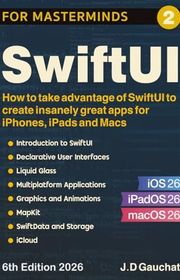
SwiftUI for Masterminds
For learners who want an extended course centered on SwiftUI app development. The linked edition provides a route through SwiftUI using iOS 26 tools, but the substantial scope takes more commitment than a compact conceptual guide.
What it's about
J. D. Gauchat develops SwiftUI application skills through a structured course covering framework fundamentals and practical app construction. The linked edition uses Swift 6.2, Xcode 26 and iOS 26, with coverage extending to applications for other Apple devices.
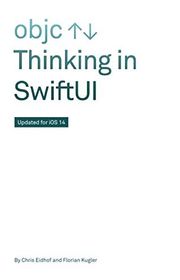
Thinking in SwiftUI
For developers who already know Swift and need to change how they reason about interfaces. Its concise conceptual approach supports the move from UIKit to SwiftUI, but it is not a complete beginner course or exhaustive reference.
What it's about
Chris Eidhof and Florian Kugler explain the ideas behind SwiftUI’s declarative approach to interface development. Focused explanations and exercises help developers with prior app-building experience form a mental model, rather than work through a comprehensive catalog of framework features.
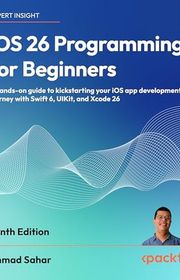
iOS 26 Programming for Beginners
For beginners who want a guided UIKit app using a recent toolchain. Its journal project connects interface building with persistence and platform features, but the UIKit-first approach is less direct for readers specifically seeking SwiftUI.
What it's about
Ahmad Sahar introduces iOS app development using Swift 6 and Xcode 26. A journal application develops UIKit, navigation, persistence, media and mapping skills through progressive exercises, with additional attention to testing and preparing an app for deployment.

For programmers who want the reasoning behind Swift, Xcode projects and Cocoa behavior. Its detailed explanations make it useful beyond a quick tutorial, but this edition’s Swift 5.5 and Xcode 13 details need checking against current tools.
What it's about
Matt Neuburg explains Swift 5.5, Xcode 13, and Cocoa fundamentals for iOS development. The guide covers objects, protocols, generics, project structure, nib loading, event-driven programming, and interoperability with C and Objective-C, establishing the foundations behind application behavior.
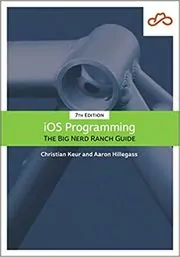
For learners who want concepts reinforced through hands-on application projects. Its training-course structure connects interface, networking and persistence work, but the linked edition predates current platform changes and requires checking version-specific instructions.
What it's about
Christian Keur and Aaron Hillegass teach iOS development through hands-on applications and explanations of platform concepts. Based on Big Nerd Ranch training, this edition uses Swift and covers interface layout, web services, data persistence, and other essential techniques.

For readers who learn best by developing one application through multiple stages. Its Selfiegram project links Swift with practical app concerns, but the Swift 4 edition needs significant updating before following its code in current tools.
What it's about
Jonathon Manning, Paris Buttfield-Addison, and Tim Nugent teach Swift 4 by building Selfiegram, an iOS application for taking and editing selfies. Lessons combine language fundamentals with interface design, notifications, sharing, localization, debugging, performance testing, and preparing an application for release.
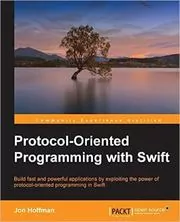
Protocol-Oriented Programming with Swift
For Swift programmers who want to compare protocol-based design with familiar object-oriented approaches. Its focused examples clarify shared behavior and value types, but the Swift 2 syntax needs substantial translation for present-day use.
What it's about
Jon Hoffman explains protocol-oriented programming in Swift 2 through examples comparing it with object-oriented design. The guide explores protocols, extensions, reference and value types, tuples, and design patterns, showing how shared behaviors can support a flexible application codebase.

Mastering Swift 5.3
Upgrade Your Knowledge and Become an Expert in the Latest Version of the Swift Programming Language
For programmers who know the basics and want stronger Swift language skills. Its treatment of protocols, value types and memory supports more deliberate design, but Swift 5.3 examples predate later concurrency and language changes.
What it's about
Jon Hoffman develops Swift 5.3 skills from core syntax to generics, concurrency, closures, and memory management. Later chapters examine protocol-oriented design, custom value types with copy-on-write behavior, and avoiding strong reference cycles, with practical examples throughout.
Sources
- 1
Awesome iOS Books
github.com
- 2
Books
iosfeeds.com
- 3
Books
objc.io
- 4
Swift Books
educba.com
- 5
Top 10 Swift Books For Learning iOS Development
whatpixel.com
- 6
Best book for new iOS dev (but not completely new developer)?
reddit.com
- 7
Ios Development Books
goodreads.com
- 8
Best iOS Development Books to Jumpstart Your Swift Journey in 2026
gearsagebook.com



Edited by
Software engineer whose passion for tracking book recommendations from podcasts inspired the creation of MRB.
Lead investor at 3one4 Capital whose startup expertise and love for books helped shape MRB and its growth.
Comments
Did we miss something? Have feedback?
Help us improve this page by sharing your thoughts