
13 Best Improv Books
The best improv books, ranked by how many expert sources recommend each one, with notes to help performers and teachers choose scene work, games, and theory.
Our take
Improv books explore how people create scenes together without a script. Some offer theater games for a workshop; others explain comic patterns, storytelling, character, or the attention needed to respond to a partner. They can give performers a useful vocabulary for practice, but the approaches differ enough that choosing a book means choosing what you want to work on.
Truth in Comedy introduces connected long-form work through the Harold, while the Upright Citizens Brigade Comedy Improvisation Manual makes the comic game central. Impro takes a wider theatrical view through status and spontaneity. Teachers can turn to Improvisation for the Theater for games, and performers frustrated by rules may find a different perspective in Improvise or A Subversive’s Guide to Improvisation. Improv Wisdom brings these attitudes into everyday life.
Start with a broad introduction if you are new, then choose a more focused book to support the scenes and exercises you are actually practicing.
13 books · 10 sources · Last updated
As an Amazon Associate, we earn from qualifying purchases (at no extra cost to you).
How to choose from this list
Skip to the full rankingIf you're new to improv: The Improv Handbook
If you want to explore the Harold: Truth in Comedy → Art by Committee
If you want comic game and scene structure: Upright Citizens Brigade Comedy Improvisation Manual
If you teach workshops: Improvisation for the Theater → Impro for Storytellers
If rules are making you hesitate: Improvise → A Subversive's Guide to Improvisation
If you want patient, attentive scene work: Improvisation at the Speed of Life
The 13 books, ranked
Ranked by how many expert sources name each book. Ties go to the book more people recommend.

For performers curious about status, spontaneity, and how people inhibit imagination. Its theatrical perspective differs from comedy manuals built around scene formulas, though the essays and mask work are less immediately usable as a practice plan.
What it's about
Keith Johnstone presents techniques for developing spontaneity and imagination in theatrical improvisation. Drawing on teaching and performance experience, he explores status, narrative skills, masks and trance through exercises intended to help actors respond more freely and inventively.
Also recommended by
2 people Patrick O'Shaughnessy recommended this book
Patrick O'Shaughnessy
"I found more interesting-ness per page than anything else I’ve read in a long time." - Patrick O'Shaughnessy
Patrick O'Shaughnessy's recommendation of this book  James Clear recommended this book
James Clear
"[One of] the 10 books with the most page-for-page wisdom." - James Clear
James Clear's recommendation of this book

For improvisers who become stuck trying to obey every rule. Its focus on what actually happens within a scene offers a practical reset, though beginners may need experience on stage to recognize the problems it addresses.
What it's about
Mick Napier examines why improvised scenes succeed or stall, questioning conventional rules and the assumptions behind them. Practical discussion covers two-person and group scenes, entrances, richer scene development, auditions, and exercises that performers can practice on their own.

For ensembles beginning to explore the Harold and connected long-form scenes. Its attention to shared patterns provides a useful foundation, though the historical Chicago perspective is narrower than a survey of all improv traditions.
What it's about
Charna Halpern, Del Close, and Kim Howard Johnson introduce long-form improvisation through the Harold. The manual explains how an ensemble can connect scenes, games, and monologues through pattern recognition, building comedy from shared discoveries and changing audience expectations.

Upright Citizens Brigade Comedy Improvisation Manual
For performers who want a structured approach to finding and developing a scene’s comic game. Its detailed exercises make the method explicit, though its particular long-form style is one approach among several.
What it's about
Matt Besser, Ian Roberts, and Matt Walsh explain the Upright Citizens Brigade approach to long-form comedy improvisation. Exercises develop two-person scenes and the recurring comic pattern called the game, then extend those skills into ensemble structures such as the Harold.

How to be the Greatest Improviser on Earth
For performers who understand basic scene work but still have questions about presence, authenticity, and difficult partnerships. Its conversational advice addresses working improvisers directly, though it is less suitable as a complete curriculum for a first class.
What it's about
Will Hines explores advanced questions in long-form comedy improvisation, moving beyond basic rules to presence, authenticity, humor, and working with difficult performers. His guide also considers the performer's well-being, connecting performance skills with the experience of sustaining an improv practice.

For teachers and directors who need exercises that put attention into action. Its theater games offer a deeper workshop resource than most scene manuals, though the extensive instructions reward preparation rather than casual browsing.
What it's about
Viola Spolin presents theater games and improvisational exercises as tools for teaching, directing, and developing performers. Her approach uses practical workshop problems to strengthen awareness, physical expression, speech, character work, and collaborative creativity in rehearsal and performance.

For beginners or groups wanting a broad introduction rather than a single school’s doctrine. Its combination of practice, discussion, and context offers range, though readers seeking one compact step-by-step curriculum may find that breadth distracting.
What it's about
Tom Salinsky and Deborah Frances-White combine a history of improvisational theatre with practical guidance on performing it. The book explores spontaneity, storytelling, collaboration, character development, and different traditions of improvisation, offering approaches for beginners and more experienced performers.

For ensembles already familiar with the Harold who want more context for collaborative long-form work. It develops ideas associated with Truth in Comedy, though newcomers will benefit from establishing the basics before tackling this extension.
What it's about
Charna Halpern develops ideas from Truth in Comedy through a closer look at advanced improvisation and its history. The book explores the evolution of the Harold, collaborative performance, and the influence of Del Close on the development of long-form theatre.

Impro for Storytellers
For teachers and performers who want to develop narrative play and group practice. Its games and teaching observations extend Johnstone’s earlier ideas, though the wealth of material is easier to use selectively than to absorb at once.
What it's about
Keith Johnstone expands his approach to improvisation with exercises, games and teaching guidance. He explores Theatresports, audience suggestions, feedback, spontaneity and character, emphasizing group play and ways to develop stories while learning to accept failure.
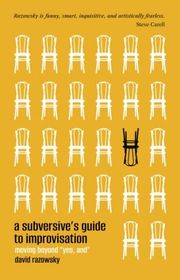
A Subversive's Guide to Improvisation
For improvisers who want to move beyond treating familiar rules as instructions for every scene. Its attention to observation and connection offers a distinct alternative, though readers expecting a conventional introductory curriculum may find it challenging.
What it's about
David Razowsky presents an approach to improvisation based on awareness, emotional connection, and responding to scene partners. Exercises and reflections question familiar rules, encouraging performers to build scenes from what they observe in the moment.

Improvisation at the Speed of Life
For experienced performers interested in patient scenes built through attention and relationship. Its account of the duo’s process offers a contrast to game-centered manuals, though it is more reflective than a ready-made set of exercises.
What it's about
T.J. Jagodowski and David Pasquesi discuss their approach to improvised performance with Pam Victor. The book explores listening, partnership, character, and discovering a scene through careful attention to what is already happening between performers.

The Second City Almanac of Improvisation
For readers interested in how improvisation connects with sketch development and an institution’s working culture. Its multiple contributors provide varied perspectives, though the anthology format is less consistent than a manual by one author.
What it's about
Anne Libera guides readers through essays, memories, and practical instruction from Second City teachers, actors, and directors. The collection explores its approach to improvisation and sketch development, including object work, revising material, and debates about long-form and short-form performance.

For readers who want to apply improvisational attitudes to ordinary uncertainty and conversation. Its short, approachable reflections reach beyond performance, though it offers less scene technique than the theater and comedy manuals.
What it's about
Patricia Ryan Madson applies principles of improvisational theatre to ordinary life, suggesting ways to respond when plans change. Her guide connects the attitudes used by actors and musicians with challenges at work, in relationships, and amid everyday uncertainty.
Sources
- 1
Improv Books: Reviews & Recommendations
improvillusionist.com
- 2
Improv books we can recommend
hooplaimpro.com
- 3
The Best Books on Improv (Updated)
korymathewson.com
- 4
Required Reading For Improv Students
crackpotcomedy.com
- 5
Recommended Improv Books and Podcasts
improvglasgow.co.uk
- 6
ImprovCoaches.com - Boston | Improv Books & Resources
boston.improvcoaches.com
- 7
The Books of Improv
goodreads.com
- 8
Big Ol' List of Improv Books (2026)
reddit.com
- 9
Recommended Reading for Improvisers
stompinggroundcomedy.org
- 10
Since everybody is sharing their improv libraries:
reddit.com







Edited by
Software engineer whose passion for tracking book recommendations from podcasts inspired the creation of MRB.
Lead investor at 3one4 Capital whose startup expertise and love for books helped shape MRB and its growth.
Comments
Spotted a missing book, a wrong order or a mistake? Tell us and we'll fix this page.
We're a reading guide, not the author or publisher, so we can't send books or pass on messages.