
11 Best Content Marketing Books
The best content marketing books, ranked by how many expert sources recommend each one, with notes for writers, content managers, and audience builders.
Our take
Content marketing involves more than keeping a publishing schedule full. A useful program connects audience needs with a business purpose, then makes decisions about topics, formats, distribution, and measurement. These books approach different parts of that work. Some help a writer improve the next draft; others address the systems and customer experiences surrounding everything a team publishes.
Start with Everybody Writes if creating clear, useful material is your immediate task. Epic Content Marketing and Practical Content Strategy & Marketing offer broader planning frameworks, while The Content Fuel Framework concentrates on generating ideas. They Ask, You Answer connects customer questions with sales, and Content Chemistry focuses on the website and promotion side of the work. For an audience-first business, consider Content Inc.; for stronger community relationships, try Superfans. Choose the book that addresses the weakest part of your current process before expanding your reading list.
11 books · 9 sources · Last updated
As an Amazon Associate, we earn from qualifying purchases (at no extra cost to you).
How to choose from this list
Skip to the full rankingIf you write the content yourself: Everybody Writes
If you need a content program: Epic Content Marketing → Practical Content Strategy & Marketing
If you need fresh ideas: The Content Fuel Framework
If content needs to support sales: They Ask, You Answer
If you manage website content and promotion: Content Chemistry
If you're building an audience-first business: Content Inc. → Superfans
The 11 books, ranked
Ranked by how many expert sources name each book. Ties go to the book more people recommend.

For marketers who write articles, emails, and other customer-facing material themselves. Its attention to drafting and revision makes it more immediately useful for improving individual pieces than the strategy books, though it is not a complete content operations manual.
What it's about
Ann Handley presents a practical guide to writing content for businesses and their audiences. She discusses developing ideas, organizing drafts, revising sentences, and approaching common marketing formats, emphasizing clarity and attention to the reader throughout the writing process.

They Ask, You Answer
A Revolutionary Approach to Inbound Sales, Content Marketing, and Today's Digital Consumer
For businesses whose prospects repeatedly ask questions that their published content avoids. Its connection between buyer education and sales makes the purpose concrete, though the approach is more suited to considered purchases than entertainment-led audience building.
What it's about
Marcus Sheridan builds a content marketing approach around answering buyers' questions openly and thoroughly. Drawing on his pool business and other company examples, he explains creating useful written and video content and connecting it with sales.

Content Inc.
For entrepreneurs considering an audience-first business rather than a content campaign for an existing product. The business model provides a different goal from conventional marketing manuals, though building trust before revenue requires time and an uncertain commercial payoff.
What it's about
Joe Pulizzi proposes building a loyal audience before developing products to sell it. His framework covers finding a distinctive content niche, choosing a primary publishing channel and converting occasional visitors into subscribers before pursuing revenue.

Epic Content Marketing
How to Tell a Different Story, Break through the Clutter, and Win More Customers by Marketing Less
For content managers who need a coherent plan connecting audience needs, production, distribution, and measurement. Its breadth provides a useful alternative to isolated writing tips, though readers seeking help with a single format may prefer a narrower handbook.
What it's about
Joe Pulizzi presents a process for creating content that attracts an audience without relying on sales interruptions. The guide covers selecting a niche, defining a mission, organizing production, distributing material and measuring performance through business case studies.
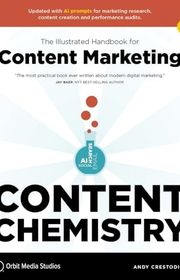
Content Chemistry: The Illustrated Handbook for Content Marketing
For marketers who want content connected with website traffic, promotion, and conversion. The illustrated explanations bridge strategy and practical web work, though its website-centered scope is less suited to creators focused entirely on other publishing channels.
What it's about
Andy Crestodina combines explanations and practical exercises about web content marketing. Topics connect attracting visitors with helping them take action, using search, social media, email, content creation, and promotion as parts of a coordinated website marketing effort.

For creators who regularly run out of angles on familiar subjects. Its repeatable brainstorming structure makes it more focused on idea generation than the broader strategy guides, though it does not decide which ideas deserve the budget or audience attention.
What it's about
Melanie Deziel offers a brainstorming system that combines ten story focuses with ten content formats. Examples and exercises show how changing either element can generate new approaches to familiar subjects, helping creators build a reusable source of ideas.

Practical Content Strategy & Marketing
The Content Strategy & Marketing Course Guidebook
For marketers who prefer a course-like sequence from research through production and promotion. Exercises help turn a general strategy into working habits, though tool references and tactical details need adapting as search and publishing platforms change.
What it's about
Julia McCoy presents a practical sequence for developing and carrying out a content marketing strategy. This course companion connects audience research and keyword selection with content creation, promotion, and measurement, using exercises to turn planning into repeatable work.

For marketers questioning how their work fits customers’ conversations and communities. The wider perspective can sharpen the purpose behind a content program, though it offers less step-by-step instruction for writing, distribution, or running an editorial calendar.
What it's about
Mark Schaefer argues that customers increasingly shape marketing through their conversations, communities, and experiences. Drawing on business examples, he explores how brands can build human connections, earn trust, and respond when traditional advertising gives them less control over their message.

Superfans
How to Capture Attention, Foster Community and Build the Most Loyal Following You Could Ever Imagine
For creators and businesses who want to strengthen relationships with an existing audience. Its community focus goes beyond attracting first-time attention, though the personal interactions it encourages take time and may be harder to sustain at scale.
What it's about
Pat Flynn outlines a path from first discovering a business or creator to becoming a devoted supporter. His guide focuses on trust, personal connection, and meaningful experiences that encourage people to become active members of a community.

F#ck Content Marketing
Focus on Content Experience to Drive Demand, Revenue & Relationships
For B2B marketers whose existing material is hard for buyers to find or navigate. Its focus on the experience surrounding content distinguishes it from creation manuals, though the organizational changes it proposes may be difficult for a small team.
What it's about
Randy Frisch argues that producing more content matters less than creating an effective experience around it. He examines how marketers organize material, personalize its delivery, and guide audiences toward engagement, connecting content strategy with organizational responsibilities and the buying journey.

The Context Marketing Revolution
How to Motivate Buyers in the Age of Infinite Media
For marketers who want to understand why the circumstances around a message affect its usefulness. The customer-experience perspective broadens discussion beyond publishing volume, though readers looking for a writing process or a ready-made content calendar will need another guide.
What it's about
Mathew Sweezey argues that marketing must fit the circumstances in which buyers encounter it. He uses research and company examples to explain context through availability, permission, personalization, authenticity, and purpose, connecting those ideas with the design of customer experiences.
Sources
- 1
The Best Content Marketing Books to Read in 2026
shorthand.co
- 2
The 17 Best Content Marketing Books To Read In 2026
thecmo.com
- 3
7 Best Content Marketing Books 2026 (Proven Strategy)
contentmavericks.com
- 4
Best Content Marketing Books Worth Reading in 2026
filipkonecny.com
- 5
Content Marketing Books
goodreads.com
- 6
Books related to content marketing
reddit.com
- 7
13 books recommended by a content marketer
reddit.com
- 8
What are the best Content Marketing Books available? A list of nine essential Content Marketing books to help Marketers Create Content
mmclearning.com
- 9
The best content marketing books of all time (chosen by content marketing authors)
bookdna.com




Edited by
Software engineer whose passion for tracking book recommendations from podcasts inspired the creation of MRB.
Lead investor at 3one4 Capital whose startup expertise and love for books helped shape MRB and its growth.
Comments
Spotted a missing book, a wrong order or a mistake? Tell us and we'll fix this page.
We're a reading guide, not the author or publisher, so we can't send books or pass on messages.