
Worlds Books in Order
Part ofJoe Haldeman Books in OrderSee the Worlds series by Joe Haldeman in order, with summaries, reading guidance, and background on Marianne O'Hara's orbiting future.
Last updated:
As an Amazon Associate, we earn from qualifying purchases (at no extra cost to you).
Worlds books in publication order
3 books

Worlds
by Joe Haldeman
1981
Marianne O'Hara leaves the orbital world of New New York to visit the old Earth below. What begins as an educational trip ends in catastrophe and a fight to survive a collapsing world order.
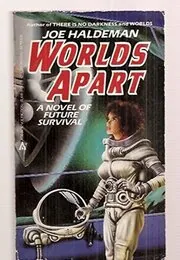
Worlds Apart
by Joe Haldeman
1983
A virus wipes out most adults, leaving Marianne O'Hara and other young survivors to piece together life in orbit and on a ruined Earth. The crisis turns the series from political future to survival story.

Worlds Enough and Time
by Joe Haldeman
1992
Marianne O'Hara leaves the shattered old world behind on an interstellar voyage to Newhome. The trilogy closes with long travel, political strain, and a dangerous meeting with aliens.
Worlds books in chronological order
Series background & context
The Worlds books are some of Joe Haldeman's most interesting social science fiction. Instead of beginning with war, they begin with habitat life and political structure. Much of humanity now lives in giant orbiting colonies called Worlds, and the first big point of tension is simple but rich. What kind of people are created by growing up above Earth, and what happens when that carefully managed life collides with the old planet below?
Marianne O'Hara stands at the center of it.
She comes from New New York, one of those orbital Worlds, and her story gives the trilogy both its emotional thread and its viewpoint on class, culture, and power. In the opening novel, a trip to Earth is supposed to be educational. Instead it becomes the start of catastrophe. Terror, system failure, and mass death pull the series away from polite future sociology and into survival.
That shift only gets sharper in the second book. The aftermath is brutal, with disease and social collapse leaving the younger generation to figure out what is left of civilization in orbit and on Earth. Marianne is still a link between worlds, but now the question is not only where she belongs. It is whether any stable future can be built at all when the adults, the governments, and the old assumptions have been cut out from under everyone.
By Worlds Enough and Time, the series stretches again. Humanity's answer to devastation is not just rebuilding, but going outward on an interstellar voyage toward a possible new home. That final movement gives the trilogy a larger scale without losing the earlier concern with politics, community, and how fragile social systems can be. Even far from Earth, the books keep asking who gets to lead, who gets heard, and what kind of future people are actually making.
These are not books built around one clean villain.
The tension usually comes from structures, from scarcity, from bad choices made under pressure, and from the fact that a society can look orderly right up until it isn't. Haldeman is very good at that kind of science fiction. He can make laws, customs, and economic arrangements feel as dramatic as a chase scene, because you can see how those things shape every private life inside them.
The orbiting setting matters in a practical way too. Space habitats here are not magic bubbles. They are engineered places with limited room, rules, infrastructure, and consequences. Earth matters because it is still the emotional original, even when it is damaged, politically fractured, or half mythic to people born off-planet.
So the Worlds series is a good pick if you want Haldeman at his most interested in society itself. You still get disaster, travel, and eventually aliens. But the real through line is Marianne O'Hara moving through systems that keep breaking and remaking the meaning of home.






%2C%20Book%202.jpg)
%2C%20Book%201.jpg)
%2C%20Book%203.jpg)


Edited by
Software engineer whose passion for tracking book recommendations from podcasts inspired the creation of MRB.
Lead investor at 3one4 Capital whose startup expertise and love for books helped shape MRB and its growth.
Comments
Did we miss something? Have feedback?
Help us improve this page by sharing your thoughts