
Uplift Saga Books in Order
Part ofDavid Brin Books in OrderSee the Uplift Saga books by David Brin in order, with quick summaries, series background, and help choosing where to start this big future-history adventure.
Last updated:
As an Amazon Associate, we earn from qualifying purchases (at no extra cost to you).
Uplift Saga books in publication order
8 books

Sundiver
by David Brin
1980
In a galaxy where every species has a patron except humanity, a mission toward the sun becomes a hunt for origins. Brin mixes first-contact politics, scientific risk, and a deep mystery about who uplifted us, if anyone.
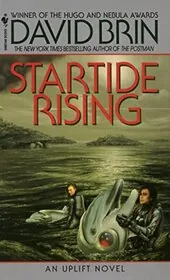
Startide Rising
by David Brin
1983
The dolphin-crewed Earthship Streaker discovers an ancient fleet and immediately becomes the prize in a galactic chase. Stranded on Kithrup, its human and uplifted crew must survive mutiny, siege, and the weight of a secret everyone wants.

The Uplift War
by David Brin
1987
While alien fleets fight over secrets uncovered in space, a brutal race seizes the human colony world Garth. Humans and their uplifted allies must hold out long enough to save far more than one planet.
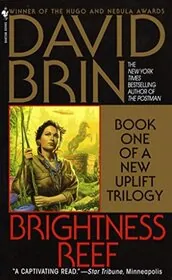
Brightness Reef
by David Brin
1995
On the forbidden world Jijo, human and alien settlers have built a fragile life by staying unnoticed. Then old secrets, new arrivals, and a dangerous curiosity begin to shake the peace from every direction.

Infinity's Shore
by David Brin
1996
Jijo's hidden settlers lose the safety of secrecy when starships crowd their sky and genocide becomes a real possibility. Humans and aliens alike must choose sides, while a band of youngsters stumbles into mysteries much larger than they expected.

Heaven's Reach
by David Brin
1998
The fugitives of Jijo brace for a last confrontation as ancient enemies close in and Streaker returns to the center of the crisis. What started as a hidden colony story expands into a struggle over the deepest secrets of galactic civilization.
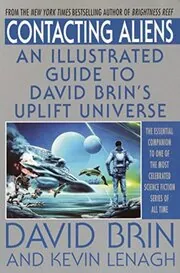
Contacting Aliens
by David Brin
2002
This illustrated guide opens up the Uplift universe, from alien races and customs to Earth's uneasy place in the Five Galaxies. It works as both a reference book and a tour through the background behind the novels.

Gorilla, My Dreams
by David Brin
2011
In this comic Uplift Universe story, humans, dolphins, and chimpanzees are debating which species to raise next. Then alien warships arrive with extinction on the schedule, and the argument turns urgent fast.
Uplift Saga books in chronological order
Series background & context
At the heart of the Uplift books is a wonderfully destabilizing idea. In Brin's far future, almost every intelligent species in the Five Galaxies was raised to full sentience by an older patron race. Uplift is not just education or kindness. It is biology, culture, debt, and law all tied together. Then humans arrive, already moving into space and already uplifting dolphins and chimpanzees, with no known patron to claim responsibility. That makes humanity interesting, suspect, and more than a little alarming to everybody else.
The first three books, Sundiver, Startide Rising, and The Uplift War, use that premise in different ways. Sundiver begins as a mystery around the sun and the ancient question of who set humanity on its path. Startide Rising widens the lens when the Earthship Streaker, crewed largely by uplifted dolphins, uncovers a discovery that can shake galactic history. The Uplift War brings the consequences down to one embattled colony world, where survival, alliance, and stubbornness matter as much as firepower.
Then Brin changes the rhythm.
The later books, Brightness Reef, Infinity's Shore, and Heaven's Reach, move to Jijo, a forbidden planet quietly settled by humans and several alien peoples who were not supposed to be there. Those books are less about a single ship in flight and more about a precarious shared society. Jijo matters because it lets Brin ask a different set of questions. Can outcasts build a workable civilization together? What happens when secrecy fails? What do people owe one another when every group carries a different history, myth, and grievance?
The series does not have one hero who carries everything. Instead, Brin works with ensembles: scientists, diplomats, soldiers, children, pilgrims, schemers, uplifted dolphins, uplifted chimpanzees, and a long parade of aliens who rarely think the way humans do. That gives the books a busy, layered feel. The stakes are huge, but the scenes often turn on a negotiation, an act of translation, a mistake, or one character seeing a problem from a completely different angle.
For all the big space-opera machinery, the appeal is not only the scale. It is the social pressure. Brin keeps asking what intelligence is for, who gets to guide whom, and whether a civilization can survive without becoming smug or cruel. The patron-client system sounds stable until you notice how much resentment, hierarchy, and fear it holds together. Humanity, with its improvising habits and half-tamed optimism, is both a problem and a possible answer.
Expect ancient artifacts, political standoffs, strange ecologies, and plenty of arguments about destiny. Expect a lot of ideas, too. But the series works because Brin keeps grounding those ideas in characters who are hungry, trapped, loyal, reckless, or trying to do one decent thing in a dangerous place. Uplift is cosmic in size, yet it keeps coming back to a very human question: what do we become when we start making new minds, and when older minds finally judge us for it?











Edited by
Software engineer whose passion for tracking book recommendations from podcasts inspired the creation of MRB.
Lead investor at 3one4 Capital whose startup expertise and love for books helped shape MRB and its growth.
Comments
Did we miss something? Have feedback?
Help us improve this page by sharing your thoughts