
Science In The Capital Books in Order
Part ofKim Stanley Robinson Books in OrderBrowse the Science in the Capital series by Kim Stanley Robinson in order, with plot summaries, series background on its Washington D.C. setting, and guidance on reading either the original trilogy or the revised omnibus Green Earth.
Last updated:
As an Amazon Associate, we earn from qualifying purchases (at no extra cost to you).
Science In The Capital books in publication order
4 books
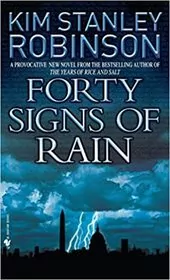
Forty Signs of Rain
by Kim Stanley Robinson
2004
Set in near-future Washington, D.C., the first Science in the Capital novel follows scientists Anna and Frank and policy aide Charlie as stalled politics meet abrupt climate shifts, culminating in catastrophic floods that force leaders to confront global warming.

Fifty Degrees Below
by Kim Stanley Robinson
2005
After Washington's flood, climatologist Frank Vanderwal chooses to stay at the National Science Foundation, experimenting with a quasi Stone Age lifestyle while helping design risky geoengineering schemes as a deep freeze grips the Northern Hemisphere.
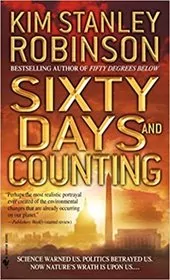
Sixty Days and Counting
by Kim Stanley Robinson
2007
In the trilogy's conclusion, a new U.S. administration takes office after an election fought on climate, and Frank, Anna, Charlie, and their allies race to stabilize weather systems and remake institutions while personal lives, politics, and spirituality collide.

Green Earth
by Kim Stanley Robinson
2015
This single-volume revision of the Science in the Capital trilogy compresses and updates Forty Signs of Rain, Fifty Degrees Below, and Sixty Days and Counting into one continuous near-future climate saga focused on Washington, D.C., politics and global environmental repair.
Science In The Capital books in chronological order
Series background & context
The Science in the Capital series looks at climate change not from spaceships or distant futures but from offices, townhouses, and flooded streets in present-day Washington, D.C. Across Forty Signs of Rain, Fifty Degrees Below, and Sixty Days and Counting, Robinson follows a loose circle of scientists, policy staffers, and politicians as they try to nudge a reluctant world toward serious climate action.
The first book, Forty Signs of Rain, introduces Anna Quibler, a program director at the National Science Foundation, her husband Charlie, a stay-at-home father who writes climate policy speeches for a liberal senator, and Frank Vanderwal, a visiting biomathematician. Their daily work with grant proposals, Senate bills, and institutional turf battles runs alongside the arrival of a small Buddhist delegation from the low-lying nation of Khembalung, which is already threatened by rising seas. As heat waves and storms build, a pair of extreme weather events finally flood Washington and strip away the illusion that climate change is only a distant problem.
Fifty Degrees Below shifts more tightly to Frank, who decides to stay on at the NSF after the flood. He experiments with a quasi Stone Age lifestyle in Rock Creek Park while working on abrupt-climate-change research and watching a deep winter freeze seize the Northern Hemisphere. Surveillance, experiments with geoengineering, and his evolving friendships with Anna, Charlie, and agency director Diane Chang give the book both its tension and its humor.
In Sixty Days and Counting a new American administration takes office after an election fought on climate issues. Senator Phil Chase moves into the White House, and the cast is pulled into a mix of high-level negotiations, grassroots organizing, and risky technical projects aimed at restarting ocean currents and drawing carbon out of the air. The trilogy closes on a cautiously optimistic note, with institutions beginning to change even as the damage already done has to be managed over generations.
The omnibus Green Earth compresses and lightly updates all three novels into a single, continuous narrative. Whether you read the original paperbacks or the revised volume, the series offers a grounded view of how scientists, civil servants, and activists might respond to crisis: lots of meetings, occasional breakthroughs, family juggling, and the sense that small choices inside big bureaucracies can still matter.
















Edited by
Software engineer whose passion for tracking book recommendations from podcasts inspired the creation of MRB.
Lead investor at 3one4 Capital whose startup expertise and love for books helped shape MRB and its growth.
Comments
Did we miss something? Have feedback?
Help us improve this page by sharing your thoughts