
Liu Cixin Books in Order
Browse all Liu Cixin books in order, with short summaries, series background on The Three-Body Problem and an easy guide to where to start reading his science fiction.
Last updated:
As an Amazon Associate, we earn from qualifying purchases (at no extra cost to you).
Liu Cixin books in publication order
26 books

Sun of China
by Liu Cixin
2001
A poor village boy leaves home for the city, drifting from menial work to a job on a gigantic orbital solar mirror called the Sun of China. His long journey becomes a reflection on ambition, spaceflight and the pull of the small road back home.

Devourer
by Liu Cixin
2002
An alien crystal warns that a vast "Devourer" fleet will soon strip the solar system of all matter, casually promising to raise humans as livestock. As its reptilian envoy toys with world leaders, Earth has to decide whether negotiation, resistance or sheer denial is even possible.
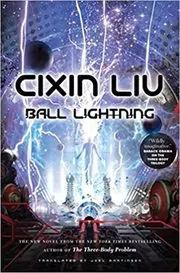
Ball Lightning
by Liu Cixin
2004
After ball lightning kills his parents, Chen devotes his life to understanding the phenomenon. His research with a driven army officer turns mysterious "macro-electrons" into devastating weapons, forcing him to choose between scientific curiosity and the human cost of his work.

The Cretaceous Past
by Liu Cixin
2005
Ants and dinosaurs form an improbable symbiotic civilization in the deep past, trading precision for strength. As pollution, weapons and mistrust escalate, their shared world hurtles toward catastrophe in a fable that mirrors modern debates about technology, class and ecological collapse.

The Wandering Earth
by Liu Cixin
2005
When the Sun threatens to engulf the planet, humanity mounts thousands of giant engines to push Earth out of the solar system toward a new star. One family witnesses riots, political upheaval and the raw cost of trying to turn an entire world into a starship.
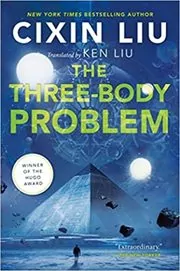
The Three-Body Problem
by Liu Cixin
2006
During China's Cultural Revolution, astrophysicist Ye Wenjie secretly contacts the unstable world of Trisolaris. Decades later, nanomaterials researcher Wang Miao uncovers a deadly conspiracy through a baffling VR game and a global breakdown of fundamental physics.
Recommended by
1 person Thomas Frank recommended this book
Thomas Frank
"Haven’t tore through a novel like that in quite a while. I couldn’t put it down. Highly recommended if you like sci-fi." - Thomas Frank
Thomas Frank's recommendation of this book
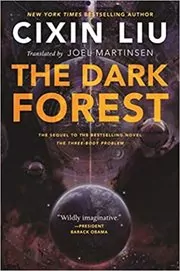
The Dark Forest
by Liu Cixin
2008
With a Trisolaran invasion fleet four centuries away and Earth's science under constant sophon surveillance, humanity creates the Wallfacer Project, giving four men power to plan in total secrecy. Reluctant strategist Luo Ji discovers a terrifying "dark forest" logic that might be the only deterrent to extinction.

The Micro-Age
by Liu Cixin
2008
A starship pilot returns to a ruined solar system and discovers that humanity has survived only by shrinking itself to microscopic scale. The tiny "micro-era" people describe their brutal war with full-sized humans, leaving him with one quiet but staggering ethical choice.

With Her Eyes
by Liu Cixin
2008
A tired traveler borrows experimental glasses that let a distant astronaut experience his vacation through his senses. As he learns where she is truly trapped, their shared glimpses of mountains and meadows become a bittersweet act of companionship and farewell.
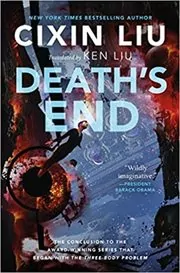
Death's End
by Liu Cixin
2010
In the final volume of the trilogy, aerospace engineer Cheng Xin inherits stewardship of humanity’s fragile peace with Trisolaris. Her choices pull her from near future politics to far future cosmic conflicts, revealing just how harsh the dark forest universe can be.

The Weight of Memories
by Liu Cixin
2010
In a near future lab, a fetus can speak and remember every moment of his mother's life thanks to an experiment that activates inherited memories. Their tender conversations slowly reveal how crushing another person's entire past can be for a brand new mind.

Mountain
by Liu Cixin
2012
A remorseful mountaineer exiles himself to life at sea, only to be drawn up a colossal "mountain" of water raised by visiting mechanical aliens. As they recount their own perilous ascent from a planet's core, he reconsiders what it means to keep climbing.

Taking Care of God
by Liu Cixin
2012
Billions of frail old men descend from the sky claiming to be humanity’s creators and asking to move in with their descendants. One family’s uneasy hospitality becomes a wry, moving look at aging, gratitude and what children owe the generations that made them.

The Longest Fall
by Liu Cixin
2012
Decades after a visionary plan to drill a tunnel through Earth’s core collapsed in scandal, its disgraced inventor is dragged back to answer for the fallout. A final test of the gravity powered transit system becomes both a thriller and a meditation on risk and responsibility.

Curse 5.0
by Liu Cixin
2013
A petty breakup program written during a financial crisis mutates over the decades into a runaway "curse" that weaponizes ubiquitous smart technology against one unlucky man. Liu folds dark comedy, self parody and a cautionary tale about networked life into a single escalating disaster.

The Circle
by Liu Cixin
2014
In ancient China, King Zheng is entranced by courtier Jing Ke’s explanation of pi and orders him to compute its digits using hundreds of thousands of soldiers as a living calculator. The resulting "human computer" becomes a gripping parable about power, belief and the cost of ambition.
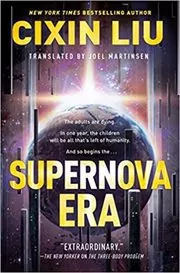
Supernova Era
by Liu Cixin
2019
When a nearby star goes supernova, radiation dooms everyone over thirteen and leaves children in charge of the planet. As adults race to train their successors, the next generation builds a strange, often chilling new world on the ruins of the old.

To Hold Up the Sky
by Liu Cixin
2020
This collection gathers eleven of Liu’s short stories, from a village teacher whose physics lessons decide Earth’s fate to cosmic performances played on the surface of the Sun. It offers a compact tour of his big idea science fiction in many different tones.

Of Ants and Dinosaurs
by Liu Cixin
2021
This short novel expands the saga of civilized dinosaurs and ingenious ants, from a toothache that sparks cooperation to nuclear brinkmanship between mismatched allies. It reads like a playful deep time fable that doubles as a sharp warning about power, technology and environmental damage.

Sea of Dreams
by Liu Cixin
2021
At an ice sculpture festival, a mysterious alien "low temperature artist" arrives and begins freezing Earth’s oceans to create a gleaming ring of ice in orbit. Sculptor Yan Dong is the only human it will talk to, and the only one trying to save a drying world.

The Village Teacher
by Liu Cixin
2021
A dying teacher in a remote mountain village keeps drilling his students in basic science, unaware that far above Earth a galactic war is judging humanity’s intelligence. His tiny classroom becomes the unlikely key to the planet’s survival.

Yuanyuan's Bubbles
by Liu Cixin
2021
Ever since she first saw soap bubbles, Yuanyuan has dreamed of blowing the biggest ones in the world, to her practical father's dismay. As their polluted city declines, her strange talent for enormous, delicate bubbles turns out to be exactly what people need.

Butterfly
by Liu Cixin
2022
During the bombing of Yugoslavia, two scientists try to shield the country by nudging atmospheric "sensitive points" so storms will hide it from pilots. Their grand chaos theory experiment collides with very personal tragedy, asking how much one life is worth against the course of history.

For the Benefit of Mankind
by Liu Cixin
2022
In a world already visited by humanity’s creators, a group of billionaires begins acting strangely, hiring a hit man to kill the homeless before suddenly showering them with money. His mission unravels into a biting parable about class, capitalism and how a richer civilization might judge ours.

A View from the Stars
by Liu Cixin
2024
Blending six stories with thirteen essays, this volume pairs early fiction about cybernetic whales and chaos theory weather hacks with Liu’s reflections on science fiction, fandom and his own career, offering both ambitious concepts and a candid creative diary.

Taking Care of God Vol. 1
by Liu Cixin
2024
This first volume of a graphic adaptation of "Taking Care of God" follows village girl Zhihan after an elderly stranger literally falls from the sky. As more ancient "gods" arrive and move into human homes, caring for one’s creators proves far messier than anyone expected.
Where to start with Liu Cixin
If you want his signature space epic: The Three-Body Problem → The Dark Forest → Death's End
If you prefer standalone novels: Supernova Era → Ball Lightning
If you love short stories and novellas: The Wandering Earth → To Hold Up the Sky → A View from the Stars
If you want playful, idea-driven fables: Of Ants and Dinosaurs → The Cretaceous Past
Liu Cixin sub-series and character series
The Three-Body Problem (Liu Cixin) books in order
Explore this seriesThe Three-Body Problem (Liu Cixin) books in chronological order
Liu Cixin collections, short stories, and related book types
Short Stories/Novellas
Collections
Graphic Novels
Standalone Liu Cixin books
Author bio
Liu Cixin was born in Beijing in 1963 and grew up in the coal-mining city of Yangquan in Shanxi, with part of his childhood spent in rural Henan during the Cultural Revolution. Those years of disruption and hard work gave him a lasting sense that civilization is fragile and history can turn suddenly.
As a boy, Liu discovered a hidden box of books that included classics such as Journey to the Center of the Earth. Reading them in secret at a time when many Western works were banned turned science fiction from a curiosity into an obsession he carried quietly for decades.
He studied hydropower engineering at the North China University of Water Conservancy and Electric Power, graduating in 1988, then was assigned to work as a computer engineer at the Niangziguan power plant near Yangquan. He stayed there for roughly thirty years, often writing late at night in a quiet control room while his colleagues relaxed after their shifts.
Liu began trying his hand at science fiction in middle school, but his first major project was the 1989 novel China 2185, a near-future story about a digitized Mao Zedong and a political crisis in a democratic China. The book circulated quietly yet earned him a reputation as one of the first Chinese writers to experiment with cyberpunk ideas.
Through the 1990s and early 2000s he built a career in magazines such as Science Fiction World with stories like “Whale Song”, “With Her Eyes”, “The Wandering Earth” and “Taking Care of God”. Many of these won China’s Galaxy Award and introduced readers to his love of giant engineering projects, far-future timelines and deceptively simple characters caught up in events far larger than themselves.
His breakthrough came with the trilogy Remembrance of Earth's Past – The Three-Body Problem, The Dark Forest and Death's End – published in China between 2008 and 2010. The books follow humanity's contact with the desperate Trisolaran civilization and develop his now famous "dark forest" take on a universe where every visible civilization may be an existential threat.
English translations of the trilogy, released from 2014 onward, turned Liu into a global name. The Three-Body Problem won the 2015 Hugo Award for Best Novel, making him the first Asian author to take that prize, and Death's End later received a Locus Award for Best Science Fiction Novel, while screen adaptations further amplified his audience.
Alongside the trilogy he has written stand-alone novels such as Supernova Era, Ball Lightning and Of Ants and Dinosaurs (also published as The Cretaceous Past), plus collections including The Wandering Earth, To Hold Up the Sky and A View from the Stars. These works range from children inheriting a world without adults to microscopic civilizations, wandering planets and sharp social satires about capitalism and technology.
Liu’s fiction is often labeled hard science fiction, but his hallmark is less technical jargon than a sense of scale. He likes to start from a single bold idea – moving the Earth, shrinking humanity, weaponizing quantum phenomena – and then patiently trace the social and emotional consequences. The result is a body of work that can feel austere, yet it keeps circling back to ordinary people trying to live under extraordinary skies.
He still lives in Shanxi with his family and often describes himself first as an engineer who happens to write. That down to earth vantage point, plus a fascination with cosmic risk and the limits of progress, keeps his stories grounded even when they range across galaxies and billions of years.

Edited by
Software engineer whose passion for tracking book recommendations from podcasts inspired the creation of MRB.
Lead investor at 3one4 Capital whose startup expertise and love for books helped shape MRB and its growth.
Comments
Did we miss something? Have feedback?
Help us improve this page by sharing your thoughts