
Leo Frankowski Books in Order
Browse Leo Frankowski books in order, with quick summaries, series background for Conrad Stargard and more, plus simple advice on where to start.
Last updated:
As an Amazon Associate, we earn from qualifying purchases (at no extra cost to you).
Leo Frankowski books in publication order
15 books
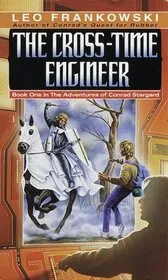
The Cross-Time Engineer
by Leo Frankowski
1986
A hungover Polish engineer wakes from a hike to find himself in 1231 Poland, just before the Mongols will devastate the region. Conrad has no easy way home, so he starts using modern knowledge to change history.
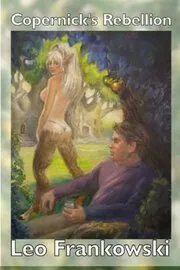
Copernick's Rebellion
by Leo Frankowski
1987
Refugees Martin Guibedo and Heinrich Copernick become brilliant genetic engineers and start giving away inventions that could upend daily life. Their bioengineered homes, creatures, and food systems promise abundance, but they also threaten governments and entrenched power.
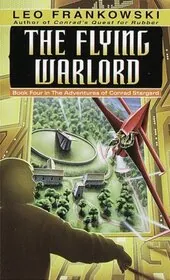
The Flying Warlord
by Leo Frankowski
1989
After years of inventions and preparation, Conrad finally faces the Mongol invasion he has been racing toward. As war breaks out, even the people watching history from outside time can no longer see where events will land.
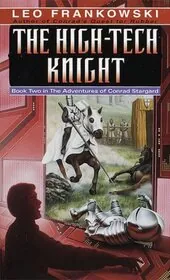
The High-Tech Knight
by Leo Frankowski
1989
Now settled in 1231 Poland, Conrad is knighted, granted land, and pushed into building a town and army from scratch. He has to juggle suspicious churchmen, hostile neighbors, and the looming Mongol invasion.
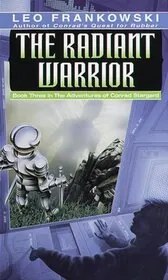
The Radiant Warrior
by Leo Frankowski
1989
Conrad has only a few years left to prepare Poland for the Mongols, so economics are no longer enough. He turns to weapons, training, and military organization, trying to build an army that can actually survive the coming storm.
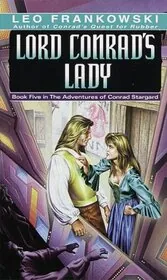
Lord Conrad's Lady
by Leo Frankowski
1990
With the Mongol crisis seemingly past, Conrad faces a different kind of danger at home, politics, marriage, and the demands of power. Lady Francine is determined to secure her place beside him, and court life proves as tricky as battle.
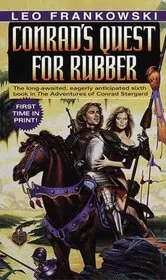
Conrad's Quest for Rubber
by Leo Frankowski
1998
With Poland secure for the moment, Conrad launches the Explorer's Corps to find rubber and map lands far beyond Europe. The book follows risky expeditions from the Arctic to the Amazon, where geography and disease are as dangerous as armies.
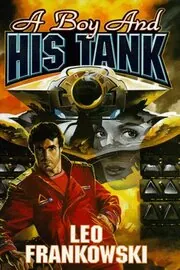
A Boy and His Tank
by Leo Frankowski
1999
On the desperately poor colony world of New Kashubia, Mickolai Derdowski escapes a death sentence by joining the army. There he forms a symbiotic bond with an intelligent tank, and virtual warfare becomes his path to survival.
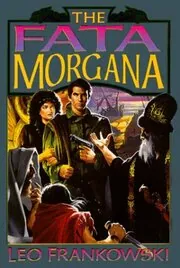
The Fata Morgana
by Leo Frankowski
1999
Two modern engineers stumble onto the legendary Western Isles after a storm at sea and find a society cut off from the modern world. To survive, they have to navigate island politics, religion, and the practical problem of keeping the place afloat.
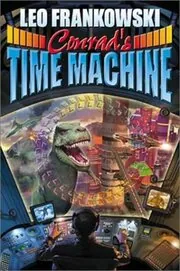
Conrad's Time Machine
by Leo Frankowski
2002
After leaving the Air Force, Tom Kolczyskrenski reunites with two old friends and stumbles into a wrecked house, a hemispherical hole, and plans for something impossible. Their attempt to master time travel becomes a chaotic prequel to Conrad's story.
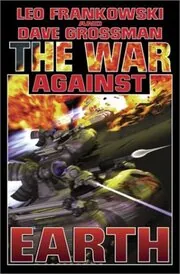
The War Against Earth
by Leo Frankowski
2003
Mickolai learns that the long war that made him famous was a virtual one, and the real fight is only beginning. New Kashubia has money at last, but Earth is now a genuine enemy and losses will be permanent.
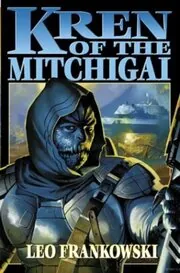
Kren of the Mitchegai
by Leo Frankowski
2004
New Kashubia's troubles expand beyond Earth when the growing Mitchegai empire enters the picture. The book shifts the focus toward a terrifying alien culture and the being named Kren, laying out the threat humans will eventually face.
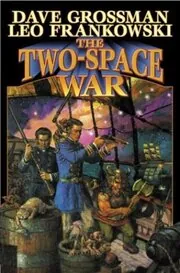
The Two-Space War
by Leo Frankowski
2004
Six hundred years from now, humanity crosses the stars through Two-Space, where advanced machines fail and sentient wooden ships sail under canvas. Lt. Thomas Melville is pulled into a widening interstellar war that feels part naval adventure, part space opera.
Lord Conrad's Crusade
by Leo Frankowski
2005
Conrad sets off on what should be a holiday, only to end up shipwrecked in North Africa and in chains. His disappearance helps spark a crusade, and he has to survive captivity while larger armies move in around him.
Conrad's Last Campaign
by Leo Frankowski
2014
The overdue Mongol threat finally pulls Conrad east, where his altered Poland must carry the war beyond its borders. It is the series finale, mixing campaign planning, battlefield action, and one last test of the world he built.
Where to start with Leo Frankowski
If you want the classic starting point: The Cross-Time Engineer → The High-Tech Knight → The Radiant Warrior
If you want the main Conrad arc first: The Cross-Time Engineer → The High-Tech Knight → The Radiant Warrior → The Flying Warlord → Lord Conrad's Lady
If you prefer military science fiction: A Boy and His Tank → The War Against Earth → Kren of the Mitchegai
If you want space naval adventure: The Two-Space War
If you want stand-alone big ideas first: Copernick's Rebellion → The Fata Morgana
Leo Frankowski sub-series and character series
Adventures of Conrad Stargard books in order
Explore this seriesAdventures of Conrad Stargard books in chronological order
Standalone Leo Frankowski books
Author bio
Leo Frankowski was born in Detroit, Michigan, on February 13, 1943, and grew up in a Polish American family with Kashubian roots. His family ran an inn in the city, and that mix of immigrant memory, working life, and practical problem-solving stayed close to him for the rest of his career.
Before he published novels, he had already lived a very technical life. He worked as an engineer, ran Sterling Manufacturing and Design in Utica, Michigan, and held several patents. Part of his professional world involved hydraulic and pneumatic systems, and one of his patented products, Formital, was used in auto-body repair.
That background shows.
Frankowski liked stories where tools, logistics, and know-how mattered, and he wrote as someone who had actually built things for a living. His fiction is full of workshops, supply problems, improvised solutions, and the kind of step-by-step thinking that comes from engineering rather than from abstract theorizing.
He had been writing short science fiction for years, but the big turn came in the early 1980s, when he joined a Detroit-area critique group that became the National Science Fiction Writer's Exchange. Members read their work aloud and pulled it apart together. Frankowski's time-travel material got a strong response, and he quickly turned one of those ideas into a novel. Sold to Del Rey, it appeared as The Cross-Time Engineer and launched the Conrad Stargard books.
Those Conrad novels are still the center of his reputation. In The Cross-Time Engineer, The High-Tech Knight, and The Radiant Warrior, a modern Polish engineer lands in thirteenth-century Poland and starts trying to prepare the country for the coming Mongol invasion. Readers who connect with Frankowski usually connect here first. The appeal is not hard to see: big alternate-history stakes, lots of practical invention, military planning, and the pleasure of watching one fix lead to three new complications.
He kept working that vein, but he did not only write medieval time travel. A Boy and His Tank moves to a harsh colony world where a young soldier bonds with an intelligent tank and fights wars shaped by virtual reality. The Two-Space War, written with Dave Grossman, takes space opera in a very different direction, imagining interstellar travel through a realm where advanced machinery fails and sentient wooden ships travel under sail.
He could go stranger, too.
Copernick's Rebellion plays with genetic engineering, living houses, and bio-made tools. The Fata Morgana starts with two modern engineers stumbling onto a legendary island and turns that setup into a story about isolation, belief, and survival. Across very different books, the same interests keep coming back: engineers, soldiers, colonists, institutions under pressure, and people trying to rebuild the world in front of them instead of waiting for somebody else to do it.
His Polish and Kashubian background was not just biographical detail. It shaped the Conrad books' focus on Poland, and it also fed into the New Kashubia series, which carried Kashubian names and identity into a space-colony setting. In 1987 he was nominated for the John W. Campbell Award for Best New Writer, a good sign of how quickly his first novel had put him on readers' radar.
Later in life he spent several years living in Russia with his wife and adopted daughter. He died on December 25, 2008, in Lake Elsinore, California. Frankowski was never a smooth, one-size-fits-all writer, but he had a very clear lane. If you like science fiction that cares about process, pressure, and what an engineer would do next, his books still feel very much like his own.






Edited by
Software engineer whose passion for tracking book recommendations from podcasts inspired the creation of MRB.
Lead investor at 3one4 Capital whose startup expertise and love for books helped shape MRB and its growth.
Comments
Did we miss something? Have feedback?
Help us improve this page by sharing your thoughts