
Clifford Stoll Books in Order
Browse Clifford Stoll's books in order, with quick summaries, background on his work as an astronomer and writer, and simple advice on where to start.
Last updated:
As an Amazon Associate, we earn from qualifying purchases (at no extra cost to you).
Clifford Stoll books in publication order
3 books
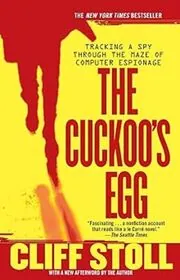
The Cuckoo's Egg
by Clifford Stoll
1989
A 75-cent accounting error at Lawrence Berkeley Lab sends Stoll on a long hunt for an intruder moving through military and research networks. The result is a tense true story about early hacking, patient detective work, and one person's refusal to let a small anomaly slide.
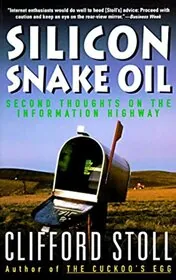
Silicon Snake Oil
by Clifford Stoll
1995
Stoll argues that the early internet was being oversold, and he pushes back against the idea that life on-screen is automatically better. It is a lively snapshot of 1990s tech optimism from a writer who knew the systems firsthand.
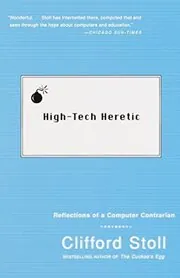
High-Tech Heretic
by Clifford Stoll
1999
In a set of sharp, often funny essays, Stoll questions the rush to put computers everywhere, especially in schools. He asks what technology actually improves, what it costs, and what gets lost when gadgets replace people and hands-on learning.
Where to start with Clifford Stoll
If you want the classic hacker hunt first: The Cuckoo's Egg → Silicon Snake Oil
If you want his anti-hype internet take first: Silicon Snake Oil → High-Tech Heretic
If you want the full arc of his writing: The Cuckoo's Egg → Silicon Snake Oil → High-Tech Heretic
Clifford Stoll collections, short stories, and related book types
Memoirs
Technology Books
Author bio
Clifford Stoll grew up in Buffalo, New York, and that mix of practicality and restless curiosity seems to run through everything he does. He studied astronomy at the University at Buffalo, then earned a PhD in astronomy from the University of Arizona. Long before readers knew him as an author, he had already moved through radio, science, and computing, following whatever problem looked interesting.
He did not set out to be a technology writer. At Lawrence Berkeley Lab, a change in funding moved him from telescope optics work into the computer center. Then, on what was basically his second day in that new job, he was asked to look into a tiny accounting discrepancy, just 75 cents. He kept pulling at that loose thread until it turned into an international hacking case.
That case became The Cuckoo's Egg, the book that put his name in front of a much bigger audience. Readers still pick it up for the suspense, because it really does move like a detective story. But the part people remember is Stoll himself, excited, stubborn, funny, and very willing to show each wrong turn along the way.
Fame never seems to have been the main point.
Stoll was trained as an astronomer, and he has often sounded more interested in the work than in any public role attached to it. That helps explain the next turn in his career. After becoming an early symbol of computer security, he started asking whether all this new technology was actually making life better, or just making louder promises.
In Silicon Snake Oil, he pushed back against the cheerful story people were telling about the early web. Some of his predictions did not hold up, and that is part of why the book still gets discussed. But it also works as a sharp time capsule of the 1990s, and as a reminder that skepticism has value when everybody else is busy selling the future.
He kept that argument going in High-Tech Heretic, especially around computers in schools. His point was not that machines are bad. He plainly likes tools. What bothered him was hype, waste, and the habit of confusing a new device with real learning. Across his books, the same themes keep surfacing: curiosity, hands-on problem solving, a distrust of empty promises, and a strong belief that people should understand the systems they depend on.
And then came the Klein bottles.
In Oakland, he built a different kind of public life around glass Klein bottles, those wonderfully strange mathematical forms with one side and no ordinary inside or outside. He has sold them through a small family business run from home, and he still turns up in talks about math, computing, and how things work. It is an odd next chapter only if you do not know Cliff Stoll. For him, it makes perfect sense.
That mix is really the key to his work. He writes about networks, schools, math, and machines, but the deeper subject is often the same: how people learn, how systems fail, and how curiosity can lead somewhere unexpected. His bibliography is small, but it has held on because he makes big technical questions feel personal, practical, and, quite often, fun.


Edited by
Software engineer whose passion for tracking book recommendations from podcasts inspired the creation of MRB.
Lead investor at 3one4 Capital whose startup expertise and love for books helped shape MRB and its growth.
Comments
Did we miss something? Have feedback?
Help us improve this page by sharing your thoughts