
7 Best Pathology Books
The best pathology books, ranked by how many expert sources recommend each one, with notes on who they suit, from medical students to readers reviewing disease mechanisms.
Our take
Pathology books serve different stages of study. A main textbook explains how disease develops and connects mechanisms with clinical and structural findings. A review book compresses that material, a question book tests its application, and an atlas helps you recognize appearances. Buying several books that perform the same job is less useful than choosing a combination that matches your course and the gaps in your understanding.
Robbins Basic Pathology offers a more compact foundation than Robbins & Cotran Pathologic Basis of Disease. BRS Pathology and Rapid Review Pathology are better suited to organized revision. Robbins and Cotran Review of Pathology adds practice questions, while the atlas concentrates on images. Pathophysiology has a broader physiological emphasis useful in nursing and other health-science courses. Editions and professional expectations change, so check the version your course recommends. Start with one explanatory text, then add questions or images according to what you need to practice.
7 books · 5 sources · Last updated
As an Amazon Associate, we earn from qualifying purchases (at no extra cost to you).
How to choose from this list
Skip to the full rankingIf you need a first medical pathology text: Robbins Basic Pathology → Robbins & Cotran Pathologic Basis of Disease
If you want outline-based revision: BRS Pathology → Rapid Review Pathology
If you want to practice applying concepts: Robbins and Cotran Review of Pathology
If you need more image study: Robbins and Cotran Atlas of Pathology
If your course emphasizes disease physiology: Pathophysiology
The 7 books, ranked
Ranked by how many expert sources name each book. Ties go to the book more people recommend.

Robbins and Cotran Review of Pathology
For students who want to test whether they can apply pathology knowledge in clinical questions. The explanations turn mistakes into targeted revision, though this is a companion question book rather than a substitute for learning the subject.
What it's about
Edward Klatt and Vinay Kumar review general and organ-system pathology through clinical questions and explained answers. Cases incorporate examination findings, laboratory testing, and imaging, while full-color images and a comprehensive final examination reinforce connections between disease mechanisms and diagnosis.

Robbins Basic Pathology
For medical students who want disease mechanisms explained without the scale of the full Robbins reference. Its illustrations support a first systematic course, though this older edition needs matching against the terminology and coverage your course currently expects.
What it's about
Vinay Kumar and colleagues present a concise introduction to human pathology, emphasizing how diseases develop and appear clinically. Illustrations and schematic diagrams clarify key pathological processes, supporting students' understanding of the principles behind disease rather than isolated findings.

BRS Pathology
For students revising pathology who prefer outlines and questions with explanations. The compact structure makes gaps easier to revisit, though the compressed treatment works better after you have learned the mechanisms from a fuller text or course.
What it's about
Mary Elizabeth Peyton Gupta presents pathology review in an outline format for medical coursework and board preparation. Summary tables, clinical questions with explained answers, photomicrographs, and illustrations help students revisit key concepts and assess their understanding through practice examinations.

Rapid Review Pathology
For students who want dense, organized review connecting pathology with clinical information. Goljan's outlines and margin notes support repeated revision, though the abbreviated style can be difficult if the underlying concepts are still unfamiliar.
What it's about
Edward Goljan provides a pathology review for medical coursework and licensing examination preparation. An outline format, margin notes, key-point summaries, and full-color material emphasize connections between disease processes and clinical information, supporting organized study throughout medical school.
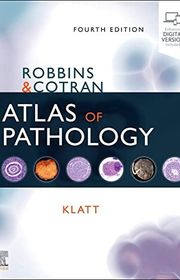
Robbins and Cotran Atlas of Pathology
For students who need more practice connecting written descriptions with gross and microscopic appearances. Klatt's image-centered format complements a textbook or question bank, though an atlas provides less sustained explanation of mechanisms than the main Robbins books.
What it's about
Edward Klatt presents gross specimens, microscopic images, and other visual material illustrating general and organ-system pathology. Captions and explanatory text connect appearances with disease processes, helping students recognize the findings discussed in broader pathology courses and textbooks.

Robbins & Cotran Pathologic Basis of Disease
For students who need deeper explanations of cellular mechanisms and organ-system disease. The full Robbins text rewards selective consultation beyond a review outline, though its size and detail make it inefficient as a sole last-minute revision resource.
What it's about
This pathology textbook examines human disease through its cellular and molecular foundations. Edited by Vinay Kumar and colleagues, it connects basic science with clinical content, using diagrams, microscopic images, and summaries to explain disease mechanisms and their manifestations.

For nursing and health-science students who need an extensive account of disease processes across age groups. Its physiological emphasis complements the medical pathology texts, though the breadth and older edition make alignment with your syllabus especially important.
What it's about
Kathryn McCance and Sue Huether examine the biological foundations of disease in adults and children. This textbook connects causes and disease processes with explanations of complex pathophysiological concepts, using illustrations and contributions from specialists to support students' learning.
Sources
- 1
MCASOM - Pathology: Official & Recommended Textbooks
libraryguides.mayo.edu
- 2
Best Pathology Books and Resources for Medical School and the Pathology NBME Shelf Exam
medschooladvice.com
- 3
8 Pathology Books for Medical Students to Improve their Concepts
windsor.edu
- 4
Pathology
library.medschl.cam.ac.uk
- 5
Pathology Books
goodreads.com




Edited by
Software engineer whose passion for tracking book recommendations from podcasts inspired the creation of MRB.
Lead investor at 3one4 Capital whose startup expertise and love for books helped shape MRB and its growth.
Comments
Spotted a missing book, a wrong order or a mistake? Tell us and we'll fix this page.
We're a reading guide, not the author or publisher, so we can't send books or pass on messages.