
11 Best General Surgery Books
The best general surgery books, ranked by expert-source recommendations, with notes for medical students and trainees choosing reviews, references and atlases.
Our take
General surgery books serve several stages of training, from learning clinical presentations to studying disease mechanisms and preparing for operations. A large reference provides depth, while a review book helps consolidate material and an atlas shows procedural anatomy and sequence. Choosing one format for every purpose can make study harder than it needs to be.
Sabiston Textbook of Surgery and Schwartz's Principles Of Surgery offer broad reference coverage. Bailey & Love's Short Practice of Surgery connects principles with clinical assessment. For shorter study sessions, NMS Surgery organizes review material, and Surgical Recall uses questions and answers. Christian de Virgilio’s Surgery develops reasoning through cases. Current Surgical Therapy emphasizes management, while Zollinger's Atlas of Surgical Operations provides a visual operative perspective. Several existing entries link older editions, so match the book with your course requirements and current clinical guidance.
Start with the core textbook your course recommends, then add Surgery for case-based revision or Surgical Recall for rapid review.
11 books · 12 sources · Last updated
As an Amazon Associate, we earn from qualifying purchases (at no extra cost to you).
How to choose from this list
Skip to the full rankingIf you want a broad clinical foundation: Bailey & Love's Short Practice of Surgery → Sabiston Textbook of Surgery
If you want detailed reference study: Schwartz's Principles Of Surgery → Current Surgical Therapy
If you prefer learning through cases: Surgery → Dr. Pestana's Surgery Notes
If you want concise rotation review: NMS Surgery → Surgical Recall
If you want a compact reference and operative illustrations: The Washington Manual of Surgery → Zollinger's Atlas of Surgical Operations
If you want an illustrated student manual: SRB’s Manual of Surgery
The 11 books, ranked
Ranked by how many expert sources name each book. Ties go to the book more people recommend.

For trainees who want surgical practice connected to its biological foundations. Its broad reference coverage supports deeper study than a clerkship review, but the size is substantial and the linked edition is older than the current textbook.
What it's about
This textbook connects the biological foundations of disease with the practice of general surgery. Evidence-based chapters and operative illustrations cover diagnosis, perioperative care, and surgical management, providing a broad reference for trainees and practicing surgeons.

Schwartz's Principles Of Surgery
For trainees who want basic science and clinical surgery developed in one substantial reference. Its breadth supports detailed topic study, but the dense chapters are less convenient for quick revision and treatment details require checking against current guidance.
What it's about
This comprehensive surgical reference brings together the scientific foundations and clinical practice of general surgery. It examines surgical disease and treatment within an evidence-based framework, addressing advances in diagnosis, operative techniques, and care for surgical patients.
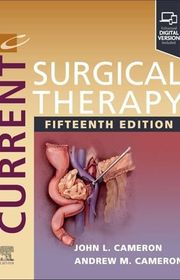
Current Surgical Therapy
For residents and surgeons who want a treatment-focused reference alongside a foundational textbook. Its emphasis on management decisions is more direct than a broad biological survey, but it is not a procedural atlas or a substitute for current local guidance.
What it's about
John and Andrew Cameron bring together a treatment-focused reference across general surgery. The fifteenth edition covers surgical management in concise chapters, supporting advanced study and review while complementing textbooks that devote more space to foundational science and disease mechanisms.

Dr. Pestana's Surgery Notes
For students preparing for a US surgical clerkship examination who need a concise review. Its short explanations and clinical vignettes focus revision efficiently, but the selective coverage cannot replace a full course text or supervised clinical teaching.
What it's about
Carlos Pestana offers a compact review of core surgery topics for clinical rotations and examinations. Brief discussions of diagnostic and therapeutic tools accompany 180 patient vignettes, giving students material for self-testing and reviewing common surgical presentations.

For medical students who learn best by working through patient presentations. Its case-based questions and explanations connect knowledge with clinical reasoning, but the review format is less comprehensive than a full textbook and reflects the linked edition’s publication period.
What it's about
This clinical review teaches surgery through cases representing important patient presentations. Questions, answers, illustrations, and management algorithms guide students through diagnosis and treatment while supporting preparation for surgical rotations and examinations.
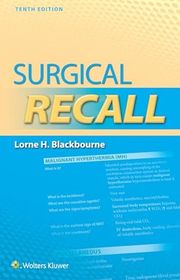
Surgical Recall
For medical students who want rapid question-and-answer revision during a surgical rotation. Its compact prompts suit active recall and short study sessions, but the compressed answers need a fuller reference when you do not yet understand the underlying topic.
What it's about
Lorne Blackbourne presents surgical knowledge in a rapid question-and-answer format. The tenth edition supports learning during clinical rotations and preparation for shelf examinations, providing concise prompts and answers for reviewing common concepts encountered in surgical education.

For medical students who want organized review alongside a surgical clerkship. Its outlines and examination-style questions support consolidation, but the compressed format and US examination emphasis offer less depth than the comprehensive surgical references.
What it's about
NMS Surgery provides concise review material for medical students during surgical clerkships and examination preparation. Organized outlines, clinical illustrations, and USMLE-style questions help readers consolidate surgical knowledge and apply it to patient presentations.
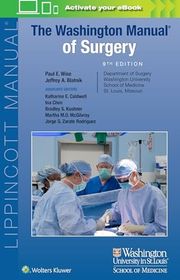
The Washington Manual of Surgery
For trainees who want a concise surgical manual to consult alongside larger references. Its compact coverage brings clinical topics and key operative steps together, but the abbreviated format leaves less room for detailed explanations of evidence and technique.
What it's about
The Washington Manual of Surgery provides a concise reference across general surgical care. Edited by Paul Wise, the ninth edition organizes core information for trainees and clinicians, including summarized operative steps and topics encountered throughout surgical education and practice.

Zollinger's Atlas of Surgical Operations
For surgical trainees who want to visualize the sequence and anatomy of operations. Its paired illustrations and procedural explanations provide a different perspective from disease-focused textbooks, but an atlas supports supervised preparation rather than independent procedural competence.
What it's about
Robert Zollinger and E. Christopher Ellison present an illustrated atlas of surgical operations. The eleventh edition explains procedures across paired text and image spreads, connecting operative sequences with relevant anatomy and providing a visual reference for surgical study and preparation.

Bailey & Love's Short Practice of Surgery
For medical students and trainees who want clinical assessment connected with surgical principles. Its illustrated textbook approach supports broad study, but it is less concise than an exam review and the linked edition needs comparison with current requirements.
What it's about
This surgical textbook combines foundational principles with clinical assessment and patient care. It guides medical students and trainee surgeons through history taking, diagnosis, surgical disorders, and postoperative management, using illustrations and summaries to support learning.

SRB’s Manual of Surgery
For students who want visual explanations of surgical conditions. Clinical photographs and physical signs help connect reading with examination, but the manual-style coverage is less extensive than the larger references and the linked edition is older.
What it's about
Sriram Bhat presents general surgery through discussions of common and less common disorders across the body. Clinical photographs, explanations of physical signs, and coverage of surgical treatment help students connect disease knowledge with examination and patient management.
Sources
- 1
Top 6 Surgery Books for Aspiring Surgeons
windsor.edu
- 2
Resident Handbook - Useful Reference Materials
cags-accg.ca
- 3
Health Sciences Textbooks: Surgery
libraryguides.missouri.edu
- 4
General Surgery: Clinical Resources
libraryguides.mayo.edu
- 5
Medical Knowledge
surgicaleducation.com
- 6
What is your favorite book for gen surgery?
reddit.com
- 7
Books for Interns
reddit.com
- 8
Reference Texts
vumc.org
- 9
MS3 Clerkships: Information Resources: Surgery
guides.himmelfarb.gwu.edu
- 10
Best 5 surgery books for medical students
asymptoticlogic.com
- 11
Best books and resources for the Surgery shelf and rotation 2024
medschooladvice.com
- 12
General Surgery Books
goodreads.com










Edited by
Software engineer whose passion for tracking book recommendations from podcasts inspired the creation of MRB.
Lead investor at 3one4 Capital whose startup expertise and love for books helped shape MRB and its growth.
Comments
Spotted a missing book, a wrong order or a mistake? Tell us and we'll fix this page.
We're a reading guide, not the author or publisher, so we can't send books or pass on messages.