
8 Best Derivatives Books
The best derivatives books, ranked by how many expert sources recommend each one, with clear notes on who each book suits and where to begin your reading.
Our take
Derivatives connect the value of a contract to something else, such as an interest rate, a share price, or a commodity. Learning the subject means understanding both what a contract promises and how its price and risks change. These books serve different needs, from a first explanation of forwards and options to the mathematics used to value and hedge them.
Derivatives Demystified and All About Derivatives offer approachable starting points. Derivatives Essentials adds practical exercises, while Options, Futures, and Other Derivatives provides a broader textbook course. Readers ready to specialize can turn to Interest Rate Swaps and Other Derivatives or Option Volatility and Pricing. Financial Calculus follows the mathematical reasoning behind pricing, and Derivatives: The Wild Beast of Finance examines the wider financial system. Start with contract mechanics if the vocabulary is new, then choose a mathematical or market-specific path.
8 books · 9 sources · Last updated
As an Amazon Associate, we earn from qualifying purchases (at no extra cost to you).
How to choose from this list
Skip to the full rankingIf you're new to derivatives: All About Derivatives → Derivatives Demystified
If you want a structured course: Derivatives Essentials → Options, Futures, and Other Derivatives
If you want to study option risk: Option Volatility and Pricing
If you want interest rate applications: Interest Rate Swaps and Other Derivatives
If you want pricing mathematics: Options, Futures, and Other Derivatives → Financial Calculus
If you want the wider financial context: Derivatives: The Wild Beast of Finance
The 8 books, ranked
Ranked by how many expert sources name each book. Ties go to the book more people recommend.

Options, Futures, and Other Derivatives
For students seeking a broad course in derivatives markets and pricing. Hull balances models with numerical applications across more products than the specialist books, but its textbook structure rewards sustained study rather than casual reading.
What it's about
John Hull introduces derivatives markets through pricing models, trading strategies, and numerical examples that connect theory with practice. This edition covers options, futures, swaps, and related instruments, including Black-Scholes-Merton formulas and the valuation of commodity derivatives.

For readers who understand basic options and want to connect volatility with position risk. Natenberg develops trading intuition more fully than a general derivatives survey, but assumes familiarity with contracts and sustained numerical work.
What it's about
Sheldon Natenberg connects option pricing theory with the practical decisions traders face. The book explains volatility, pricing models, hedging, arbitrage, and risk management, showing how these concepts inform the construction and evaluation of advanced option trading strategies.

Derivatives Demystified
A Step-by-Step Guide to Forwards, Futures, Swaps and Options
For newcomers who want contract intuition before pricing models. Chisholm connects the basic building blocks to practical problems more gently than Hull, though readers seeking mathematical derivations will need a more technical follow-up.
What it's about
Andrew Chisholm introduces derivative products through a progressive explanation of their mechanics and uses. Coverage includes forwards, futures, swaps, options, pricing, hedging, sensitivities, and structured securities, helping readers connect financial concepts with practical market applications.

All About Derivatives
For readers who need a compact first explanation of contracts, valuation, and hedging. Durbin makes unfamiliar terminology approachable, but the brief treatment leaves less room for detailed models or specialized markets than the textbooks here.
What it's about
Michael Durbin explains forwards, futures, swaps, options, and credit derivatives using accessible examples. Chapters connect contract mechanics with pricing, valuation, leverage, and hedging, including discussion of the role derivatives played in the 2008 financial crisis.

For readers interested in why derivatives matter to the financial system. Steinherr offers a historical argument about innovation and instability rather than a pricing course, with examples that reflect an earlier market era.
What it's about
Alfred Steinherr examines the growth of derivatives and their role in global finance. His account considers financial innovation, risk management, market instability, and crises, arguing for ways to retain the benefits of derivatives while addressing their systemic dangers.

For students who learn by working through practical examples and spreadsheets. Gottesman gives contract mechanics and exposures more attention than abstract theory, though the exercises still require patience with numbers and financial terminology.
What it's about
Aron Gottesman explains derivative securities with an emphasis on how contracts work. Practical examples and exercises cover forwards, futures, options, swaps, pricing, valuation, sensitivities, and trading strategies, supported by spreadsheet illustrations of the concepts.

Interest Rate Swaps and Other Derivatives
For readers moving from general derivatives into interest rate markets. Corb links pricing mathematics with how swaps and related trades work in practice, but its specialization and formulas make it a demanding first book.
What it's about
Howard Corb combines mathematical analysis with trading experience to explain interest rate swaps and related derivatives. Chapters cover pricing, risk characteristics, caps, floors, swaptions, structured notes, and more complex trades, with examples showing how products can be constructed and analyzed.
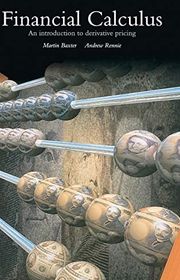
Financial Calculus
For mathematically confident readers who want to understand why derivative pricing works. Baxter and Rennie build a focused route through arbitrage and martingales, but offer less product coverage and trading detail than Hull.
What it's about
Martin Baxter and Andrew Rennie introduce the mathematics behind derivative pricing, moving from discrete models to continuous processes. Arbitrage, hedging, martingales, and interest rate models show how pricing arguments are constructed and where their assumptions enter.
Sources
- 1
Derivatives Books
goodreads.com
- 2
13 Best Books on Derivatives Trading | India, Beginner, Equity, Commodity
stockpathshala.com
- 3
The 6 Best Books on Derivatives [For 2026]
conqueryourexam.com
- 4
Best Books on Derivatives – Top 6 Derivatives Trading Books!
blog.joinfingrad.com
- 5
Books on options, markets & risk | BeInOptions
beinoptions.com
- 6
Book/Source recommendation on Derivatives ?
reddit.com
- 7
Textbook recommendations
reddit.com
- 8
Derivatives and Pricing Foundations
finlib.rondanini.com
- 9
Top 10 Best Books on Derivatives [Updated 2026]
wallstreetmojo.com





Edited by
Software engineer whose passion for tracking book recommendations from podcasts inspired the creation of MRB.
Lead investor at 3one4 Capital whose startup expertise and love for books helped shape MRB and its growth.
Comments
Spotted a missing book, a wrong order or a mistake? Tell us and we'll fix this page.
We're a reading guide, not the author or publisher, so we can't send books or pass on messages.