
Thomas Pynchon Books in Order
Find Thomas Pynchon books in order, with concise summaries, publication context, short stories, and a clear guide to where to start with his novels.
Last updated:
As an Amazon Associate, we earn from qualifying purchases (at no extra cost to you).
Thomas Pynchon books in publication order
15 books

Mortality and Mercy in Vienna
by Thomas Pynchon
1959
This early, uncollected story drops Siegel into a rain-soaked Washington party, where social chatter, confession, and menace blur. A strange guest and a roomful of uneasy people turn manners into something much darker than expected.

The Small Rain
by Thomas Pynchon
1959
Army specialist Nathan Levine is sent with his unit to help after a hurricane on the Louisiana coast. The cleanup detail becomes a dry, uneasy look at boredom, disaster, military routine, and emotional distance.

Low-Lands
by Thomas Pynchon
1960
Dennis Flange, a Long Island lawyer and ex-Navy man, is thrown out by his wife after old shipmate Pig Bodine arrives. His night at a garbage dump turns comic escape into a strange dream of the sea.
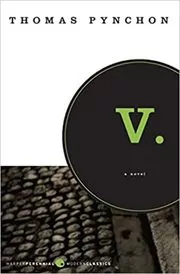
V.
by Thomas Pynchon
1963
Pynchon's debut follows ex-sailor Benny Profane and the obsessive Herbert Stencil, who is hunting for the elusive figure known only as V. Their paths roam through cities, memories, and conspiracies that keep slipping out of reach.

The Secret Integration
by Thomas Pynchon
1964
In a Berkshire town, a band of bright children stage pranks and imagine a friendship with Carl McAfee, a Black man pushed to the margins. The story turns childhood play into a sharp look at racism and exclusion.
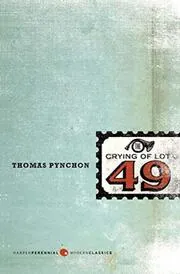
The Crying of Lot 49
by Thomas Pynchon
1966
Oedipa Maas becomes coexecutor of a former lover's estate and stumbles into signs of a possible underground postal conspiracy. The deeper she looks, the harder it is to tell revelation from pattern-hunting.

Gravity's Rainbow
by Thomas Pynchon
1973
As V-2 rockets fall on London, intelligence officers notice a strange link between impact sites and Lieutenant Tyrone Slothrop's private life. His search for Rocket 00000 becomes a sprawling journey through war, technology, fear, and desire.

Entropy
by Thomas Pynchon
1983
In Washington, D.C., Meatball Mulligan tries to contain a wild lease-breaking party while, upstairs, Callisto and Aubade wait in a sealed hothouse. The paired rooms turn thermodynamics into a funny, anxious story about disorder.

Slow Learner
by Thomas Pynchon
1984
Slow Learner gathers five early Pynchon stories written before V., including The Small Rain, Entropy, and The Secret Integration. With Pynchon's own introduction, it shows the young writer testing science, jokes, paranoia, and social unease.

Vineland
by Thomas Pynchon
1990
In Reagan-era Northern California, ex-hippie Zoyd Wheeler and his daughter Prairie are pulled back into the wreckage of a 1960s radical past. Family history, federal power, and television culture collide in strange, comic ways.
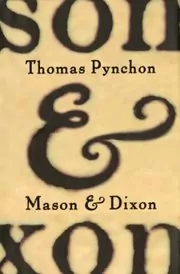
Mason & Dixon
by Thomas Pynchon
1997
Charles Mason and Jeremiah Dixon set out to survey the famous boundary line between Pennsylvania and Maryland. Pynchon turns their historical partnership into a comic, eerie trip through science, empire, friendship, and early America.
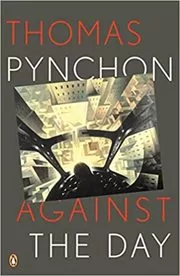
Against the Day
by Thomas Pynchon
2006
From the 1893 Chicago World's Fair to the years after World War I, a vast cast of balloonists, anarchists, mathematicians, spies, and wanderers chase private dreams while history closes in around them.
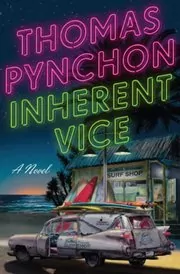
Inherent Vice
by Thomas Pynchon
2009
Stoner private eye Doc Sportello is pulled into a missing-person case when his ex-girlfriend asks for help with a billionaire developer. In late-1960s Los Angeles, every clue leads to another haze of trouble.
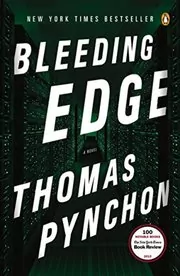
Bleeding Edge
by Thomas Pynchon
2013
In 2001 New York, fraud investigator Maxine Tarnow looks into a computer-security firm and its billionaire CEO. Her case winds through hackers, money trails, family life, and the uneasy months before September 11.

Shadow Ticket
by Thomas Pynchon
2025
In 1932 Milwaukee, private eye Hicks McTaggart is hired to find a runaway cheese heiress. The case carries him from Depression-era America to Europe, where gangsters, spies, fascists, and strange rumors crowd the trail.
Where to start with Thomas Pynchon
If you want the easiest doorway in: The Crying of Lot 49 → Inherent Vice → Bleeding Edge.
If you like noir and detective plots: Inherent Vice → Shadow Ticket.
If you're ready for the major challenge: V. → Gravity's Rainbow → Mason & Dixon.
If you prefer historical sprawl: Mason & Dixon → Against the Day.
If you want early Pynchon first: Slow Learner → V..
Thomas Pynchon collections, short stories, and related book types
Short Stories/Novellas
Short Story Collections
Standalone Thomas Pynchon books
Author bio
Thomas Pynchon was born Thomas Ruggles Pynchon Jr. on May 8, 1937, in Glen Cove, Long Island. He grew up nearby in Oyster Bay, one of three children in a family with deep colonial roots and a father who worked in engineering and local government. The Long Island start matters: his books often treat America as both hometown and puzzle box.
He was a strong student, and he graduated from Oyster Bay High School at 16. Pynchon entered Cornell to study engineering physics, then left after his sophomore year for the U.S. Navy, where he served from 1955 to 1957. When he returned to Cornell, he switched to English, wrote for the student literary magazine, and published his first story, “The Small Rain,” in 1959.
Then came aerospace.
After college, Pynchon worked as a technical writer for Boeing in Seattle. That job gave him a close look at corporate language, weapons systems, engineering culture, and the strange comedy of official paperwork. Those things did not stay in the office. Rockets, acronyms, secret projects, and suspicious companies became part of the machinery of his fiction.
His debut novel, V., arrived in 1963 and set the pattern in a big way: sailors, artists, spies, bad jokes, history, and a mysterious figure who may or may not explain anything. The Crying of Lot 49 tightened the focus around Oedipa Maas and a possible underground postal system. Then Gravity's Rainbow pushed the scale outward, following Tyrone Slothrop and the shadow of the V-2 rocket across wartime Europe. It won the National Book Award in 1974.
That prize also fed the Pynchon myth.
Pynchon did not show up to accept it. A comedian, Professor Irwin Corey, took the stage for him, which is about as Pynchonian as literary awards get. The author’s long refusal to play the publicity game has made him famous for being hard to see. But the privacy can distract from the work itself, which is often funny, crowded, worried, and full of people trying to live decently inside systems that do not care much about decency.
His novels return again and again to paranoia, technology, state power, pop culture, and the uneasy feeling that everything might be connected. Mason & Dixon turns an eighteenth-century surveying job into a story about friendship and borders. Against the Day roams from the 1893 Chicago World's Fair into the years after World War I. Inherent Vice lets him play with California noir, while Bleeding Edge moves through New York, the dot-com crash, and the approach of September 11.
Pynchon has kept his family life private. He married literary agent Melanie Jackson in 1990, and they have a son. He has long been associated with New York City, and he still publishes on his own schedule. Shadow Ticket, a 1930s detective caper set partly in Milwaukee and Europe, appeared in 2025.






Edited by
Software engineer whose passion for tracking book recommendations from podcasts inspired the creation of MRB.
Lead investor at 3one4 Capital whose startup expertise and love for books helped shape MRB and its growth.
Comments
Did we miss something? Have feedback?
Help us improve this page by sharing your thoughts