
The Astonishing Life of Octavian Nothing Traitor to the Nation Books in Order
Part ofMT Anderson Books in OrderSee The Astonishing Life of Octavian Nothing books by M.T. Anderson in order, with summaries, series background, reading order help, and where to start.
Last updated:
As an Amazon Associate, we earn from qualifying purchases (at no extra cost to you).
The Astonishing Life of Octavian Nothing Traitor to the Nation books in publication order
2 books
The Pox Party
by MT Anderson
2006
Raised in luxury by scholars in Revolutionary Boston, Octavian slowly uncovers the brutal experiment shaping his life. What begins as an eerie coming-of-age story turns into a sharp, unsettling reckoning with slavery, science, and power.
Recommended by
1 person John Green recommended this book
John Green
"One of the best novels of the past decade." - John Green
John Green's recommendation of this book
The Kingdom on the Waves
by MT Anderson
2008
Escaping a death sentence, Octavian and Dr. Trefusis flee into British occupied Boston as the Revolution explodes around them. War, shifting loyalties, and promises of freedom force Octavian to decide whom he can trust.
The Astonishing Life of Octavian Nothing Traitor to the Nation books in chronological order
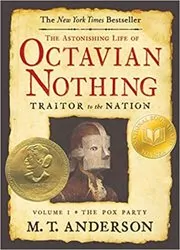
by MT Anderson
2006The Astonishing Life of Octavian Nothing Traitor to the Nation, Book 1
by MT Anderson
2008The Astonishing Life of Octavian Nothing Traitor to the Nation, Book 2
Series background & context
The two books in this series, The Pox Party and The Kingdom on the Waves, follow Octavian, a Black boy being raised in Revolutionary Boston by a circle of wealthy philosophers who call themselves by numbers. He receives a classical education and every outward sign of privilege, but that polished life hides something cold and brutal. The more he learns about the household around him, the more he understands that he is living inside someone else's idea of reason.
That contradiction, liberty praised in public and denied in private, drives the whole story.
In The Pox Party, the action stays close to the College of Lucidity, where Octavian, his mother Cassiopeia, and the scholars around them move through a tense, watchful world. Cassiopeia is brilliant, proud, and trapped in her own way, which gives the early chapters an eerie, almost courtly mood. Anderson uses letters, documents, and period-style language to make the setting feel immediate, but the emotional center is clear: a young man trying to understand who controls his life and what freedom could possibly mean.
In The Kingdom on the Waves, the series opens outward. Octavian and his tutor, Dr. Trefusis, are pulled into the chaos of war, British occupied Boston, military encampments, and shifting promises of emancipation. The scale grows larger, but the questions stay painfully personal. Who offers real protection? Who is using noble ideals as cover? What does loyalty mean when every side is tangled up in violence and self-interest?
These are historical novels, but they do not read like distant museum pieces. The tension comes from confinement, pursuit, betrayal, and battle, and from Octavian's sharp, wounded intelligence. The prose can be formal on purpose, echoing the eighteenth century without losing the emotional urgency of the story. Readers who like immersive settings, moral complexity, and narrators who notice everything will find a lot to hold on to here.
This is serious, searching fiction.
Still, the series is not only grim. It is also about thought, endurance, friendship, and the stubborn act of claiming a self in a world built to deny it. If you want a Revolutionary War story that looks past the usual patriotic legend and asks much harder questions about power, slavery, and national myth, this is where Anderson does some of his boldest work.














Edited by
Software engineer whose passion for tracking book recommendations from podcasts inspired the creation of MRB.
Lead investor at 3one4 Capital whose startup expertise and love for books helped shape MRB and its growth.
Comments
Did we miss something? Have feedback?
Help us improve this page by sharing your thoughts