
Suzette Haden Elgin Books in Order
Explore Suzette Haden Elgin books in publication order, with short summaries and series lists to help you compare titles and choose your next book to read.
Last updated: 34 new books added
As an Amazon Associate, we earn from qualifying purchases (at no extra cost to you).
Suzette Haden Elgin books in publication order
34 books

Furthest
by Suzette Haden Elgin
1971
Intelligence agent Coyote Jones investigates a remote planet whose inhabitants appear suspiciously average in every statistic. Agreeing to hide his assistant’s sister from a sentence of Erasure makes him a criminal and draws him toward the world’s concealed strangeness.

At the Seventh Level
by Suzette Haden Elgin
1972
Agent Coyote Jones visits Abba, a world granted civilized status after limited reforms in its treatment of women. The rise of brilliant Jacinth to its highest social rank provokes hostility and a conspiracy that threatens both her and the planet's standing.
Guide to Transformational Grammar
by Suzette Haden Elgin
1973
John Grinder and Elgin introduce the history, theory, and practice of transformational grammar. The textbook examines sentence structure through formal rules, derivations, and linguistic examples, connecting grammatical analysis with the models developed in generative linguistics.
What Is Linguistics?
by Suzette Haden Elgin
1973
A Primer Of Transformational Grammar For Rank Beginners
by Suzette Haden Elgin
1975
This introductory booklet explains phrase structure, transformational rules, and phonology for readers new to modern grammar. Its account of movement, insertion, substitution, and deletion aims to make contemporary linguistic scholarship in English and other languages more accessible to beginners.
Pouring Down Words
by Suzette Haden Elgin
1975
Elgin examines language in prose, poetry, politics, religion, folklore, and the media in this composition textbook. Her discussion connects different uses of words with the practical organization of written arguments, including thesis statements and supporting paragraphs.

Star-Anchored, Star-Angered
by Suzette Haden Elgin
1979
Agent Coyote Jones is sent to investigate a supposed messiah whose miracles are unsettling the planet Freeway. His inability to receive telepathic messages should protect him from deception, but determining whether Drussa Silver is fraudulent proves less straightforward than expected.
The Gentle Art of Verbal Self-Defense
by Suzette Haden Elgin
1980
Elgin introduces ways to recognize verbal attacks that often pass unnoticed in daily conversation. Her approach focuses on identifying hostile language and choosing responses, giving readers practical tools for handling confrontations in personal relationships and other everyday encounters.

And Then There'll Be Fireworks
by Suzette Haden Elgin
1981
Crystal invaders from space threaten the planet Ozark as its familiar magical defenses fail. Responsible must confront the danger in this concluding volume of the trilogy, where the divided kingdoms face a threat beyond their local rivalries.

The Grand Jubilee
by Suzette Haden Elgin
1981
As the rare Grand Jubilee approaches on planet Ozark, Responsible of Brightwater senses trouble developing. The celebration brings fresh uncertainty to a society where magic, family authority, and the fragile confederation shape everyday life.

Twelve Fair Kingdoms
by Suzette Haden Elgin
1981
Fourteen-year-old Responsible Brightwater travels among the twelve kingdoms of planet Ozark to investigate magical sabotage. Her search for whoever is undermining an approaching Confederation meeting brings encounters with rival families, intelligent creatures, and concealed threats to their world.
More on The Gentle Art of Verbal Self-Defense
by Suzette Haden Elgin
1983
Extending her approach to verbal self-defense, Elgin examines hostile exchanges at work, at home, and between everyday obligations. She offers strategies for responding without losing composure, helping readers develop a calmer and more deliberate style of communication.

Native Tongue
by Suzette Haden Elgin
1984
On a future Earth where women have lost their rights, linguist Nazareth works within families essential to alien commerce. Unknown to their male rulers, older women are creating a secret language intended to reshape thought and challenge the system that confines them.

Yonder Comes The Other End of Time
by Suzette Haden Elgin
1986
Investigating a powerful telepathic signal, Federation agent Coyote Jones arrives in the Brightwater Kingdom on Ozark. There he encounters Responsible, a determined young ruler, as his assignment draws him into the unfamiliar workings of a world unlike those he knows.

The Judas Rose
by Suzette Haden Elgin
1987
Women on a male-dominated future Earth use the secret language Láadan to organize resistance and reclaim their freedom. Their struggle expands beyond domestic oppression as an alien confederation threatens humanity, making communication central to both liberation and survival.
The Last Word on the Gentle Art of Verbal Self-Defense
by Suzette Haden Elgin
1987
Elgin examines the cues beneath spoken words, including silence, body language, expression, and tone. Practical tactics aim to help readers understand another person's communication patterns and respond more effectively in the difficult exchanges of personal and professional life.
A First Dictionary and Grammar of Láadan
by Suzette Haden Elgin
1988
Elgin presents a dictionary and grammar of Láadan, the constructed language she created to express women's perspectives. The reference introduces its vocabulary and linguistic framework, allowing readers to explore the language as a system beyond its fictional setting.
The Gentle Art of Verbal Self Defense for Business Success
by Suzette Haden Elgin
1989
Elgin applies verbal self-defense to business situations, showing how to identify and defuse hostile exchanges. Examples involving angry customers and manipulative supervisors support an approach intended to improve communication while reducing the pressure of confrontational workplace encounters.
Staying Well with the Gentle Art of Verbal Self-Defense
by Suzette Haden Elgin
1990
Elgin applies her verbal self-defense framework to the relationship between communication and well-being. She argues that harmful language patterns can contribute to illness and offers approaches intended to reduce verbal stress and encourage healthier interactions in daily life.
Genderspeak
by Suzette Haden Elgin
1993
Elgin examines conversational misunderstandings between men and women through examples from work and personal relationships. She discusses differing perceptions, body language, and manipulative exchanges, offering techniques for recognizing confusion and responding more effectively when communication becomes confrontational.
The Gentle Art of Written Self-Defense Letter Book
by Suzette Haden Elgin
1993
Elgin explains how to respond in writing to mistakes, complaints, misstatements, and other difficult situations. Sample letters for fifteen scenarios are paired with analysis of their strategies, helping readers address conflict clearly while avoiding the traps of an angry reply.

Earthsong
by Suzette Haden Elgin
1994
The interplanetary Consortium prepares to abandon a violent Earth to ecological and economic collapse, then destroy it. Women of the linguist Lines receive one last opportunity to change humanity's destructive behavior and prevent the planet's annihilation.
Businessspeak
by Suzette Haden Elgin
1995
Elgin explores why carefully prepared business proposals can fail when colleagues hear something different from what a speaker intends. Workplace scenarios and revised exchanges demonstrate techniques for clarifying ideas, building understanding, and gaining commitment to a shared plan.
The Gentle Art of Communicating with Kids
by Suzette Haden Elgin
1995
Elgin uses parent-child conversations and everyday scenarios to explain ways of listening and speaking that reduce confrontation. The guide addresses routine disagreements alongside more difficult family issues, emphasizing firm, compassionate communication with children of different ages.
You Can't Say That to Me
by Suzette Haden Elgin
1995
This guide presents an eight-step approach to recognizing verbal abuse and responding without escalating conflict. Questionnaires, diaries, and language exercises help readers examine recurring patterns and practice different responses in relationships at home and at work.
Try to Feel It My Way
by Suzette Haden Elgin
1996
Elgin explores the experiences of people who rely strongly on touch in a culture that often discourages it. Scenarios from home, school, work, and intimate relationships illustrate communication difficulties and offer techniques for navigating them.
How to Disagree Without Being Disagreeable
by Suzette Haden Elgin
1997
Elgin explains how to deliver criticism, respond to hostile remarks, and disagree without increasing tension. Examples cover family arguments, workplace feedback, and sensitive topics, showing ways to preserve dignity while communicating difficult or unwelcome messages.
How to Turn the Other Cheek and Still Survive in Today's World
by Suzette Haden Elgin
1997
Elgin presents seven connected communication techniques for responding to conflict without retaliating. Practical examples from family, social, and professional life explore how changing the way people listen and speak can help them handle difficult interactions.
The Gentle Art of Written Self-Defense
by Suzette Haden Elgin
1997
Elgin applies her principles of verbal self-defense to letters and other written exchanges. Model responses and analyses show ways to handle mistakes, apologies, accusations, and difficult messages while reducing hostility and communicating a clear point.
The Grandmother Principles
by Suzette Haden Elgin
1998
Elgin offers guidance for grandmothers navigating family conflict, financial boundaries, emergencies, and relationships across distance. Her principles emphasize sharing experience and family history while respecting parents’ authority and preserving the grandmother’s own resources, time, and independence.
Language in Emergency Medicine
by Suzette Haden Elgin
1999
A communication handbook for emergency medical settings, this book examines how clinicians and patients can misunderstand one another under pressure. Elgin explains listening techniques, clearer explanations, and ways to reduce the barriers created by jargon and conflicting expectations.
The Gentle Art of Verbal Self Defense at Work
by Suzette Haden Elgin
1999
Applying verbal self-defense techniques to the workplace, Elgin examines insults, discriminatory language, sarcasm, and other hostile exchanges. Scenarios and practice exercises offer ways to respond professionally while communicating clearly through meetings, email, voicemail, and remote work.
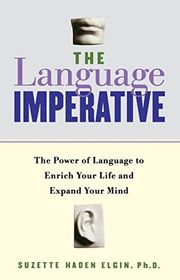
The Language Imperative
by Suzette Haden Elgin
2000
Elgin examines how language influences thought, culture, and personal experience, arguing for the value of multilingualism. Examples from medicine, business, religion, and family life connect everyday communication with questions about language education and the disappearance of languages.
Peacetalk 101
by Suzette Haden Elgin
2003
This short novel presents Elgin's principles of verbal self-defense through a narrative rather than a conventional advice manual. Its approach explores listening, assumptions, communication goals, and ways of refusing the bait in hostile conversations without escalating them.
Suzette Haden Elgin sub-series and character series
Coyote Jones books in order
Explore this seriesNative Tongue books in order
Explore this seriesOzark books in order
Explore this seriesStandalone Suzette Haden Elgin books









by Suzette Haden Elgin
1995Using the Gentle Art of Verbal Persuasion to Get What You Want at Work


























Edited by
Software engineer whose passion for tracking book recommendations from podcasts inspired the creation of MRB.
Lead investor at 3one4 Capital whose startup expertise and love for books helped shape MRB and its growth.
Comments
Spotted a missing book, a wrong order or a mistake? Tell us and we'll fix this page.
We're a reading guide, not the author or publisher, so we can't send books or pass on messages.