
Quest for Tomorrow Books in Order
Part ofWilliam Shatner Books in OrderSee William Shatner’s Quest for Tomorrow books in order, with quick summaries, series background on Jim Endicott’s coming-of-age space adventures, and suggestions on how to read them.
Last updated:
As an Amazon Associate, we earn from qualifying purchases (at no extra cost to you).
Quest for Tomorrow books in publication order
5 books
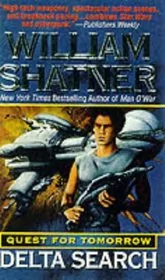
Delta Search
by William Shatner
1997
In the twenty-second century, teenager Jim Endicott discovers his DNA hides a dangerous secret: instructions for a vast organic computer. Branded a fugitive, he flees powerful agencies while trying to choose his own future.
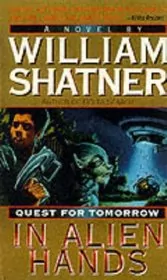
In Alien Hands
by William Shatner
1997
Jim Endicott is drawn into a war between alien fleets and human factions that covet the weapon in his genes. To survive, he must decide who can be trusted with power that could reshape civilization.
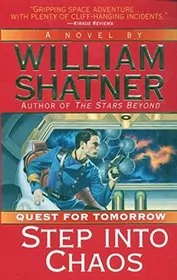
Step Into Chaos
by William Shatner
1999
The Quest for Tomorrow saga escalates as Jim Endicott confronts mass psychosis and political upheaval triggered by misused group-mind technology. Alliances with alien cultures may be the only way to stop Earth from tearing itself apart.
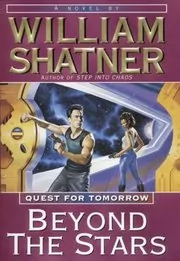
Beyond the Stars
by William Shatner
2000
Still hunted for the weapon encoded in his DNA, Jim Endicott ventures deep into alien territory. What begins as a bid to protect humanity becomes a search for the truth behind the enigmatic beings surrounding Earth.
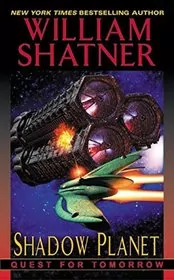
Shadow Planet
by William Shatner
2002
Teen captain Jim Endicott and his ragtag Stone Cowboy crew head to a Kolumban world where a lethal drug and cloning technology threaten their ship. The voyage forces him to confront alien conspiracies and the true cost of command.
Quest for Tomorrow books in chronological order
Series background & context
Quest for Tomorrow is William Shatner’s take on a classic form of science fiction the young person thrust into a vast, unfriendly universe who has to grow up fast. Across five novels, beginning with Delta Search and continuing through In Alien Hands, Step Into Chaos, Beyond the Stars and Shadow Planet, he follows Jim Endicott, a teenager whose very DNA makes him a target.
In the opening volume, Jim lives a relatively ordinary life until he learns that his genetic code secretly carries instructions for a powerful organic computer, the kind of group mind that could give humanity a chance to compete with more advanced alien civilizations. Government agencies and private interests immediately close in, most notably his ruthless biological father, Delta, who heads a combined intelligence apparatus and sees his son more as an asset than a person.
Forced onto the run, Jim is pushed into space long before he is ready. Along the way he gathers a found family of misfits, from street kids to alien allies, and stumbles into bigger and bigger crises. Battles with enemy fleets, encounters with species whose psychology runs very differently from humanity’s and brushes with mass psychosis on Earth all nudge him toward leadership whether he wants it or not.
The series wears its influences openly. Reviewers have compared its feel to mid century space adventure, updated with flashes of cyberpunk tech and more frank discussion of violence and politics. There are clear echoes of Heinlein juveniles in the emphasis on competence and self reliance, but the books also make room for doubts, mistakes and the messy emotional fallout of betrayal.
As the volumes progress, the villainy becomes more complex. There are obvious antagonists, such as the alien Communers who manipulate entire cultures, but there are also human institutions that claim to protect Earth while treating large parts of its population as expendable. Jim’s father embodies that tension, having designed the very techniques that are now driving people mad and still believing he knows best.
What keeps the books grounded is their focus on Jim’s perspective. He is brilliant and occasionally reckless, alternately exhilarated and terrified by the scale of what he is caught up in. His friendships, loyalties and romantic attachments evolve under pressure, reminding readers that however grand the stakes, this is still one teenager’s story about trying to decide who he is.
For readers who enjoy fast paced, slightly pulpy space opera with a young lead, Quest for Tomorrow offers a complete arc. It begins with a single boy on the run and ends with him standing at the crossroads of several civilizations, having learned that power without empathy is just another kind of disaster.




Edited by
Software engineer whose passion for tracking book recommendations from podcasts inspired the creation of MRB.
Lead investor at 3one4 Capital whose startup expertise and love for books helped shape MRB and its growth.
Comments
Did we miss something? Have feedback?
Help us improve this page by sharing your thoughts