
Pip Williams Books in Order
Explore Pip Williams books in order, with short summaries, notes on her historical fiction and memoir, and clear guidance on where to start reading.
Last updated:
As an Amazon Associate, we earn from qualifying purchases (at no extra cost to you).
Pip Williams books in publication order
4 books
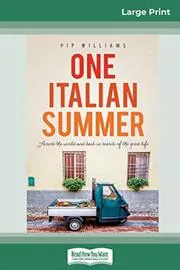
One Italian Summer
by Pip Williams
2017
Feeling stuck on their Adelaide Hills farm, Pip and Shannon pull their children out of school and head to Italy in search of a simpler life. This memoir follows their funny, messy months on organic farms, and the unexpected dream Pip finds there.
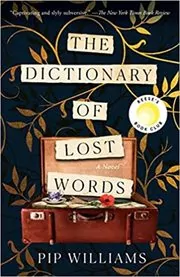
The Dictionary of Lost Words
by Pip Williams
2020
Raised in the Oxford Scriptorium where the first Oxford English Dictionary is taking shape, Esme notices that words tied to women and ordinary lives keep slipping away. She starts gathering those lost words for a dictionary of her own as suffrage and war reshape England.
Recommended by
1 person Ann Patchett recommended this book
Ann Patchett
Ann Patchett recommended this book on the Parnassus Books website.
Ann Patchett's recommendation of this book
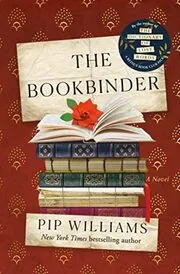
The Bookbinder of Jericho
by Pip Williams
2023
Oxford, 1914. Twin sisters Peggy and Maude work in the bindery at Oxford University Press, where Peggy longs to read and study the books she helps make. War, Belgian refugees, and family duty force her to choose between the life she has and the one she wants.

The German Ward
by Pip Williams
2026
In France in 1915, an English nurse and a German doctor who is a prisoner of war begin a forbidden love affair. More than a century later, a set of drawings pulls another woman into their lost story.
Where to start with Pip Williams
If you want her breakout historical novel: The Dictionary of Lost Words
If you want the Oxford companion novels: The Dictionary of Lost Words → The Bookbinder of Jericho
If you want memoir instead of fiction: One Italian Summer
If you want another World War I story: The Bookbinder of Jericho → The German Ward
Pip Williams collections, short stories, and related book types
Non-Fiction
Standalone Pip Williams books
Author bio
Pip Williams was born in London, grew up on Sydney's Northern Beaches, and now lives in South Australia's Adelaide Hills. Before most readers knew her as a novelist, she spent years working as a social researcher and public health academic. That habit of looking closely at ordinary lives still shapes her books.
Writing started early. She wrote poems as a child, kept diaries as a teenager, and had a poem published when she was fifteen. At seventeen she was diagnosed with dyslexia, after years of teachers noticing that her lively ideas did not always show up neatly on the page. She has spoken about how that experience changed the way she thinks about words, power, and who gets judged by language.
Books mattered at home, too. Her father wrote children's stories and joke books, and encouraged both reading and independence. Williams studied science, psychology, and sociology, later completed a PhD in public health, and built a career in research focused on people's working lives and wellbeing. She also co-authored Time Bomb: Work, Rest and Play in Australia Today, long before fiction became her main focus.
Then Italy changed the plan.
In 2003, Williams moved with her partner, Shannon, and their two sons to the Adelaide Hills, hoping for a slower life on a hobby farm. A few years later the family stepped away from work and school and spent six months on organic farms in Italy, learning by trial and error how to live differently. That trip became One Italian Summer, a funny, candid memoir about family, work, the dream of the good life, and the gap between fantasy and real life.
The trip also pushed her toward the writing life she had been putting off. Back home, she kept writing and found that cafes and libraries worked better for her than any perfect, silent writing room. That suits the kind of books she writes, because they often begin with a practical question and grow into something bigger.
Her breakthrough novel, The Dictionary of Lost Words, came out of research into the making of the Oxford English Dictionary. Williams wrote much of it in the State Library of South Australia, near a full first edition of the OED, and imagined the story from the edges rather than the center. Through Esme, a girl who notices that words linked to women and working lives can be dropped or ignored, the novel asks who gets recorded in history and who slips away. It became a New York Times bestseller and a Reese's Book Club pick.
She returned to Oxford in The Bookbinder of Jericho, following twin sisters Peggy and Maude, who work in the bindery at Oxford University Press during the First World War. Readers who liked The Dictionary of Lost Words often find the same mix here, careful research, strong feeling, and a deep interest in the women whose labor sits just outside the official record. In The German Ward, she moves to France in 1915 and follows a forbidden love story that survives in art long after the war itself.
She likes the stories tucked into the margins.
Across fiction and memoir, Williams keeps returning to similar things: women whose work is overlooked, class and access to knowledge, the physical life of books, and the lives hidden inside archives. She still lives in the Adelaide Hills with her family, and she has said that public libraries remain central to how she reads, researches, and writes. That may be why her books feel both carefully built and warmly human, even when they take on big questions about history, language, and power.
Edited by
Software engineer whose passion for tracking book recommendations from podcasts inspired the creation of MRB.
Lead investor at 3one4 Capital whose startup expertise and love for books helped shape MRB and its growth.
Comments
Did we miss something? Have feedback?
Help us improve this page by sharing your thoughts