
Pages from History Books in Order
Part ofJill Lepore Books in OrderSee the Pages from History entry by Jill Lepore in order, with a summary of Encounters in the New World, series background, and where to start.
Last updated:
As an Amazon Associate, we earn from qualifying purchases (at no extra cost to you).
Pages from History books in publication order
1 book
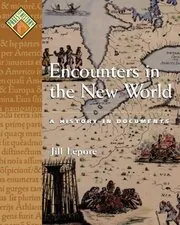
Encounters in the New World: A History in Documents
by Jill Lepore
1999
This sourcebook collects letters, diaries, petitions, maps, and eyewitness accounts from 1492 to 1789. Lepore's commentary helps readers follow the clash of cultures, empires, and lives across the early Americas.
Pages from History books in chronological order
Series background & context
Pages from History is not a conventional narrative series. It is a documentary history line built around primary sources, and Jill Lepore's Encounters in the New World fits that mission exactly. Instead of retelling the past in one continuous voice, it lets readers work through the raw material of the early Americas.
The documents do a lot of the talking.
In Lepore's volume, the setting stretches across the Atlantic world from Columbus's 1492 voyage to the late eighteenth century. The cast is wide: explorers, missionaries, colonists, Indigenous witnesses, captives, enslaved people, officials, and travelers. That mix matters because the book is about encounter in the fullest sense, people meeting across lines of empire, religion, language, and power.
What carries the book forward is not one hero but a set of ongoing pressures. European expansion brings trade, conquest, evangelism, forced labor, and war. Native peoples are not side characters in that story, and neither are Africans swept into the Atlantic slave trade. The tension comes from watching different people describe the same world in sharply different terms, and from seeing how much of early American history was shaped by misunderstanding, coercion, and survival.
You get the clash of cultures, but you also get the paperwork of it, letters, logs, petitions, memoirs, and maps.
That makes the series useful in a way standard survey histories sometimes are not. Lepore provides context, headnotes, and explanations, but she does not crowd out the evidence. Readers can see how historians build arguments from partial, biased, and often painful records. That concern with evidence and omission later becomes central to Lepore's larger books, too.
If you know her from These Truths, New York Burning, or The Name of War, this shorter book feels like an early map of her interests. She is drawn to moments when archives are messy, when language itself becomes part of the struggle, and when official records leave ordinary people only half visible. Even in a classroom-friendly format, you can already see her habit of asking who gets remembered and who disappears.
So what should you expect from Pages from History? Not a dry textbook, and not a grand single-author argument. Expect a guided walk through firsthand sources, with enough framing to keep you oriented and enough space for the past to sound strange, vivid, and unsettled. For readers curious about early American history, it is a solid place to start.







Edited by
Software engineer whose passion for tracking book recommendations from podcasts inspired the creation of MRB.
Lead investor at 3one4 Capital whose startup expertise and love for books helped shape MRB and its growth.
Comments
Did we miss something? Have feedback?
Help us improve this page by sharing your thoughts