
Nadia Owusu Books in Order
See Nadia Owusu's books in order, with a quick guide to Aftershocks, a short summary, author background, and helpful advice on where to start.
Last updated: July 8, 2026
As an Amazon Associate, we earn from qualifying purchases (at no extra cost to you).
Publication Order
1 book
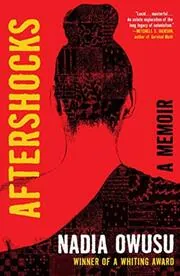
Aftershocks
by Nadia Owusu
2020
Owusu's memoir traces a childhood shaped by constant moves, her mother's abandonment, and her father's death, then follows her into early adulthood as she tries to piece together identity, grief, and a workable sense of home.
Where should I start?
If you're new to her work: Aftershocks
If you want the fullest version of her story: Aftershocks
If you'd like a shorter early piece first: So Devilish a Fire → Aftershocks
Author bio
Nadia Owusu was born in Dar es Salaam, Tanzania, to a Ghanaian father and an Armenian American mother. Her childhood did not unfold in one steady hometown. Because her father worked for the United Nations, she spent parts of her early life in Tanzania, Uganda, Ethiopia, Italy, and England, while also keeping close ties to Ghana and to the wider histories carried by both sides of her family.
Home kept moving.
Owusu has said she started writing when she was very young. She would sit on the floor of her father's home office, make little handmade stories, and bring them to him for comments. That early routine mattered. Writing became more than a school exercise or a private habit. It became a way to ask hard questions about family, race, grief, place, and what it means to belong.
Her best-known book is Aftershocks, a memoir that grew out of private writing she began while coming out of a period of deep depression. At first, she thought she was writing a novel. In graduate school, though, a teacher responded to the material that was closest to her own life and pushed her toward memoir instead. The project eventually became her MFA thesis and then her debut book.
It changed the course of her writing life.
In Aftershocks, Owusu writes about being left by her mother when she was very young, losing her father as a teenager, and entering adulthood with a fractured sense of self. The book moves across cities and continents, then follows her into the United States as she tries to understand identity, Blackness, family history, and the damage that old losses can keep doing years later. Readers who connect with her work often like that mix of close personal detail and wider context. She is interested not just in what happened to her, but in how private pain sits inside larger histories of migration, colonialism, class, and race.
Before Aftershocks, Owusu published the lyric essay chapbook So Devilish a Fire. Even in that shorter work, you can see the subjects that keep returning in her writing: memory, inheritance, girlhood, mixed identity, abandonment, and the effort to build a self out of scattered pieces. Her essays and criticism range widely, but they often circle the same questions. Who belongs. Who gets protected. What does it take to make a life feel honest.
She has never really split writing from the rest of her work.
Alongside her literary career, Owusu has worked in urban policy, racial justice, and social change organizations. That background helps explain why place matters so much in her nonfiction. Cities, borders, public life, and power are not just scenery in her work. They shape how people live, what they fear, and where they are allowed to feel safe. She has described both policy work and writing as ways of asking who a place serves and why.
In 2019, she received a Whiting Award. Aftershocks later appeared on many 2021 best-of-the-year lists and was translated into several languages. Now based in Brooklyn, Owusu teaches creative writing at Columbia University and in the Mountainview MFA program. She also works in strategic communications and engagement for a consulting firm that supports social change organizations. That mix feels right for her work. Nadia Owusu writes about fracture and repair, and her life still seems organized around those same concerns, how people make meaning, how they make community, and how they learn to stand on ground that finally feels like their own.



Edited by
Software engineer whose passion for tracking book recommendations from podcasts inspired the creation of MRB.
Lead investor at 3one4 Capital whose startup expertise and love for books helped shaped MRB and its growth.
Comments
Did we miss something? Have feedback?
Help us improve this page by sharing your thoughts