
Frederik Pohl (Arthur C Clarke) Books in Order
Part ofArthur C Clarke Books in OrderExplore Frederik Pohl’s collaborations and connections with Arthur C Clarke, especially their joint novel The Last Theorem, with summaries, background, and suggested reading order.
Last updated:
As an Amazon Associate, we earn from qualifying purchases (at no extra cost to you).
Frederik Pohl (Arthur C Clarke) books in publication order
1 book
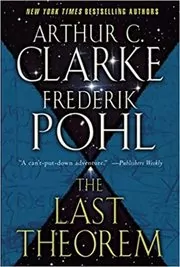
The Last Theorem
by Arthur C. Clarke
2008
Sri Lankan prodigy Ranjit Subramanian discovers a short proof of Fermat’s Last Theorem, gaining sudden fame just as distant aliens begin to worry about humanity’s nuclear testing. His mathematical breakthrough entangles him in global politics, secret agencies, and a looming decision about Earth’s fate.
Series background & context
The most direct bridge between Frederik Pohl and Arthur C Clarke is The Last Theorem, a late‑career collaboration that blends Clarke’s interest in space, communications, and future societies with Pohl’s feel for politics and character. The book grew out of a stalled Clarke project about Fermat’s Last Theorem and eventually became a full novel once Pohl came on board to help finish it.
At its centre is Ranjit Subramanian, a Sri Lankan mathematics prodigy who finds a surprisingly short proof of Fermat’s famous conjecture. That intellectual triumph catapults him into global fame and draws the attention of governments and secretive international agencies. In the background, an ancient alien civilisation—the Grand Galactics and their client races—has taken a dim view of humanity’s noisy nuclear age and is debating what to do about us.
The novel moves between Ranjit’s personal life, the shifting politics of Earth in the twenty‑first century, and the distant perspectives of the aliens. Along the way it revisits subjects familiar from Clarke’s earlier work: space elevators rooted in Sri Lanka, solar‑sail races, and the idea that advanced beings might judge species partly by how they handle technology and war. It also carries Pohl’s fingerprints in its attention to institutions, media, and the ways big decisions ripple through ordinary lives.
A page devoted to the Clarke/Pohl connection will usually outline how The Last Theorem came together, place it in the context of each author’s late work, and suggest where to slot it into a broader Clarke reading order. It’s a natural follow‑up if you’ve read The Fountains of Paradise and the Space Odyssey novels and are curious to see how Clarke’s ideas about space elevators, first contact, and Sri Lanka itself reappear when filtered through another Grand Master’s sensibility.









Edited by
Software engineer whose passion for tracking book recommendations from podcasts inspired the creation of MRB.
Lead investor at 3one4 Capital whose startup expertise and love for books helped shape MRB and its growth.
Comments
Did we miss something? Have feedback?
Help us improve this page by sharing your thoughts